








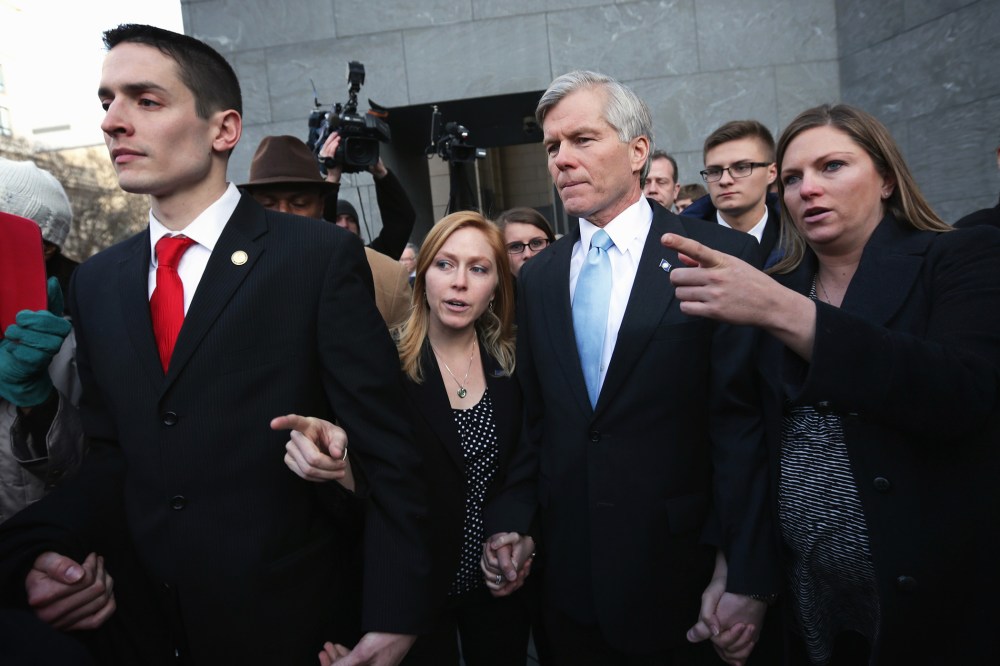
Robert McDonnell, the disgraced former Virginia governor sentenced to prison for bribery, hopes to persuade the U.S. Supreme Court Wednesday that his conviction should be overturned.
His case presents two starkly different views of how the outcome could affect the government’s approach to political corruption.
McDonnell, backed by a bi-partisan group of former prosecutors and government lawyers, says a defeat for him would mean that public officials could be imprisoned for doing even the most mundane political favors for supporters and contributors.
But the Justice Department says a win for McDonnell would allow public employees to put virtually every aspect of their official duties up for sale.
RELATED: Supreme Court to Hear Corruption Appeal From Former Virginia Governor
A jury convicted McDonnell in 2014 on a host of federal bribery charges for accepting $175,000 in money and luxury goods from a Virginia businessman who wanted help getting two state universities to conduct research on a diet supplement, so it could be submitted for approval to the Food and Drug Administration.
The businessman, Jonnie Williams, wrote checks to help McDonnell pay credit card and real estate debts and cover the cost of catering his daughter’s wedding. Among the gifts were a Rolex watch, $20,000 worth of designer clothes for McDonnell’s wife, Maureen, and the use of a country club, a vacation home, and a Ferrari sports car.
RELATED: Former First Couple of Virginia Puts Hopes in U.S. Supreme Court
None of those favors were illegal under Virginia law, which had no limit on gifts or loans given to public officials. But McDonnell was charged with violating federal anti-corruption laws.
McDonnell’s lawyers insist he never actually used the power of the governor’s office to help Williams, who never got anything in return. The universities did not agree to research the diet supplement.
“This case marks the first time in our history that a public official has been convicted despite never agreeing to put a thumb on the scales of any government decision,” says McDonnell’s lawyer, Noel Francisco.
While the governor talked to some state employees about the diet supplement, he never pressured them to make any decisions in the businessman’s favor, Francisco says. “At most, Governor McDonnell provided Williams with access to other officials so Williams could plead his case.”
If the court rules that what McDonnell did can be considered “official acts” exposing him to prosecution for bribery, that will have far-reaching effects on how the government works, according to a brief supporting McDonnell signed by two former US attorneys general, Michael Mukasey and John Ashcroft, and former White House lawyers from both parties.
In upholding McDonnell’s conviction, the appeals court “took a core feature of representative democracy — access to public officials — and turned it into a federal felony if a jury can infer a link between that access and a thing of value.” But in its Supreme Court filings the Justice Department says a ruling for McDonnell would scale back the reach of federal bribery laws “and allow the purchase and sale of much of what government employees do.” The government says it doesn’t seek to criminalize the courtesies that public officials extend to donors who give legal campaign contributions. In McDonnell’s case, “the bribes were personal loans and luxury goods.” Prosecutors reject McDonnell’s notion that a public official can be prosecuted for accepting money only in return for some formal action or direct pressure exerted on others. The range of official duty includes an office holder’s exercise of influence over decisions made by others, they say. McDonnell lost a potential ally with the death of Justice Antonin Scalia, who expressed the view that some anti-corruption laws were vague, including one that makes it a crime for public employees to deprive the government of their “honest services.” A decision is expected by June. If McDonnell loses, he will report to federal prison to begin serving a two-year sentence. If he wins, the court could simply reverse his conviction or order a new trial, requiring narrower instructions for jurors on what constitutes an official act. McDonnell’s wife, Maureen, who was also convicted, has also filed an appeal. It is on hold pending the Supreme Court’s decision in his case. This story first appeared on NBCNews.com.
Pete Williams Recommended


