








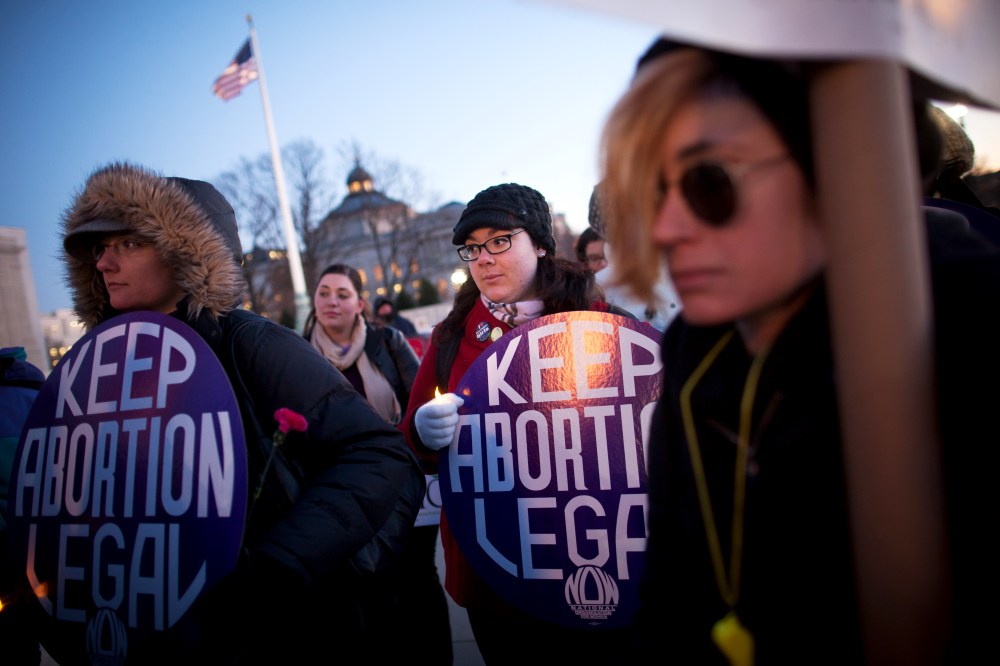
The Supreme Court has declined to take up the state of Arizona’s ban on abortion at 20 weeks, continuing a recent streak of reluctance to revisit the core of the abortion issue.
That’s good news for pro-choice advocates, who had successfully argued at the Ninth Circuit Court of Appeals that the law violated the standard set by Roe v. Wade by banning abortion well before viability. Attorneys for abortion providers had told the court the appeals court decision “faithfully follows this Court’s precedents, is in conflict with the decision of no other court, and thus merits no further review.” They added, “Two generations of American women and families have come of age, depending on constitutional protection for their reproductive decisions.”
The Court’s choice to let that decision stand means that Arizona’s ban, which drew the line two weeks earlier than other states with such bans did, won’t be enforced, nor will a similar one in Idaho, which also falls in the Ninth Circuit.
The 20-week bans, many of which are based on a scientifically-suspect notion of fetal pain, are a key part of the right’s strategy to overturn, or at least significantly undermine, Roe v. Wade. Americans United for Life president Charmaine Yoest had said that the Arizona challenge “may well be the case that leads the Supreme Court to examine and acknowledge the risks of abortion to women.” That is now highly unlikely to be the case.
The Supreme Court has repeatedly held that women have a constitutional right to end a pregnancy before a fetus can survive on its own, which even with scientific advances is no earlier than 24 weeks. But anti-abortion advocates saw an opening after the last major abortion decision by the court in 2007, Gonzales v. Carhart, in which Justice Anthony Kennedy seemed to waver before the messy specter of later abortions.
Starting in 2010, such bans swept through the states, eventually passing in a dozen of them, as well as in 2012 in the House of Representatives. But the strategy has stumbled somewhat in recent months: The first popular vote on later abortion, in Albuquerque, New Mexico in November, failed by a ten-point margin. And pro-choice litigators, no longer confident that the Supreme Court would be on their side, were careful not to fall into the trap by challenging the laws in states with a conservative judiciary. (A split in the circuit courts of appeals is often a motivating factor for the Supreme Court to take a case.) That strategy, though, has its costs for women living in those states. Last June, Texas became the most populous state to ban abortion after 20 weeks in an omnibus abortion bill that survived Wendy Davis’s filibuster. Though two other provisions of that law have been challenged and will likely end up before the nation’s highest court, the 20-week ban has been left alone, out of a concern that the Fifth Circuit Court of Appeals would find a way to uphold it. “Today the Court did the right thing, but women’s health is still on the docket — not only at the Supreme Court, but in active cases all across the country,” said Planned Parenthood president Cecile Richards in a statement. “This unprecedented assault against women’s constitutional rights shows it’s time for new leaders who value women’s health. A dangerous and blatantly unconstitutional law like Arizona’s abortion ban should have never passed in the first place.” The Center for Reproductive Rights’ Nancy Northup struck a similar note: “This ensures that no Arizona women’s lives or health are harmed by this callous and unconstitutional law. But women should not be forced to run to court, year after year, in state after state, to protect their constitutional rights and access to critical health care.”
Irin Carmon Recommended


