








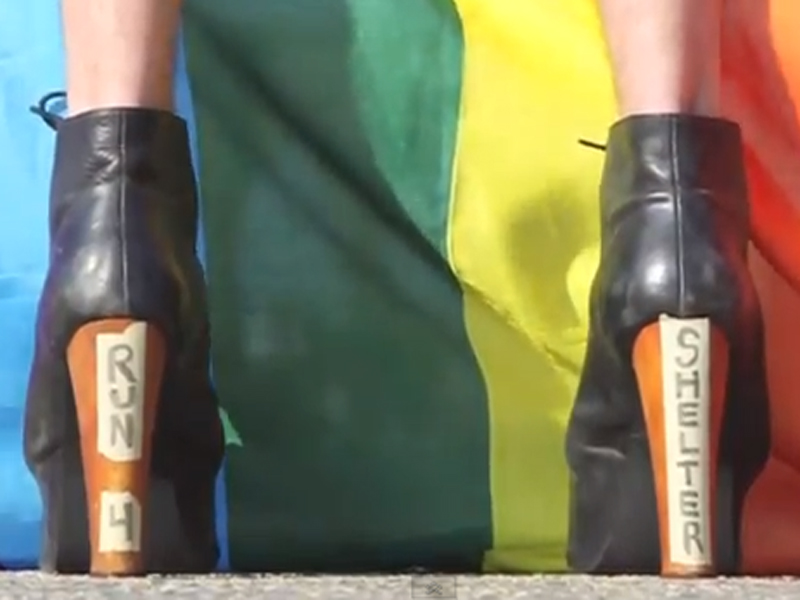
Jacob Tobia ran across the Brooklyn Bridge on Saturday. He dodged tourists and bicyclists as they took photos and enjoyed the beautiful, sunny day. He ran past people of all ages and nationalities and didn’t stop once. When he made it across the 1.1 mile-long bridge, a small crowd of cheering friends and coworkers were eager to greet him and celebrate his run.
The run took him eight minutes. He did it in five-inch heels.
“My feet didn’t hurt as much as I thought they would,” said Tobia, a 21-year-old college student from Duke University. His run was a stunt to help New York City’s Ali Forney Center, a service provider and shelter for LGBT youth,which had suffered severe damage after Hurricane Sandy hit the Northeast in October.
Tobia hoped his campaign, Run for Shelter 2012, would be “ridiculous enough to work,” and he was right: he was able to raise over $10,000 for the AFC leading up to Saturday.
But the run was more than a lark: it was a way for Tobia to use his personal history to try to change the national conversation about LGBT youth.
Rebuilding the Ali Forney Center
When the Ali Forney Center opened in 2002 in New York City, it was a unique program that gave displaced LGBT youth a place to go. AFC founder and executive director Carl Siciliano described the need for a safe haven after seeing so many LGBT youth separated from their families.
“It was unbelievable to see kids on the street, to see violence, to see kids beaten up with black eyes, to see kids starving, to see the kids getting killed in the streets,” Siciliano said. “There was a real problem—here we are in New York City, the birth place of the gay rights movement, and there are all these gay kids just stranded out there with no where to go. It seemed like such a profound disconnect.”
The center is named in honor of Ali Forney, a gay and transgender youth who Siciliano met in 1994 when he began working with youth. Forney was killed in Harlem in 1997 at the age of 22.
The center’s various residential units around the city were unharmed following Hurricane Sandy, but without the drop-in center, which was destroyed, there was no place for youth to go for many of the services the AFC provided, from counseling to medical care.
With a plan already in place to open a new drop-in center in Harlem in 2013, the urgency to open its doors increased. When Tobia heard about the AFC’s needs, he wanted to find a way to help.
“It’s usually seen as a joke: ‘Haha, men running in heels’…But for me, this wasn’t really a joke,” Tobia said. “How can I take who I already am and how can I take something I already do…and use that in a way that both helps LGBT youth and helps change the conversation about gender non-conformity a little?”
In addition to the $10,000 from Run for Shelter 2012, the center, along with other groups around the country, threw fundraisers and accepted donations online with the help of a viral campaign that reached many Hollywood celebrities. The Ali Forney Center reached its goal of $400,000 for the renovations in their new Harlem space this month and will host an opening reception Wednesday night. The center hopes to be fully operational by March.
Homeless LGBT youth: a rising population
According to the National Coalition for the Homeless, several studies in the U.S. have determined that 20% of homeless youth are LGBT. Homeless LGBT youth are at high risk for victimization, mental health problems, and disease. The National Coalition for the Homeless also notes that LGBT youth are more likely to experience acts of sexual violence than heterosexual homeless youth, and are also more likely to commit suicide.
Siciliano says there’s been a noticeable increase of LGBT youth in the last decade seeking help. “I think more and more kids are coming out at younger ages, and in parts of the country that are very hostile to gay people,” he explained.
When the AFC first opened its shelters in 2002, the wait list contained about 100 names a night, and most all of the kids were from New York City. By 2011, that number doubled and nearly half of the kids waiting for beds are from the South.
Tobia’s own coming out story led him to connect with the mission at the Ali Forney Center. He said he’d known since the fifth grade that he had feelings for boys, but wasn’t ready to tell his parents then in fear they wouldn’t take it seriously. “I knew if I came out too young, my parents would say, ‘It’s just a phase. He’s just confused,’ and I didn’t want them to say that.”
But then five years ago, at the age of 16, he decided it was time. He sat his parents down and told them he was gay.
After his mother ran through a series of questions, the spotlight turned to his father. “It’s like he had some script from a movie where the parent rejects the kid and says all the mean things,” Tobia recalled. “He did the whole ‘Ignorant Parent Things To Say’ checklist, and he checked all of the boxes. He said, ‘If you make this choice, I won’t have any part of this lifestyle…’ and ‘If you have a partner, he will not be my son-in-law…’ and he just went on and none of that really bugged me because I know parents go into shock and people say things that are hurtful because they don’t know what else to say.”
Before the conversation ended, Tobia asked his father for a hug. “He said, ‘I’m not sure if I can do that right now, son,’ and that’s when I knew not only was he angry about it, but he was having trouble loving me.” Tobia needed to get away, so he spent the rest of the night at his best friend’s house. But he knew he could still go home, despite his father’s cold response. “I knew I had a place to go back to, but the sense of being fundamentally alienated from your family and from your home is something that resonates with me,” he said. Though his father apologized and fully embraced his son two years later, Tobia carries that feeling of alienation with him as a reminder of the profound loss that homelessness brings, especially to the young. He considers himself lucky: so many like him no longer had homes after coming out, which is why he focused his fundraising efforts on helping the AFC. “The kids who end up homeless—it’s not just that their families kick them out, it’s that their families kick them out and they couldn’t even get any friends to take them. That’s the level of abandonment that a lot of these people are facing and the level of desperation that a lot of these folks are facing,” he said. Running toward the future After coming out, Tobia began advocating for equality throughout his community. He was active in student government at Raleigh Charter High School and served as president of the school’s Gay Straight Alliance. As a student at Duke University, Tobia continued his work, particularly in the fight against North Carolina’s Amendment 1, the Constitutional amendment that banned legal recognition of same-sex marriages and civil unions. But despite his efforts and Duke’s commitment to fight passage of the amendment, the bill was passed by the North Carolina General Assembly in September 2011, and voters approved it the following May. “As a North Carolinian, it felt like my state was stabbing me in the back,” Tobia said. He added that it was hard not to take the vote personally because he’d spent time working in the General Assembly and serving as a Senate page and a Governor’s page. “I’d had so many conversations with legislator after legislator after legislator, and for them to do that, the thought that kept coming across my mind was just, ‘Did you ever forget we met? Did you forget my face? Because we’ve seen each other, and you understand that I’m a human and you understand that I exist and that I love myself and that I’m proud of myself and that I deserve rights. How can you sit down with me and have a 30-minute conversation, and then vote for something like this?’” North Carolina is the 31st state to amend its constitution to prohibit same-sex couples from marrying. Six additional states have laws that ban same-sex marriage. 2013 is expected to be a big year for marriage equality advocates, who are still celebrating victories at the ballot box this past November with same-sex marriage initiatives passing in three states. The Supreme Court announced earlier this month that it will take up two same-sex marriage cases next year with a decision expected in June. But Tobia notes that LGBT rights aren’t just about legal definitions: it’s necessary to change the culture. “Even if the Supreme Court decides, ‘Gay marriage across the land!’ there will still be kids who will be kicked out of their houses because of who they are,” he said. “There will still be communities where you cannot walk around in high heels without the threat of being murdered. There will still be communities where hate crimes are regular occurrences. None of these things are going to change because of legal changes.” With plans to return to Raleigh in January, Tobia is interested in increasing awareness of LGBT history, especially in classrooms where introducing LGBT figures into the current curriculum can open students’ perspectives and worldviews and help to prevent bullying inside and outside of schools. Tobia also hopes that his run across an iconic landmark like the Brooklyn Bridge will contribute to the conversation of gender non-conformity. “I’ve claimed that space for people like me, and in a world where there aren’t a lot of spaces for people like me. That feels exciting and that feels really gratifying,” he said. And it will also be a part of his own family’s history that he hopes will one day be passed down to future generations who may be living in a more tolerant society. “This is something I’m going to tell my grandchildren about, and hopefully this is something they’ll their children about. ‘Look what your great-grandfather did. Isn’t that funny that they used to think that was a weird thing?’”
Traci Lee Recommended


