








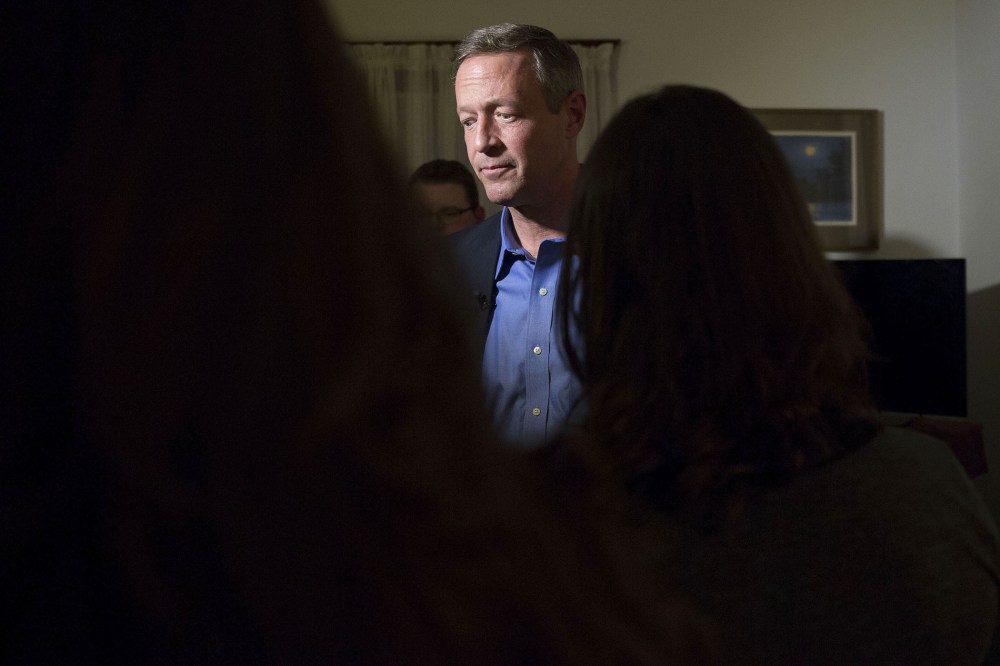
U.S. 30 BETWEEN GRINNELL AND AMES, Iowa – As Martin O’Malley, the once promising, now longshot Democratic presidential candidate, was about to give a rousing speech to staff and volunteers who had dialed into a conference call from across the state, his cell service suddenly dropped as he sped down a dark highway between events.
A “Veep”-worthy scramble ensued as the candidate’s state-based spokeswoman snatched a phone being used by a reporter in the backseat and handed it to the candidate in the front, while the driver passed back the phone he was using to navigate. As the spokeswoman used one phone to text someone about the problem and the other to dial back in, it was suddenly O’Malley’s turn to speak.
Unsure if he was actually connected, the former governor of Maryland started in with what is admittedly not the most uplifting message. Instead of asking his troops to win the Iowa caucuses, then just four days away, or even to finish in a respectable second, O’Malley was merely asking with them make him “viable” — to meet the threshold, in most places 15 percent, candidates need to hit to register support in the contest.
“If you guys can lift me above viability in your precinct, we could change the dynamic of this race,” he told his team in what built to an impassioned speech for survival. “I’m going to give this 1,000 percent. We are taking this shot as if the future of the Republic depends on it – and you know what, it just might.”
“Get me above viability,” he signed off. “I love you guys,”
After a pause, the staffer running the call confirmed that O’Malley was indeed connected. “Well, that was harrowing,” the candidate chuckled.
Running for president, even for front-runners, is often an act of humiliation. And Martin O’Malley is no front-runner. After going all in on Iowa and despite his impressive resume, the Des Moines Register’s final poll before the caucuses showed the former Baltimore mayor at just 3 percent.
RELATED: Trump regains lead over Cruz in Iowa, Clinton barely leads Sanders: Poll
He’s a favorite butt of jokes from reporters and rival campaign staffers, who poke fun at his colorful turns of phrases and poor polling.
But it’s easy to snark and harder to try. O’Malley’s underdog message of late has focused on the value of an earnest effort in a world of peanut gallery cynics, and even critics can’t help but admire his zealous tenacity.
And laugh all you want, but O’Malley and his team are having more fun than anyone else out there, and he’s got a good shot to beat your nonexistent expectations.
As Clinton’s juggernaut struggles to conjure joy and Sanders grumpily carries the weight of the middle class on his shoulders, O’Malley is a happy warrior busking from brewpub to brewpub, liberated by his low odds to win the nomination.
Holding strong, aiming for viability
O’Malley’s hero and former boss, Gary Hart, wasn’t doing much better in the polls before finishing with a respectable 16 percent in 1984. But no one seems under the apprehension that O’Malley is in anything other than a fight for basic survival. “Growing the caucus viability beard,” said O’Malley campaign manager Dave Hamrick as he stroked his new whiskers.
Getting to the viability threshold seems impossible when you’re polling at 3 percent, so the universal expectation is that O’Malley will finish with 0 percent. But that assumption is based on a too simplistic view of the caucus process.
O’Malley’s campaign has worked to build up support in concentrated precincts, including some places where turnout will be small enough that it won’t take many supporters to get him over the threshold. Meanwhile, his volunteers have had some success convincing Democrats supporting other candidates to help make O’Malley viable in precincts where their top candidate is expected to win with supporters to spare.
RELATED: All about turnout in Iowa
Meanwhile, O’Malley will likely get a boost from unlikely friends in the Clinton and Sanders campaigns. In the right circumstances, clever caucus campaigns will peel off a few of their own supporters to give to a lesser candidate if keeping them viable would rob delegates from a more threatening rival.
To do any of that, though, he needs supporters to “hold strong,” the phrase he ad-libbed a few days earlier at a nationally televised forum, which has now become his closing mantra. Holding strong means that O’Malley wants his supporters to actually gather up in the caucus room and be counted, even if they fail to achieve viability, rather just slink off to join Sanders or Clinton supporters before the first break.
If and when his supporters have to realign, the O’Malley campaign thinks they will split fairly evenly between Clinton and Sanders. Their impact as kingmakers might be overblown.
O’Malley and his campaign won’t reveal their target for Monday night, other than to say they want to surpass expectations. With expectations at zero, that seems very doable.
On Wednesday night, Drake University in Des Moines held a mock caucus. Sanders and O’Malley each got delegates, while Clinton failed to achieve viability.
That same night, 400 Grinnell College students and area residents packed into an auditorium that hosts the liberal arts college’s caucus precinct. Hillary Clinton didn’t even achieve viability here in 2008. This year, the campus, like almost every other one in the state, is dominated by Sanders fans.
But on Wednesday, they were all there to see O’Malley, and they were earnestly fired up. They think he’s the most electable Democrat, they like that he’s an underdog, they think he’s been treated unfairly by the party and the press, they like that he worked across the aisle to get things done in Maryland, they like his wonkiness, they like his record, they like that he’s not a socialist and not a Clinton. They like his vibe.
“He has a very decent chance of mainlining viability in this precinct,” said Kennen Goeason, who has been volunteering for O’Malley on campus.
RELATED: What it’s like to live in Iowa during a presidential election
Wearing jeans on this “O’Malley Unplugged” tour, the candidate took off his jacket, rolled up his sleeves and climbed onto a chair. “I always like to give speeches standing on a chair. It adds an element of entertainment: Everybody wants to see if the presidential candidate will fall on his face,” he said.
After his stump, young people circled around him like he was coolest counselor at camp. They asked him policy questions and requested selfies and handshakes. Eventually, a guitar was produced (he doesn’t need to bring them to events anymore), and everyone gathered as the former governor of Maryland led the group in “The Iowa Waltz,” a lovely folk song by Hawkeye State native Greg Brown. “What a boss! What a boss!” said Henry Bolster, a sophomore who plans to caucus for O’Malley. “I fundamentally do not understand why he is not the front-runner.” ‘I feel compelled’ O’Malley entered this race wounded, physically as well as politically. As he announced his candidacy on a sweltering late May day on a hill overlooking Baltimore, a broken elbow made his left arm a limp paperweight for his notes. He wore no sling, but the immobility was obvious if you knew to look for it. Behind him, his city was still roiling in the aftermath of the death of Freddie Gray. The incident called attention to O’Malley’s tough-on-crime policing and tarnished the value of his mayoral legacy. A few months earlier, his handpicked successor was swamped in the Republican midterm election wave, complicating the value of his gubernatorial legacy. So it seemed like an omen when the slickly produced video meant to introduce O’Malley at the kickoff rally failed to play. The political media establishment began laughing then and hasn’t really stopped, except to pretend they forgot the name of the third wheel in the Democratic Primary. O’Malley can hear you sniggering, of course, and he knows what the race looks like from the outside. And yet he keeps showing up, spending more time in Iowa and holding far more events here than any his rivals. So why does he do it? Why endure the little humiliations, like walking past 20-something reporters to squeeze himself into the rear rows of a Delta flight? And he endures the bigger ones, like the polls. Why not go home to his family and live the lucrative life a former governor, instead of dealing with this crap? It’s an objectively crazy thing to think you can and should be president, as even the pols who do it will tell you. But without the relentless optimism bordering on delusion shared by politicians and entrepreneurs, we would have no presidents or governors or iPhones. O’Malley is a true believer who carries with him a pocket-sized book of Thomas Merton, the Catholic poet and mystic, that he reads every day. “I feel compelled,” he said. And who knows — maybe, just maybe — Democrats might need a backup option. Many in the party think Sanders would be an unacceptable standard-bearer for the party, and Clinton has that FBI investigation looming over her head. With a slate of delegates to his name, it might logistically be easier for the party to back O’Malley than blow up the entire nominating process to draft someone else like Joe Biden. Mostly, O’Malley says, what keeps him going is the people. When the car pulls up to an Ames brewpub, 250 people are waiting eagerly for him. In fact, the bar is over capacity, and they’re not letting anyone else in. It’s a good problem, but a problem nonetheless. “Come on, man,” O’Malley pleads to the bouncer, without luck. After shaking some hands, it’s back on the chair, with his jacket off, sleeves rolled up, and, this time, a beer at hand. On television, his advisers know O’Malley can come across as a bit robotic. He looks too polished and too political for a moment when anti-politicians from Donald Trump to Bernie Sanders reign supreme. “I’m on a learning curve,” he’s said. But in the bar, O’Malley is charming and easygoing and inspires confidence. He urges the crowd to “hold strong,” and it seems like maybe some of them will. He sticks around to chat with anyone who wants to. There’s more singing and guitar playing. He loves this, the face-to-face, and clearly feeds off it. If only he could have a beer with every Democrat in the state, he might win this thing in a landslide. Maybe he’ll figure how to do it in another four or eight years.
Alex Seitz-Wald Recommended


