








When Kery Rodriguez was arrested earlier this year during a drug sting in Florida, law enforcement agents discovered that heroine wasn’t the only thing that Rodriguez and his crew were trafficking.
According to detectives and informants, Rodriguez also sold young women whom he referred to as “fresh meat.”
“If you want them young, normally those we have to take by force,” Rodriguez said, according to an affidavit obtained by the Orlando Sentinel. “The key is to keep them drugged, and locked up, and have [them] at gunpoint.”
Agents conducting a drug investigation in April were tipped off that Rodriguez was running a suspected human trafficking ring out of an Orlando apartment, where agents say several young women were being offered up for sale.
Earlier this week, authorities announced that 16 additional arrest warrants were issued for members of Rodriguez’s crew. And by Thursday morning most of the suspected players in the case had been arrested, according to reports.
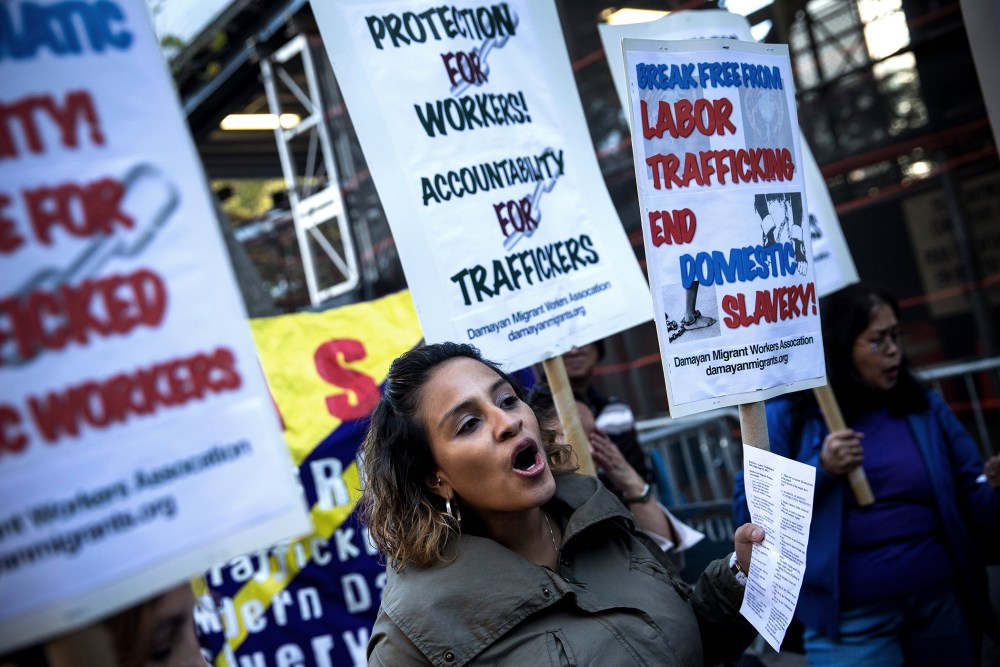
The Rodriguez case is not an isolated one, and according to organizations that fight human trafficking, Florida ranks among the states with the highest number of potential cases. Many of the victims are runaways, migrant workers and society’s most vulnerable.
“Human trafficking is a crime that reaps high profits at low risk for traffickers,” said Bradley Myles, CEO of Polaris Project, which operates The National Human Trafficking Resource Center. Myles says human trafficking is nothing more than modern-day slavery.
On Thursday, the Polaris Project released a report that highlights just how staggering a problem human trafficking remains in the United States.
According to the report, the NHTRC has recorded more than 9,000 cases of potential human trafficking between 2007 and 2012. The suspected victims include women and men alike, many of whom are domestic, farm or sex workers. The top three victim nationalities are Mexican, Chinese and Filipino.
The NHTRC hotline has experienced a 259% increase in calls reporting trafficking cases since 2008.
“With hundreds of thousands of people forced to provide labor or commercial sex right here in the U.S., we are fundamentally working to preserve and restore freedom to exploited men, women, and children,” Myles said. “The information provided to the national human trafficking hotline by community members and victims is data that can then be used to make it harder for traffickers to operate. The more people understand they can be part of the solution, the more we are able to help victims reclaim their lives.”
The NHTRC received reports of 9,298 unique cases of human trafficking. Of those cases, 64% involved sex trafficking, 22% involved labor trafficking, nearly 3% involved both sex and labor trafficking. An additional 12% were unspecified.
More than 42% of reported sex trafficking cases were pimp-controlled prostitution, the most commonly referenced form of sex trafficking, occurring mostly in places like hotels, truck stops and street corners. And while more than 85% of sex trafficking cases involved women and girls, many involve men and transgender people.
The NHTRC report comes as lawmakers across the country are making the fight against human trafficking and sexual exploitation more of a political priority.
Several members of Congress have introduced a resolution titled, “Our Daughters Are Not For Sale.”
According to the FBI, the average girl becomes involved in sexual exploitation between 12 and 14, and that some 293,000 American youths are at risk of becoming victims of sex trafficking.
“This is slavery, pure and simple. We all know slavery is abhorrent to our basic democratic ideals and to our way of life. We fought a war 150 years ago to end this scourge in America for good, and yet it persists today — in many ways, because it can,” Reps. Rosa DeLauro, a Democrat from Connecticut and Ileana Ros-Lehtinen, a Republican from Florida, wrote in a joint op-ed in The Hill.
“Those who buy children in this fashion are rarely arrested and charged with statutory rape, child endangerment or sexual assault of a minor. For all we talk of getting tough on crime and protecting our kids, it is rarely the buyer—and much more often the trafficked girl—who is punished for what is essentially child abuse and child rape.” State and local authorities in states like California, Florida and in major cities across the country are dedicating resources to protecting victims and potential victims of human trafficking. Florida Attorney General Pam Bondi has called human trafficking “an unconscionable crime” and came out in support recently of an online training course for law enforcement officers that provides information on ways to identify suspected victims and information they might need to arrest perpetrators. Earlier this year, when an undercover agent asked Rodriguez how he finds the girls he sells, Rodriguez laid it out plain: some he lures, some he takes by force. “Well, I normally get working girls on the streets. Try to get them in the car, then I’ll bring them to you, and you take them. There are some you can lure to come with you, and others you have to take by force,” Rodriguez told the detective, according to a Metropolitan Bureau of Investigation report analyzed by the Sentinel. When asked how long he normally keeps the girls, Rodriguez was equally blunt. “Well, as long as they want to stay, and as long as you keep them drugged,” he reportedly said. “The harder ones to control are the ones who are addicted to crack.” After his arrest, Rodriguez changed his tune, saying that he was in the drug business and not the business of selling women. He told investigators that he was a compulsive liar and not a kidnapper. Rodriguez is currently serving 2 ½ years in prison on drug and human trafficking charges at Florida’s Walton Correctional Institution. Myles, of the Polaris Project, said far too often human trafficking victims toil in the shadows and out of sight as many Americans assume the trade is a third-world issue. All the while, he says, a largely silent population of citizens is being exploited. “Girls are forced by pimps to sell sex at truck stops. Domestic workers are abused by their employers. Men are isolated on farms with limited access to food and water,” he said. “We have identified potential cases of human trafficking in every state in the nation, and we are finding important trends that can help us stop this violence and exploitation.”
Trymaine Lee
Trymaine Lee is an NBC News correspondent. Recommended


