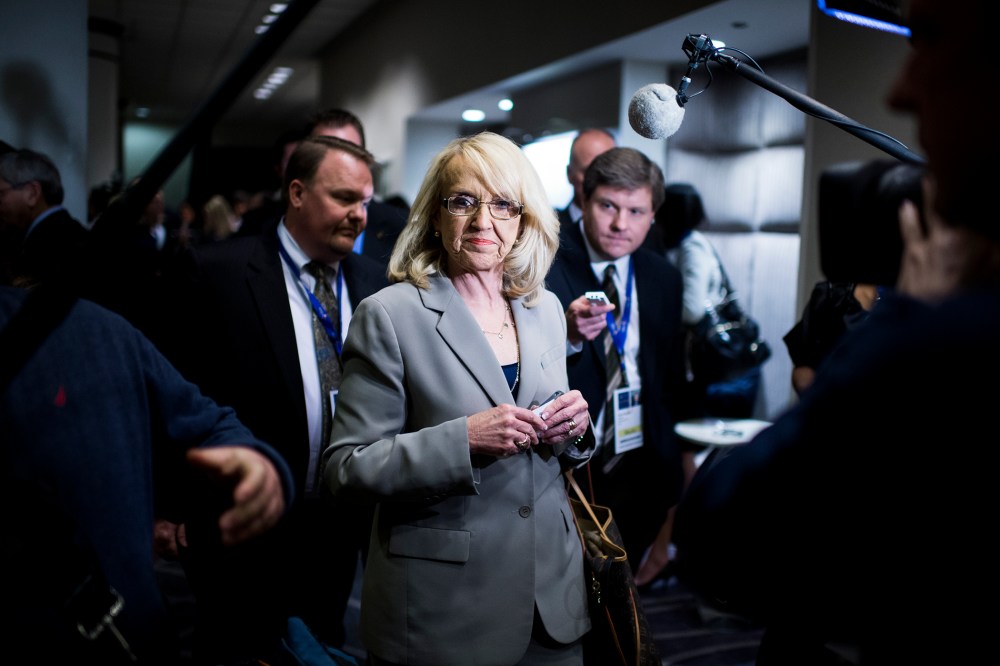
Late Wednesday, Gov. Jan Brewer vetoed Arizona’s Senate Bill 1062, a measure that would have made it easier for businesses to discriminate against gays and lesbians on the grounds of sincerely held religious beliefs. Facing backlash that, in her own words, threatened to “divide Arizona in ways we cannot even imagine,” the Republican governor squashed the bill’s chances of becoming law.
But her veto and the legislation’s swelling controversy did more than kill the bill in the Grand Canyon State; Brewer’s action effectively vetoed similar legislation for every state in the country.
At one point, legislation that moved quickly in more than a dozen states dominated headlines. Now, the issue looks to be a shooting star, one that lit up the national debate on equality before fading away–at least for the foreseeable future.
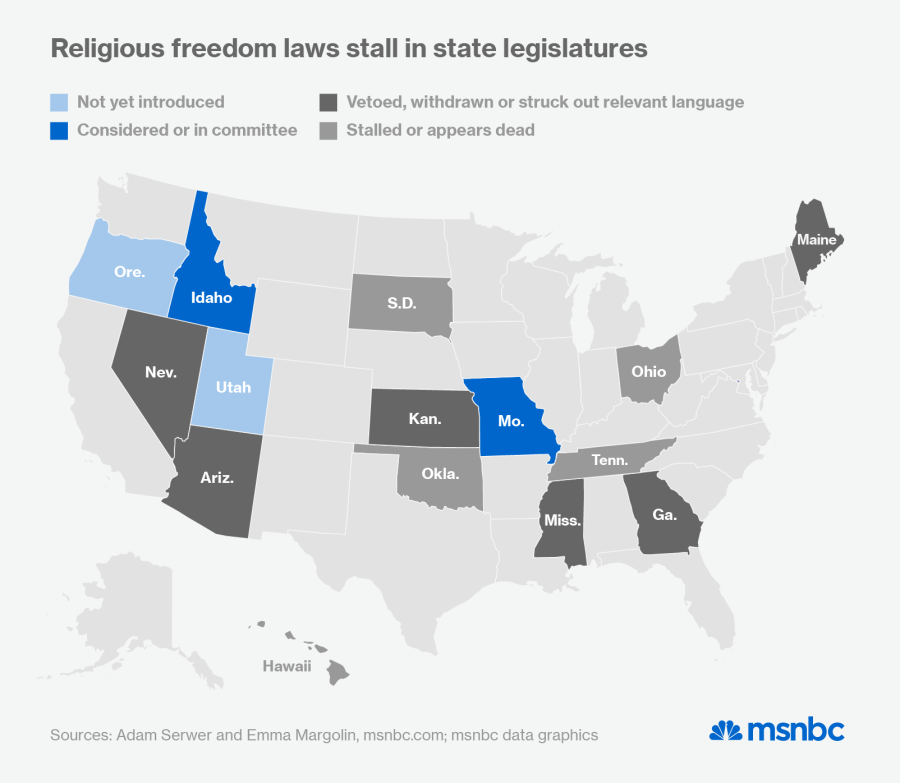
From Georgia to Hawaii, religious freedom bills have stopped dead in their tracks as supporters scramble to put distance between their measures and SB 1062. Though these bills may resurface, it likely will not be during this legislative session.
Here’s a breakdown of state measures that now look to be doomed:
Georgia: Senate Bill 377, and House Bill 1023, aka the “Preservation and Religious Freedom Act”
The goal: Both bills would affirm the “right to act or refuse to act in a manner substantially motivated by a sincerely held religious tenet or belief,” and would require the government to provide a “compelling” interest for otherwise burdening a person’s free exercise of religion, as well as proof that the government action is the “least restrictive means of furthering that compelling” interest. Critics say they could allow for private business owners to discriminate against LGBT individuals on religious grounds.
Why they went south: SB 377 passed out of the Judiciary Committee this week, and was set to be considered by the Rules Committee next Monday. But it has since been taken off the calendar, with no word as to whether it will be rescheduled before the end of the session. In the state House, the Judiciary Committee chair said Tuesday that more vetting of HB 1023 was needed, and that it likely wouldn’t make Monday’s Crossover Day deadline, at which point legislation must be approved by at least one chamber to survive.
What supporters are saying: Republican state Sen. Josh McKoon, one of the sponsors of SB 377, told the Huffington Post he believed the outcry over Arizona’s legislation hurt his bill’s chances: “I think that the sort of hysteria and misinformation about this entire issue had an awful lot to do with it being held up.” Similarly, in response to widespread concerns that his bill encouraged discrimination, Republican Rep. Sam Teasley, HB 1023’s sponsor, amended the legislation to “almost precisely word for word” mirror the language in the federal Religious Freedom Restoration Act, which he said in a statement has “a long legislative record of bipartisan support.”
Hawaii: House Bill 1624, aka the “Religious Freedom Restoration Act” (RFRA)
The goal: Modeled after a federal law that was held unconstitutional as it applied the states in a 1997 Supreme Court ruling, the RFRA would prevent new laws from burdening a person’s free exercise of religion. Twenty-nine states have since adopted their own versions through legislation or court action. Critics argue the latest wave of proposed “religious freedom” acts would allow individuals or businesses to cite religion as a defense when discriminating against LGBT Americans.
Why it went south: Though supporters garnered enough votes to pull HB 1624 to the House floor, the bill effectively died for this legislative session earlier this month when lawmakers voted to send it back to the Judiciary Committee.
What supporters are saying: “I would say that what you’re seeing across the nation is a conflict between the right of religious freedom and the newly created set of rights based on chosen behavior,” Republican Rep. Bob McDermott said in an interview with msnbc. “What happened in Arizona was the political correctness police descended on Gov. Brewer and she caved … With the political climate the way it is, there is a lot of cowardice. The last thing Democrats want to do is be on the wrong side the homosexual lobby. They cower in fear.”
Idaho: House Bill 426, and House Bill 427
The goal: HB 426 would protect professionals, like doctors or counselors, from losing their licenses based on violations committed for religious reasons; HB 427 amends the state’s Religious Freedom Restoration law so individuals can use religion as a defense in discrimination suits. Deputy Attorney General Brian Kane told House State Affairs Committee members that both bills could be vulnerable to constitutional challenges.
Why they went south: HB 426 never went anywhere after it was proposed, and HB 427 was sent back to committee after the bill’s sponsor, Republican Rep. Lynn Luker, pulled it. Republican House Speaker Scott Bedke said the bill isn’t coming back this legislative session.
What supporters are saying: “The intent of the bill was to provide a shield to protect the free exercise of religion under the First Amendment in light of the variety of increasing government mandates,” Luker said in a statement to the Idaho Statesman. “However, many misinterpreted the intent to be a sword for discrimination. I respect the concerns that I heard and therefore want to find the right language to balance those concerns.”
Kansas: House Bill 2453
Goal: Allow Kansans the right to deny same-sex couples a host of goods, services, benefits, or even employment on the grounds of “sincerely held religious beliefs.”
Why it went south: After breezing through the Republican-controlled state House of Representatives earlier this month, HB 2453 ran into trouble when the GOP state Senate leadership expressed concerns the bill could greenlight discrimination. The House speaker then said if the vote were held again in his chamber, it probably wouldn’t pass. On Tuesday, Senate Vice President Jeff King said lawmakers were not going to revise the measure, and that “House Bill 2453 [was] kaput.”
What supporters are saying: Republican Rep. Steve Brunk, chairman of the House committee that handled the bill, told the Associated Press the issue wasn’t going to go away. “As the topic progresses, we’ll refine the language,” he said. On the other side of the spectrum, Republican Rep. Scott Schwab, who also supported HB 2453, told the AP he now regrets voting for it. “It’s so tainted now,” he said, “it needs to go away.”
Mississippi: Senate Bill 2681
Goal: Enact the Mississippi “Religious Freedom Restoration Act,” and add “In God We Trust” to the state seal.
Why it went south: SB 2681 sailed through the state Senate on Jan. 31 with good prospects for passage in the House. But late Wednesday, the Mississippi House of Representatives Civil Subcommittee voted to strike the problematic language critics said would have invited LGBT discrimination. Republican House Speaker Philip Gunn told the Clarion-Ledger on Wednesday that lawmakers are just now become aware of “some other things this bill might do” and wanted to take a closer look in committee.
What supporters are saying: Republican state Sen. Joey Fillingane, one of the bill’s authors, told local ABC affiliate WDAM that he flatly rejected comparisons between Mississippi’s legislation and the one in Arizona: “I don’t agree with what Arizona has done. I don’t see the similarity at all.”
Missouri: Senate Bill 916
Goal: Expands the state definition of “free exercise of religion” to include “an act or refusal to act that is substantially motivated by sincere religious belief.” Similar to a bill nixed in Kansas, which many credit with sparking the national outcry over such legislation, SB 916 would allow businesses to cite religious beliefs as a legal defense in discrimination suits.
Why it went south: To say SB 916 “went south” is a little premature, as it has yet to be assigned to a committee. But if it were to make it through committee, the full Senate, then the full House, the bill stands next to no chance of being signed by Democratic Gov. Jay Nixon.
What supporters are saying: After facing major backlash, the bill’s sole sponsor, Sen. Wayne Wallingford, took to Facebook to defend his legislation: “This bill is meant to ensure that the government is not able to force individuals to violate their religious beliefs, and will provide protections to all. This is not a bill about discrimination. Indeed, it specifically says that the law shall not be construed to provide a defense in discrimination cases.” Wallingford also told a local newspaper that Arizona’s bill went “way, way further” than his.
Ohio: House Bill 376
Goal: Allow Ohioans to challenge state or local laws, as well as non-discrimination ordinances on the grounds that they burdened their “practice or observance of religion.” LGBT advocates have criticized HB 376 as one of the most extreme religious liberty measures to be considered in the nation.
Why it went south: The lead sponsors withdrew the legislation Wednesday in the wake of intensifying backlash surrounding Arizona’s bill.
What supporters are saying: Republican state Rep. Tim Derickson and Democratic Rep. Bill Patmon released a statement that read in part: “The intent of House Bill 376 was to ensure Ohioans’ religious freedom by protecting their ability to freely worship and preventing any laws from burdening the free exercise of religion. However, with the controversy that is occurring in Arizona, we feel that it is in the best interest of Ohioans that there be no further consideration of this legislation.” Oklahoma: House Bill 2873 Goal: The same intent as Missouri’s SB 916. Why it went south: Republican Rep. Tom Newell, the bill’s sponsor, decided to table the bill this week based on the growing outcry in Arizona. What supporters are saying: Newell told the Associated Press he’d try again to pass a religious liberty bill next session, but his legislative assistant said otherwise. “He will not be running the bill,” said Joey Magana to msnbc. Oregon: Ballot Initiative No. 52, aka the “Protect Religious Freedom Initiative” Goal: Allow private businesses to deny services related to same-sex weddings based on religious objections. Why it went south: The initiative hasn’t exactly gone south, but proponents were dealt a blow last week when the state’s attorney general drafted a ballot title that included the word “discrimination.” The group Friends of Religious Freedom, which is sponsoring the proposed initiative, criticized the title as “misleading and riddled with politically charged and emotionally laden words that create bias and partiality.” What supporters are saying: Friends of Religious Freedom released a statement stressing the differences between Oregon’s proposed ballot initiative and Arizona’s legislation: “Our initiative will protect an individual from being coerced to participate in a same-sex ceremony in violation of their conscience for fear of retribution; it does not seek an ‘exemption’ from providing service to individuals.” Shawn Lindsay, legal counsel to the organization, told msnbc he had the word “ceremony” underlined multiple times. South Dakota: Senate Bill 128 Goal: Protect individuals and businesses “regarding speech pertaining to views on sexual orientation.” Why it went south: The Senate Judiciary Committee tabled SB 128 last week, with one Republican member calling it “a mean, nasty, hateful, vindictive bill.” What supporters are saying: Mark Chase, a pastor and president of the South Dakota Family Policy Council defended the legislation, saying: “We should not have to fear that we’ll have retribution because we’ve expressed that something is wrong according to my religious faith.” Republican state Sen. Phil Jensen, who proposed the measure, expressed a similar sentiment on Facebook: “We do not agree that it is OK for anyone to withhold mercy and grace because of someone’s lifestyle choices, but the bill is about protecting the rights of people to practice their religion. The bottom line, is if a person has a private business, and they don’t want to give their business to a specific individual because it would violate their religious principles, that business owner’s free exercise of speech and religion should be protected.” Tennessee: Senate Bill 2566 Goal: Permit individuals and religious organizations to refuse services related to same-sex unions based on a “sincere religious belief.” Opponents dubbed it the “Turn away the gays” bill. Why it went south: Republican state Sen. Brian Kelsey withdrew his sponsorship earlier this month under heavy fire from civil liberties and gay rights advocates. What supporters are saying: Prior to punting the bill out of the Senate Judiciary Committee, Kelsey released a statement saying he “would never introduce legislation that attempts to limit the civil rights of any Tennessean, whether straight or gay.” His legislative aide, Kendall Marr, told msnbc Kelsey would likely wait for the courts to rule on the issue of religious liberty before trying to push similar legislation in the future. Utah: Religious Liberties Amendments Goal: Two proposed initiatives would allow businesses to deny services on religious grounds, and would protect clergy from conducting marriages that conflict with their religious beliefs. They would need two-thirds support from the House and Senate in order to get on the 2014 ballot. Why they went south: Utah lawmakers shelved the proposals and publicly excoriated their potential effects earlier this month. Democratic Sen. Jim Dabakis, the only openly gay member of the legislature, told the Salt Lake Tribune that Utah narrowly dodged the bullet that ended up wounding its neighbor state. “Arizona is going to continue to look weird and dumb and stupid, and Utah came this close to leading the way,” he said. Republican Senate President Wayne Niederhauser said the legislature could possibly return to the issue of religious liberty next year. What supporters are saying: With a federal decision striking down the state’s ban on same-sex marriage, Republican state Sen. Stuart Reid, one of the amendment’s sponsors, said lawmakers are going to have to deal with the tension between religious liberty and LGBT rights sooner or later. “They can’t coexist because for people of religious conscience, it is a fundamental issue and for the LGBT community it’s an issue of creating a protected class,” Reid told the Salt Lake Tribune.
Emma Margolin
Emma Margolin is a reporter at MSNBC.com. Recommended