








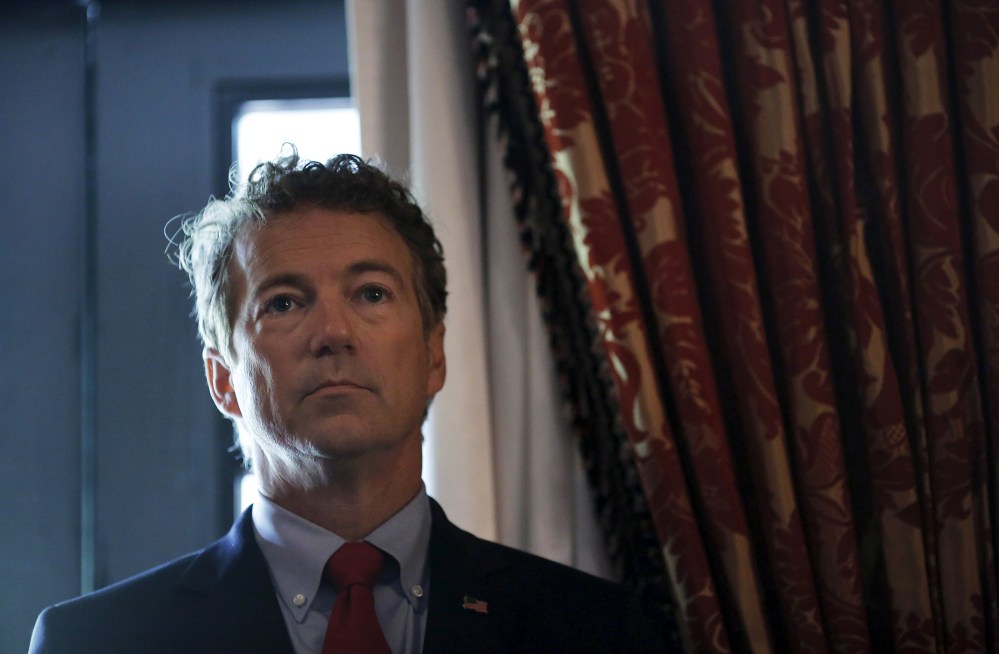
This will be a pivotal week for Rand Paul, as he shares the stage with top tier Republican rivals in the first GOP presidential debate — a group setting the Kentucky senator has largely avoided this cycle.
With all eyes on the show in Cleveland Thursday, Paul will have a chance to separate himself from the field by discussing his foreign policy approach of fewer military interventions.
“We will make a clear distinction between myself and some of the others,” Paul said in a taped television interview that aired on Sunday. “I will do whatever it takes to defend the country, but I’m not interested or a believer that every intervention has been good for us.”
Paul is currently polling at about 6% nationally.
Related: Who’s making the debate cut?
The Republican candidates who favor a more aggressive foreign policy — Chris Christie, Rick Perry and Rick Santorum — are all fighting for a spot in the primetime debate, hosted by Fox News. According to network rules, only the top 10 candidates ranked using polling averages from the last five national polls will make the cut.
But the party’s more hawkish voices may end up relegated to the Fox News candidate forum held in the afternoon, which has been derisively called the “kiddie table” debate. Fox recently lowered the threshold for the presidential hopefuls, removing the requirement for participants to garner at least 1% in polling. This allows candidates like Lindsey Graham — a frequent Paul critic who is polling at less than 1% — to participate.
“The worst possible person to send into the arena on our side would be Rand Paul,” Graham told NBC’s Kelly O’Donnell this week in response to a question about Hillary Clinton and national security.
“We’ve made the case that Rand Paul’s foreign policy views are weaker than President Obama and he’s sinking because of that,” Graham argued. The South Carolina senator later added that Clinton would be the “worst possible person to pick, other than Rand Paul.”
Paul defended his positions and sees an opening to set himself apart from Republican candidates like Graham who supported the 2011 intervention in Libya.
“Many of the Republicans who are carping at my heels, those who want to be relevant in this debate, they supported Hillary Clinton’s war in Libya,” Paul said. “We will have this debate over who supports the president’s foreign policy. And I think you’ll find that the tables may well be turned.”
Related: Rand Paul gets pulled into the Trump whirl Paul will take that national security message to the early-voting state of South Carolina a day after the debate, where 12% of the population are veterans. The Republican hopeful will hold three campaign events across the Palmetto State on Friday, ending the evening with Pints for Liberty at River Rat Brewery in Columbia. Putting an exclamation point on the visit, Paul’s last event in South Carolina on Saturday morning will be held at an American Legion Post in Goose Creek. Efforts to monopolize on any post-debate hype for Paul will be complicated by the RedState Gathering held nearby, in Atlanta — this year’s alternative to the canceled Iowa Straw poll. And it is a showcase that, as of Sunday, does not include Rand Paul on the schedule of events. At least 10 Republican presidential candidates are scheduled to speak at the conservative confab following the debate, where over 700 people are expected. Attendees on Friday will hear from Christie, Perry, Bobby Jindal, Carly Fiorina and Marco Rubio — the same day Paul is campaigning across South Carolina. On Saturday, the lineup includes Mike Huckabee, Ted Cruz, Jeb Bush, Scott Walker and Donald Trump. Paul’s last event in South Carolina on Saturday starts at 9 a.m., giving the presidential hopeful enough time to take a one hour flight to Atlanta and make an appearance at the RedState Gathering. Although the Paul campaign has not publicly made a decision to join the weekend’s festivities, Paul has previously avoided events with multiple presidential candidates. “My single biggest surprise this election season is the failure of Sen. Rand Paul to do much of anything,” the event’s host Erick Erickson wrote recently. The conservative activist added, “(Paul) is the only invited candidate not coming,” to the RedState gathering.
Anthony Terrell Recommended


