








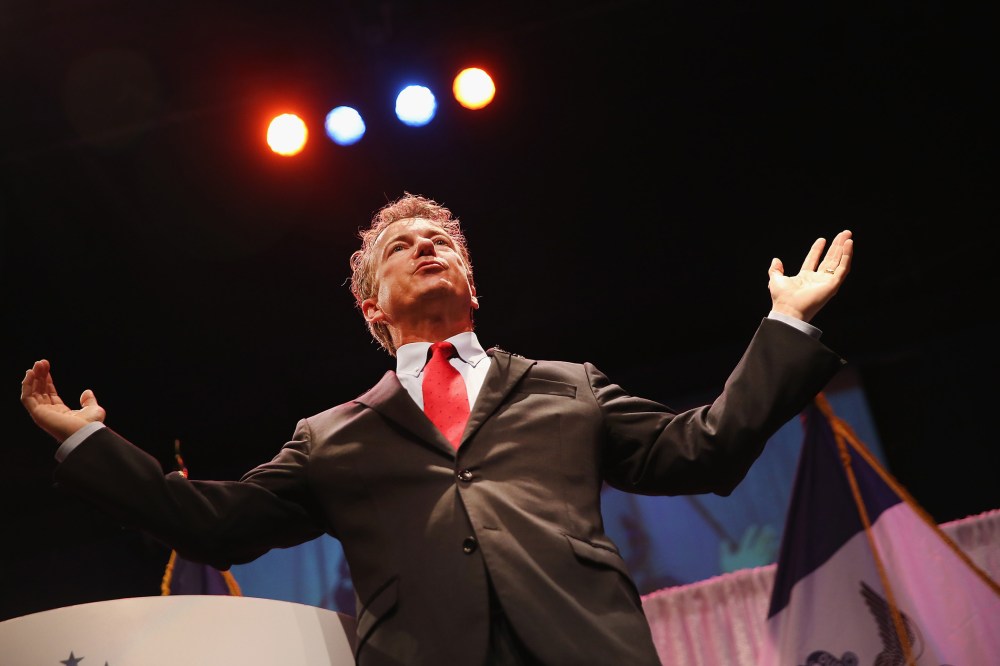
While Jeb Bush and Marco Rubio have struggled to articulate their views on Iraq, Rand Paul has offered the most direct answers of the 2016 Republican field. As he’s made clear for years and reiterated again last week, he not only believes the war was a mistake in retrospect, he was against it at the time as well.
Within that framework, though, Paul offered a surprising take on President George W. Bush’s decision to “surge” American troop levels in 2007 to help regain security in Iraq amid a brutal civil war that had riven the country along ethnic lines.
Asked by Bloomberg’s Dave Weigel whether he credited the surge with stabilizing Iraq at the end of Bush’s second term, Paul indicated he viewed it as a success even as he quickly added that removing Saddam Hussein from power at all was a mistake either way.
Related: Rand Paul highlights GOP gulf on civil liberties in Philadelphia
“Whether or not the surge worked — obviously, it worked,” Paul said. “It was a military tactic and it worked. In fact, some of the ideas from the surge could be used again.”
Based on his answer, Paul seemed to be less focused on the surge’s increase in troops than with a related effort, known as the Anbar Awakening, to make alliances with Sunni militias opposed to the occupation in order to team up against a shared enemy in al Qaeda in Iraq.
“The main problem we have with ISIS is that the Sunni population is either indifferent, supportive, or hates the Shiite government more than it hates ISIS,” he continued on Monday. “Now, over time I think that will turn, but I think there are ways that Americans and our interactions can influence the support of the Sunni chieftains. Many will say that the surge’s success was in encouraging the Sunni chieftains to be on our side, and I still do favor that.”
As Paul alluded to in his comments, there’s a long running political debate over how connected the two parts were — supporters of the surge argue that although the Anbar Awakening began first, the more hands-on approach by American troops in managing security was necessary to gain the trust of the Sunni leaders in question as well. The ambiguity and Paul’s lack of comment on the U.S. half of the equation make it tough to tell whether, as the Washington Post interpreted Paul’s comments, he was “shifting to the right” towards Jeb Bush’s position.
For what it’s worth, Paul sounded a lot less enamored with the idea of adding or even maintaining American troop levels in Iraq during the surge back when he was a fledgling senate candidate in May 2009. In an interview with Antiwar.com’s Scott Horton that month, he indicated repeatedly that the U.S. had not withdrawn fast enough from Iraq and that he would have preferred a rapid transfer of responsibility for security to Iraqi forces during the period in question. From that interview, the relevant part starts around 24:30: PAUL: Yeah, I say not out of Iraq now, I say out of Iraq two or three years ago and — or never go in, even better. But I think that when you get out, the only thing that you need to propose and that people will accept, is that you do it in an orderly fashion. The main thing that, for example, Republicans fear and didn’t like about out of Iraq, is that they fear the helicopters taking off the embassy and people hanging on to the helicopters like they saw in Saigon and nobody wants to see that happen. But, to tell you the truth, through an orderly process and working with the generals in the military, you probably could orderly be gone from Iraq in a six-month period from whenever you started and that time period could have started years ago. You had to turn over more quickly, even if you disagree with the war … we should have been forcing them to turn over more quickly back to the Iraq army and Iraq people. So, yes, I say out of Iraq as soon as you can get out of there. The only thing I would say is to make it acceptable to everyone we … my fear in 2012 is actually that they’ll just be out of the cities maybe and still in bases and that we’ll be there permanently in the bases. I’ll kind of believe it when I see it if we’re actually gone in 2012, I doubt that we will be. A spokesman for Paul’s campaign declined to comment on the record on whether Paul had changed his views since then or believed the increase in American troops had contributed to the surge’s short-lived success.
Benjy Sarlin Recommended


