








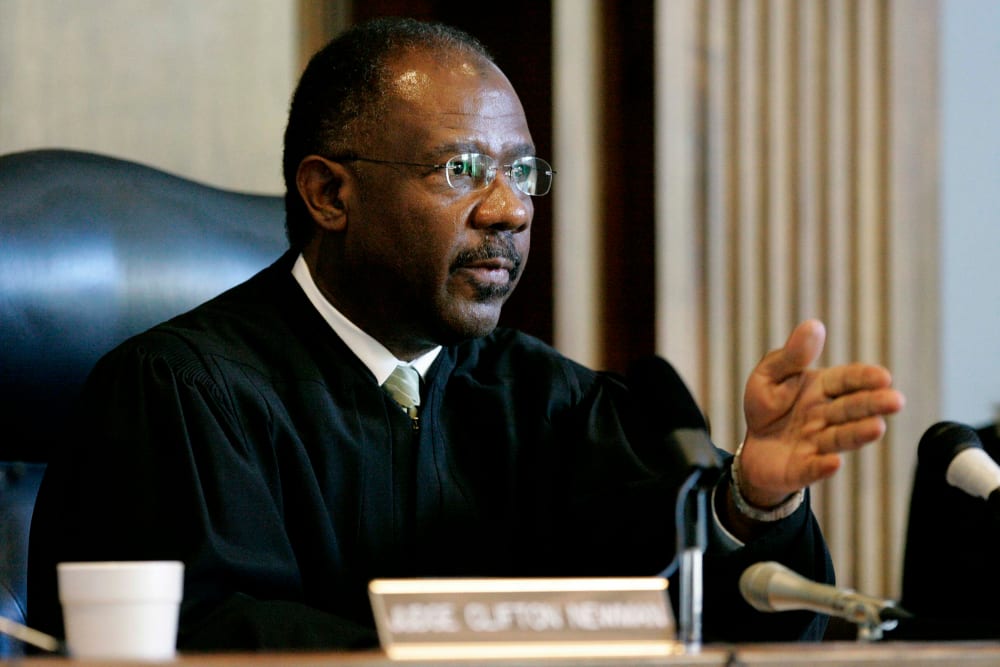
The South Carolina Supreme Court has appointed a prominent African-American judge to preside over the case of former North Charleston Police Officer Michael Slager, who is charged with murder in the April 4 shooting death of Walter Scott, an unarmed black man.
The court assigned Third Circuit Judge Clifton Newman to “decide all matters pertaining to this case,” Chief Justice Jean Toal wrote in the order.
RELATED: The killing of Walter Scott
“I think the African-American community will have some comfort that one of only five African-American judges in South Carolina will be presiding over this case,” said Pete Strom, a former U.S. Attorney in South Carolina. “Also I think the law enforcement community, to the extent that there is some concern form that constituency, they know Judge Newman’s reputation as a prosecutor as being honest and straight up.”
Newman’s appointment comes amid a surge of national interest in Slager’s case, which has ushered a fresh wave of protests across the country calling for police accountability and an end to police brutality.
%22I%20think%20the%20African-American%20community%20will%20have%20some%20comfort%20that%20one%20of%20only%20five%20African-American%20judges%20in%20South%20Carolina%20will%20be%20presiding%20over%20this%20case.%22′
On Tuesday, thousands of protesters took to the streets in dozens of cities including New York, Los Angeles and Gainesville, Florida. According to organizers of yesterday’s national day of action, about 30 protesters were arrested in New York City and 20 more in Los Angeles.
“This is unacceptable! The police brutalize and murder people every day, every day with impunity,” veteran activist and organizer Carl Dix said. “Then, when people take to the streets to declare to the world this must stop, they lash out to brutalize and arrest people who protest these horrors.”
In North Charleston, a racially and economically divided sister city to nearby Charleston, activists and residents have gathered for protests since Scott’s killing, chanting through megaphones and wearing t-shirts and carrying signs emblazoned with “Black Lives Matter,” a now ubiquitous rallying cry that took root during protests in Ferguson, Missouri, following the killing of unarmed black teenager Michael Brown Jr. last summer.
Slager, 33, is charged with murder in the shooting death of Scott, 50, following what began as a routine traffic stop for a broken brake light and ended with a confrontation between the officer and Scott. At some point, Slager shot Scott with his Taser. Then, when Scott tried to run away, Slager fired on him with his gun, fatally wounding him with four shots to the back.
Video evidence shot by a witness contradicts Slager’s initial claims that Scott gained control of his Taser and that he feared for his life. Slager has since been fired from the department, charged with murder, and jailed.
The North Charleston police department has handed over the investigation to the South Carolina Law Enforcement Division, and federal investigators with the Justice Department and FBI are running parallel investigations into the killing.
RELATED: Scott’s killing exposes racial tensions
Protesters have called for the establishment of a civilian police review board as well as a special prosecutor in the case. And as Scott’s killing has sparked anger and hurt in the city’s African-American community, which makes up almost 50% of the city’s population of 100,000, it has also divided the North Charleston police department, with a small number of officers privately maintaining support for Slager despite wide condemnation by the city’s police and political leaders.
Newman’s appointment comes somewhat unexpectedly, as he is a Third Circuit judge and Slager’s case is out of the Ninth Circuit. Justice Toal did not give any reason to why she chose Newman for the case.
Ninth Circuit Solicitor Scarlett Wilson broke news of Newman’s appointment on her Facebook page Tuesday evening and said she had no idea the appointment was coming down.
“While I was unaware this was in the works, it is not without precedent for the Chief Justice to assign judges to cases,” Wilson said.
Newman is one of just five African-American judges in the state and a nephew of Isaiah DeQuincey Newman, who in 1983 became the first black state senator elected to the South Carolina legislature since Reconstruction. Andy Savage, Slager’s high-powered Charleston attorney, applauded Newman’s appointment. RELATED: Who’s paying for Michael Slager’s heavy-hitting defense lawyer? “Judge Newman enjoys an excellent reputation as a jurist and we look forward to working under his guidance,” Savage told The Post and Courier. “A more competent member of the judiciary could not be found.” Strom, the former U.S. Attorney, was similarly praiseful. “I think that’s probably the best pick our chief justice could pick for a trial judge. He has a tremendous amount of courtroom experience, particularly criminal experience,” he said, adding that he’s known Newman for much of his career and that Newman is widely expected to be the next African-American judge to move up to the state Supreme Court. %22Judge%20Newman%20is%20a%20quintessential%20jurist.%20He%E2%80%99s%20the%20best%20of%20the%20best.%22′ Newman, 63, was elected to the Third Circuit in 2000, served as Third Circuit Solicitor for 17 years and as a private attorney for 24 years. He decided to go into law after playing a lawyer in a high school production about the Brown v. Board of Education case, which ordered the desegregation of American public schools. “South Carolina is rooted in culture and history of struggle and no one better understands that than Judge Newman,” Bakari Sellers, a lawyer and former state legislator told msnbc. “We have a ton of great judges in South Carolina, but Judge Newman is a quintessential jurist. He’s the best of the best. So, fair and just is what we’ll get.” Strom said that as an observer he’s pleased with the manner in which the courts and criminal justice system have handled the Slager case, noting that Solicitor Wilson quickly filed charges against the former police officer once sufficient evidence surfaced. “This isn’t a case that sat out there and lingered in some secret grand jury process,” Strom said, adding that the solicitor “kept her mouth shut” and didn’t fan any flames. He said he expects a trial date in a reasonable amount of time and that having a reputable judge in place to hear pre-trial motions should help the process move smoothly. Newman has previously presided over at least two cases in which an officer was killed, one in which a defendant pleaded guilty in the 2004 killing of an Orangeburg Department of Public Safety officer, and another in which a defendantpleaded guilty to killing an Aiken Public Safety Officer.
Trymaine Lee
Trymaine Lee is an NBC News correspondent. Recommended


