NORTH CHARLESTON, South Carolina — The shaky, cell phone video, just four minutes long, is chilling. In it, a black man, wearing a bright green sweater breaks away from the hold of a police officer. For a few, brief seconds he is seen running over a grassy expanse. He isn’t particularly fleet; he doesn’t get very far. In an instant, the police officer takes a stance, squares up, and calmly fires seven shots – pop, pop, pop, pop, pop, pop, pop, then a pause, and pop!The man in green seems to skirt away at first, but at the eighth shot he staggers, falling limp onto the grass.
Five shots landed in his back, one hit him in his ear.
In the video, shot by bystander Feidin Santana, — who said he nearly deleted it out of fear, the officer — Officer Michael Slager, 33, walks calmly over to the lifeless man as he radios in “shots fired,” and orders him to put his hands behind his back, a command with which the limp figure on the ground clearly cannot comply. We hear Santana’s voice: “Oh shit …” he says … and then “f**kin’ abuse.” Another officer, an African-American named Clarence Habersham, enters the scene, summoned by the wailing sirens in the background of Santana’s video, and standing over the body that will soon be identified as Walter Scott, 50, of North Charleston, South Carolina.
WATCH: Who was in the car with Walter Scott?
What happens next will surely be the focus of the legal proceeding against Slager, who was fired by the North Charleston Police Department and charged with first-degree murder in Scott’s killing after the video came out. He is seen calmly but briskly jogging back toward where the chase began and retrieving a small, black object from the ground. He walks back over to the body and drops something on the ground. Is it the same object? Is it his department-issue Taser, which he claimed in his report Scott fought him over, causing him to “fear for his life?”
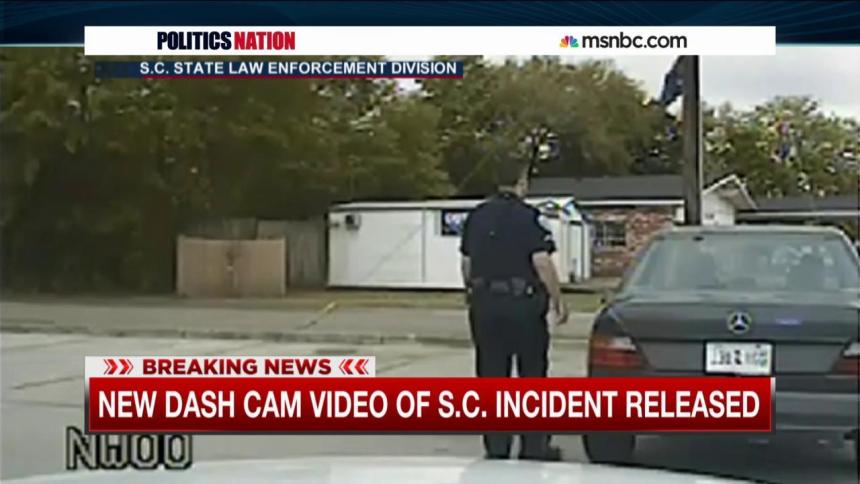
That story, told in Slager’s police report, has now been called into serious question. A second video, from the dashboard camera in Slager’s police cruiser, shows the beginning of the fateful encounter: a routine traffic stop over a broken third tail light, and Scott’s initial flight from the driver’s side of the car.
North Charleston is not Ferguson
Slager’s swift and methodical takedown of Walter Scott is chilling to watch, in its seeming banality. It’s also the stuff of black nightmares, brought frightfully to life so that even the most skeptical, and the most generous toward the accounts of police officers, can grasp the root of this most primal African-American fear. Black Americans’ fear of police is often written off as irrational, or simply an excuse to condone law breaking. But the fear is real, and deep, and so is the dread that in the aftermath of the taking of a black life by a policeman, the familiar and rote explanation — He tried to grab my weapon / I thought he was armed / I was afraid for my life — will be enough for the slate to be wiped clean, and the death of a loved one to be written off as just another black man making a fatal decision to violently challenge authority.
Indeed, the story of North Charleston contains some familiar elements of past police-involved shootings: a white officer killing a black man; a local police force that’s overwhelmingly white in a community that’s predominantly black. North Charleston’s police department is 80% white in a community with 42% white and 47% black residents, according to the 2010 Census. And North Charleston boasts a stretch of railroad tracks, familiar in southern cities and towns, separating the city of just over 100,000 from Charleston proper, which is 68% white and 26% black, and whose historic downtown boasts $2 million French Quarter colonial mansions, cobblestone streets and wide alleys gently lit with gas lamps.
RELATED: New details emerge in Walter Scott case
But North Charleston is not Sanford, Florida, where an out-of-town teenager, Trayvon Martin was shot and killed by a neighborhood watch volunteer. And it’s not Ferguson, Missouri, where Michael Brown was killed by now former police officer Darren Wilson. North Charleston’s deputy police chief is African-American. So is the police spokesman, whose brother is one of three African-Americans on the nine-member city council. Inside the expansive, glossy, warm wood paneled City Hall complex, police officers, city officials and administrative staff mix and backslap with picture perfect, inter-racial jocularity.
Moreover, South Carolina, unlike Florida and Missouri, has a law remanding all police-involved shootings to a state agency, nicknamed SLED (the South Carolina Law Enforcement Division), for investigation. So now, city and police officials refer any and all question to them. It’s an arrangement that leaves members of the media frustrated.
Some black residents are frustrated, too. They sidle up to our camera position; one of the many camped out outside City Hall, dropping phrases like “target practice,” and “like chasing down a runaway slave” to describe what they saw in the cell phone video of Walter Scott’s death. The latter description is particularly searing in a city that once housed numerous slave camps, more genteelly termed in the tourism booklets lining the hotel mantles of North Charleston as plantations.
Many point out that North Charleston has long had problems between black residents and the police. They murmur that Mayor R. Keith Summey is a “good old boy” who, while cultivating solid relations with some black leaders, takes better care of his own. His opponent in the November elections is African-American, and he’s been making the rounds in the days since Walter Scott was killed. They grumble that the police chief, Eddie Driggers, “needs to go,” though one resident pointed out that people who say that do a lot more complaining than voting. A group of local activists who have joined the Black Lives Matter movement and have been staging protests around the city, say that what happened to Scott was only surprising in that this time, the casual brutalization of a black resident by NCPD was caught on tape.
RELATED: Who’s paying for Michael Slager’s heavy-hitting defense lawyer?
On Thursday, a 27-year-old black resident, Mario Givens, reluctantly came forward to tell of his own encounter with Officer Slager, who he says beat and Tazed him at his mother’s house in 2013, after he and a second officer banged on the door at 2 o’clock in the morning, looking for Mario’s brother. Givens was visibly shaken when the media showed up on his street on a tough block in the city, dotted with abandoned homes. His case was contained in Slager’s police file, tipping off the national press to his existence, and his address. Slager’s police report said Mario and his brother looked “just alike,” though the report said the officers were seeking 5’6” Matthew, while Mario stands over 6 feet tall. His attorney says they plan to sue. The police spokesman says the department, which cleared Slager of excessive force allegations in 2013, is “looking into the incident.”
At the Scott house, local NAACP president Edward Bryant III, wiping sweat as he stands outside the Scott home in the 88-degree heat, says he can name five black men shot down by police right off the top of his head, and adds that police don’t get held accountable when they kill people in North Charleston.
A quiet block, a chaotic house
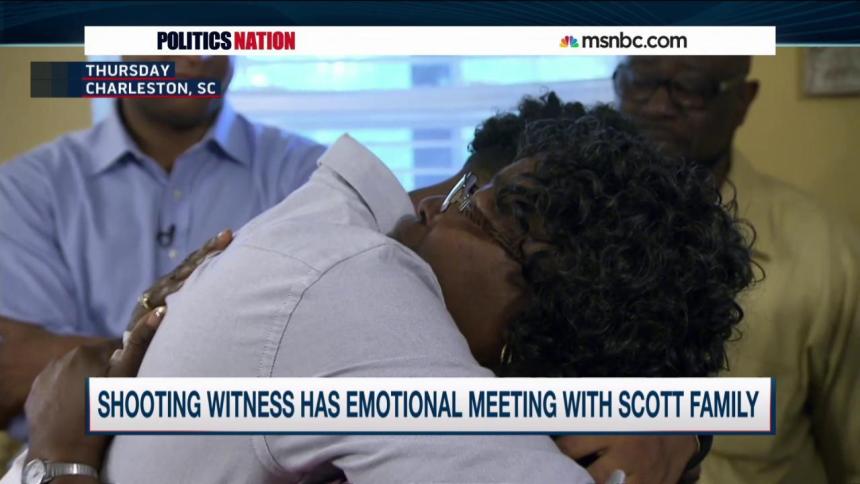
Judy Scott was Walter’s mother. Her home sits on a quiet, expansive, suburban block lined with small, aging one-story houses, with front porches, wide lawns and a neighborly feel. Now, the home is filled with cousins and nieces, mothers and children, brothers and nephews, but also attorneys, politicians, pastors, civil rights organization representatives and of course, cameras and reporters. The kitchen is crammed with food — some cooked, some delivered, including elaborate spreads of sandwiches — gifts from news organizations. As national media outlets parade in and out of the house in a seemingly endless procession, the Scott brothers talk about the video, and what they call the “miracle” of Santana coming forward and bringing it to them. Anthony Scott, 52 and his brother Rodney, 48, call Santana, who had an emotional meeting with the family on Thursday, a hero. Rodney goes further, saying of Santana, “He’s my brother.” Without the video, they say, their brother’s death would have been written off as just another black man who posed a nearly superhuman threat to an armed and trained police officer, even when unarmed himself. WATCH: Officer’s mother speaks out after SC shooting On Wednesday, the family tunes in to the live press conference held by Mayor Summey and Chief Driggers, flanked by members of the city council. The mayor and the chief had visited the family earlier that morning to pay their respects, and the two men were being widely praised in the media for quickly getting out in front of the story once the cellphone video hit The New York Times – courtesy of the family’s representatives. But the family points out that for four days after Walter was killed, police officials parroted Slager’s version of the shooting. And Anthony Scott says police at the scene confiscated his cellphone, though the police department says it was at the direction of SLED, and that the phone was promptly returned. Within minutes, the press conference, into which city officials have allowed more than 100 members of the public, dissolves into protests and chaos. Members of the family and their lawyers shake their heads in disbelief. One reporter shouts out what strikes many the room as an absurd question: “Why do you think North Charleston didn’t turn into Ferguson?” Judy Scott tells a media outlet that she forgives Slager. She is a woman of profound and expressive faith, who breathes out “Thank you Jesus” as readily as another person might say “okay.” But Rodney says he is “a broken man,” shattered by the loss of his brother and best friend. Walter was the middle brother of a threesome, each two years apart. Walter and Rodney shared chores, childhood baths (and whoopings) and a special bond that lasted into adulthood. Anthony, the oldest, constantly teases Rodney, and their attorney, L. Christopher Stewart, about their heights, though he’s barely a couple inches taller than they are. It’s a bid to lighten the dreary mood, and all three men manage to laugh as they sit on Judy Scott’s old style, brocade covered couch, waiting for the lighting to be set for the interview. Rodney pulls at the heavy, printed fabric. “Boy, we slept on this couch so many times as kids,” he says. As the interview goes on, he dabs his face with a napkin. Eventually, he breaks down. The Scott brothers readily admit to their middle brother’s troubles with child support. But they emphasize that he was a military veteran, a loving father, and a devoted family man, who dreamed of taking all four of his children to Disney World. Rodney says his brother would definitely have run from the police. He didn’t want to go to jail over a child support debt. He definitely would have run, Rodney says, but he wouldn’t have fought a police officer. Walter was in the process of buying a used car from an acquaintance, which he was driving on that fateful day. He was trying to make life better for himself and his family, the brothers say, now he’ll never get that chance. The big, bustling family prepares to receive more visitors, relatives and media. By Friday, they’ve had enough, and tell the media to go. They’re burying Walter on Saturday and they have a funeral to plan.
Joy-Ann Reid
Joy-Ann Reid is host of “The ReidOut” at 7 p.m. ET on MSNBC. “The ReidOut” features one-on-one conversations with politicians and newsmakers while addressing provocative political issues both inside and outside of the beltway. Recommended