








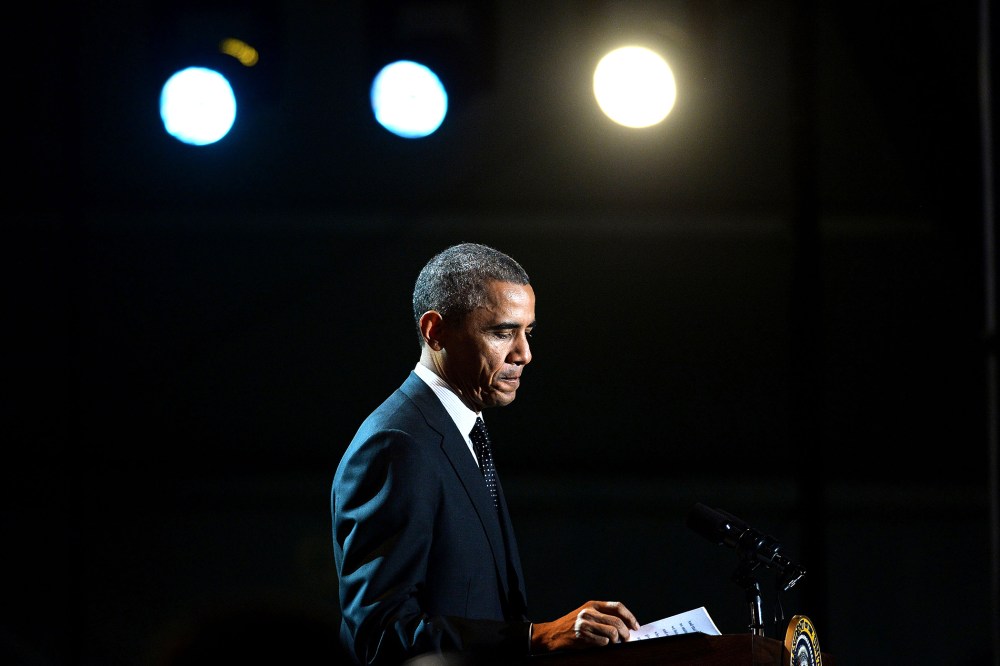
As President Obama prepares to take action on immigration in defiance of last Tuesday’s midterm shellacking, he faces an uncertain political and policy terrain filled with risk.
On the policy front, the loudest argument against executive action is by far the easiest for the White House to dismiss. That would be Speaker John Boehner’s plea that by going alone, Obama would “poison the well” for immigration reform in Congress and kill any chance of major legislation passing.
If Boehner had shown any intention of moving forward on reform earlier, this might be a concern. Instead, he sat on a bipartisan Senate bill for over a year then announced over the summer that he wouldn’t even pass a GOP-only counteroffer, let alone anything that the president might sign, because his caucus didn’t trust Obama enough. It was this move that prompted Obama to announce that he would come up with a White House-based alternative.
This is the main reason immigration groups have upped the pressure on the White House to act even if the policy gains are less sweeping and more fragile than a legislative solution. The default GOP position has shifted several ticks to the right since the Senate passed its bipartisan bill last year and many newly elected Republican politicians won their races while railing against “amnesty” in speeches and ads. On the Senate side, expected Majority Leader Mitch McConnell wanted nothing to do with immigration reform last year. Based on his history, he’s loath to pass anything Obama can claim as a legacy achievement.
Related: Immigration activists to Obama: Go big
What the White House does have to worry about, however, is the Republican response to its move. A bitter, early confrontation could set the tone for a long final two years in office.
Boehner and McConnell have made it clear their goal is to avoid high-profile standoffs like last year’s shutdown. On Tuesday, McConnell made a speech on the Senate floor, saying that unilateral action by President Obama on immigration would be a “big mistake,” urging Obama and Senate Democrats to help set “a positive tone for the work of the next Congress,” which he said “will depend largely on the adminstration’s willingness to respect a message sent last Tuesday.”
Other Republicans are taking the opposite tack. Even immigration reform co-sponsor Senator Marco Rubio has suggested tying measures to undo Obama’s executive action to must-pass funding bills, which could lead to a shutdown. Others, like Republican Senators Ted Cruz and Mike Lee, want to press Obama’s pick for Attorney General, Loretta Lynch, on the issue in hearings and could threaten her confirmation. A handful of Republicans, most recently Congressman Joe Barton, have even thrown around the idea of impeachment.
Here we get to the political risks and benefits.
In the short term, what happens if things come to a head in a series of standoffs? Republicans suffered the most in the last shutdown fight, though the botched health care rollout quickly lifted them right back up in the polls. It might be easy to assume that another Republican-initiated cliff would be an immediate boon to Democrats, especially given how hard Boehner and McConnell are trying to avoid them.
Related video: The Fence: A road trip along a fortified border
This is possible, but not guaranteed.
One Republican strategist argued that while blocking Obamacare looked like a quixotic fight to undo an already passed law from the start, executive action has not been litigated the same way and Republicans might be able to spin a new standoff their way. A new post-election Gallup poll shows 53% of respondents want Republicans in Congress to “have more influence over the direction the nation takes” next year versus 36% who say the same for Obama. While exit polls for the 2014 midterms indicated that 57% of voters this year favor a path to legal status for undocumented immigrants rather than deportation, Obama’s approval ratings on the issue are low and it’s less clear whether Americans support unilateral action.
“[Executive action] undercuts supporters of immigration reform and emboldens the opponents,” Republican pollster Whit Ayres, who has advocated passing reform to help the GOP win back Latinos, told msnbc. “It’s going to come across as an illegitimate and crassly political move by a desperate president.”
Related: Will Obama call Boehner’s immigration bluff? Looking further ahead, there’s the question of whether executive action on immigration might hurt Democrats in 2016. Democrats in red states were concerned enough about executive action to pressure Obama into delaying his planned move only to lose as their opponents bashed them over it anyway. It’s easy to chalk up their losses to a low-turnout midterm fought mostly in red states, but as The New York Times analyst Nate Cohn noted this week, the winning Republicans also made gains with rural white voters that suggest the next GOP presidential candidate might have a narrow path to victory if they can boost their performance even further. In the medium term, the minority share of the electorate is growing too fast to make this approach viable for long, but 2016 is only two years away. Could a prolonged battle over deportations juke those numbers? Democrats may have even bigger concerns when it comes to Latino voters, however, and that’s where the intended political benefits of action come into play. While a solid 64% of Latinos went for Democrats in November per exit polls, individual Republicans like Senator-elect Cory Gardner in Colorado, Texas Governor-elect Greg Abbott, and Governor Brian Sandoval in Nevada turned in stronger performances, suggesting Democrats can’t take the margins and turnout that defeated Mitt Romney and John McCain for granted. Matt Barreto, co-founder of pollster Latino Decisions, told msnbc his own research indicated disillusionment with Obama’s failure to act on immigration before the elections was a culprit in depressing the Democrats’ performance. “We did a survey of Latino nonvoters and 60% said the delay made them less enthusiastic about Democrats,” Barreto said. “68% said they’d be more enthusiastic about Democrats if the president took action before the end of the year. This was definitely something on their mind and concerning to them.” A modest dropoff in support wasn’t a great concern to Democrats in 2014 given a Senate map in which Colorado alone featured a large and influential Latino bloc. In 2016, however, it could be far more consequential. In addition to the presidential contest, there are potentially competitive Senate races in Colorado and states like Florida, Nevada, Arizona, California, and Illinois that also feature a significant pool of Latino voters. Even modest GOP gains or weaker turnout among Latinos could do some real damage in this environment. “It’s a tough political decision,” one Democratic pollster who worked on midterm races told msnbc. “The majority of the public overwhelmingly favors the kind of reforms the president’s talking about. On the other hand, the means by which he does it and the labels his enemies can attach to it have the potential to create problems. At the same time, that Latino vote is much more politically potent come 2016 than it was in 2014.” Looking even further ahead, the Latino share of the electorate could double by 2030, giving Democrats a strong incentive to try to both press their current advantage and bait Republicans into undermining their own outreach efforts. Whatever backlash Obama risks in the next month, or year, or election cycle may seem small in retrospect if he ends up the president who locked down Latino voters for another generation.
Benjy Sarlin Recommended


