








Hampstead, NH – Beantowne Coffee House, where Scott Brown delivered his stump speech to voters last Wednesday, is 2,218 miles from the nearest Southern border crossing by car. After a few minutes listening to the Republican senate candidate, it started to feel a lot closer.
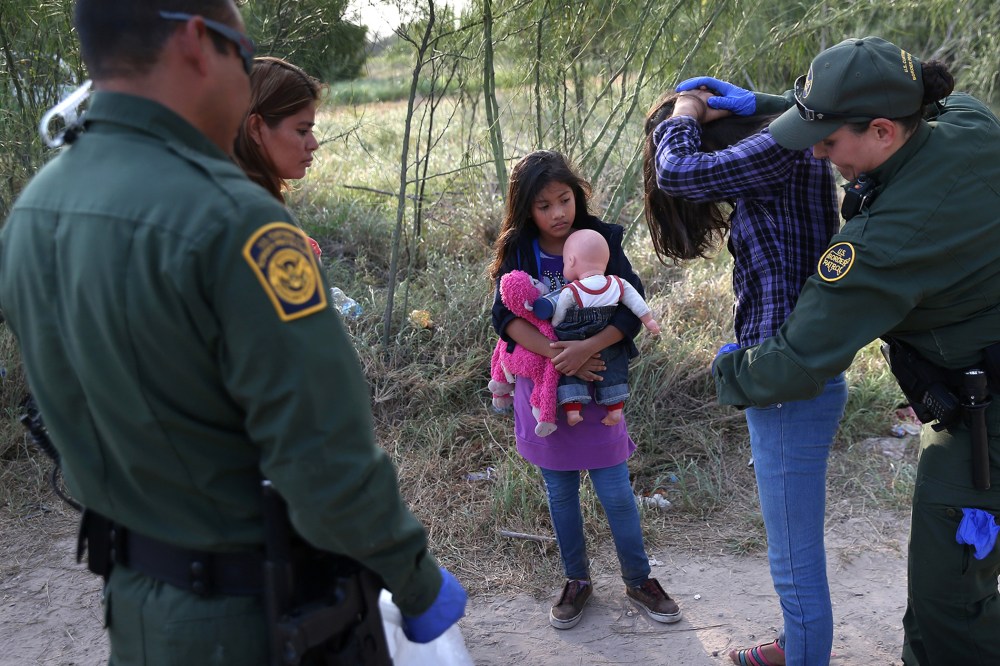
“Do you think maybe we should close the border to make sure that those who have different intentions, whether they’re criminal or terrorist elements or somebody who is unfortunately and not knowing it carrying a disease, [don’t just] stroll through the border?” Brown told café-goers. “Do you think we should close the border? Of course, we should, and that’s the difference between Senator Shaheen and me.”
Lines like that struck a chord with Richard Burns, a 66-year-old resident of Derry, who came to hear Brown speak. Burns, who wears a Marine Corps hat autographed by every major political figure in the state and a host of former presidential candidates, follows campaigns as closely as anyone. He named the border as the top issue he wanted Washington to address this year.
“I want it to be the United States of America, not the United Nations of America,” Burns told msnbc. “Nobody has the right to come into this country except Americans.”
Brown, who is challenging Democratic Sen. Jeanne Shaheen, has put immigration and border security at the top of his platform for months. He’s just one of many prominent Republicans doing so in competitive races around the country, a move that could have long lasting implications as the party tries to rebrand itself with Latino voters ahead of the next presidential election.
It’s an unexpected turn in an election cycle that many observers assumed would largely hinge on other issues. Heading into 2014, only 3% of voters told Gallup that immigration was their most pressing concern. Latino voters, the group most engaged on the issue and who had helped power Obama’s re-election, are mostly concentrated in states without competitive Senate races. Republican leaders, equally afraid of offending conservative activists and the emerging Latino electorate, typically preferred not to draw attention to the topic while they quietly gauged support for immigration reform legislation that might neutralize the issue in 2016.
Since then, conservatives have shifted the center within the GOP decisively to the right. Immigration reform was already dead this summer when a wave of Central American migrant children pushed border issues back onto the front page. Led by lawmakers like GOP Texas Sen. Ted Cruz, Republicans rallied behind legislation that would dismantle Obama’s Deferred Action for Childhood Arrivals program, which provides temporary work permits to young undocumented immigrants. By the time Congress left for recess, the default Republican position had drifted even further to the right than Mitt Romney’s “self deportation” 2012 platform.
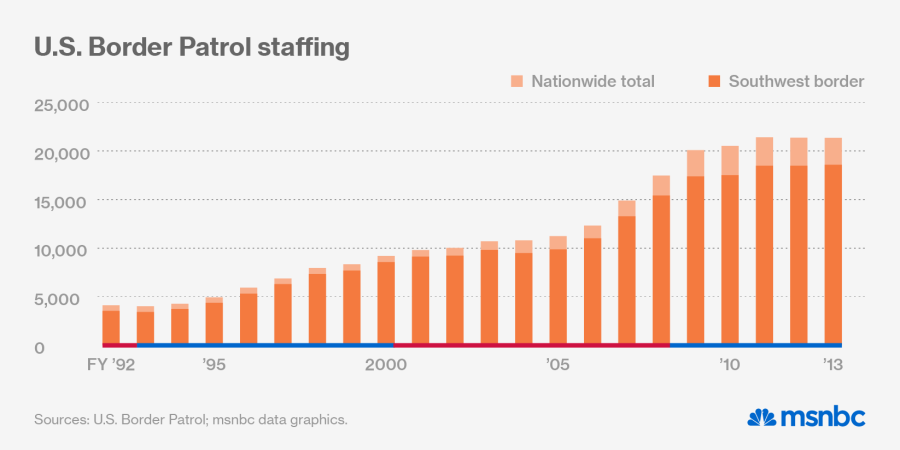
Brown, sensing an opportunity, reoriented his campaign against Shaheen around immigration. “Thanks to the pro-amnesty policies of President Obama and Sen. Shaheen, we have an immigration crisis on our hands,” he said in one July ad. A follow up in August railed against “lawlessness on our border.” The ads coincided with a rise in the polls for Brown, who trails Shaheen in most surveys but has kept the race competitive.
“You have a situation where we have a porous border,” Brown told msnbc afterwards. “We have people with criminal records, people who are potentially going to be carrying some kind of disease, you have a potential economic and national security issue. It’s very big and the people here care very deeply about it.”
His solution: “You got to close the border. Period.”
While the Central American crossings leveled off, new crises arose to replace it in the news – first ISIS, then Ebola – and Brown kept plugging them into the same border frame.
By then other Republicans had started following the same approach, like David Perdue in Georgia, who ran ads denouncing “amnesty” that warned of ISIS fighters crossing the border and Tom Cotton in Arkansas, who suggested terrorists were actively working with Mexican cartels and could attack the state (Homeland Security officials have said they have no evidence such plots exist). Even outside groups like American Crossroads, whose founder Karl Rove has urged the GOP to back immigration reform, rolled out commercials attacking Democrats for “amnesty” votes.
Republicans working on campaigns say the trend towards border and immigration issues has been driven from the party’s grassroots.
“If you look at the polling, as recently as a few months ago it was the economy and jobs number one and then healthcare and energy and other issues,” Ohio Sen. Rob Portman, who serves as finance chairman for the National Republican Senatorial Committee, told msnbc. “Now, in most states, jobs and economy are number one and foreign policy is number two. I think it’s more driven by ISIS, frankly, than the border, but they’re related.”
The data backs him up. In August, a Gallup poll found that 22% of Republicans listed immigration issues as their top concern – more than any other topic – amid increased coverage of the Central American migrants and renewed fears of terrorism.
The Democratic response
Among Democratic candidates, immigration hasn’t been as prominent in advertising or campaign materials, but it hasn’t been a non-issue either.
Democratic candidates in conservative-leaning states like Arkansas, North Carolina, and Alaska distanced themselves from a pending shakeup of deportation procedures Obama has promised and even convinced the White House to delay executive action on the issue until after the election, infuriating Latino advocacy groups who had been promised movement by summer’s end.
At the same time, however, Democratic candidates in competitive races uniformly support comprehensive immigration reform. While the issue isn’t nearly as prominent in ads and campaign materials as it is for their GOP opponents, they’ve shown a surprising willingness – even eagerness – to go on offense in debates over the issue.
Several Democrats have cited their support for the Senate’s bipartisan immigration bill as evidence they’d be willing to work with Republicans to break through gridlock.
In Iowa, Democrat Bruce Braley challenged Republican opponent Joni Ernst in one debate to “join John McCain and Marco Rubio in calling on Speaker Boehner to bring this immigration bill to the floor of the House so we can pass it.” In North Carolina, Democratic Senator Kay Hagan has also drawn attention to her support for the Senate bill in debates against Republican Thom Tillis while name-dropping its GOP co-sponsors. In Kansas, independent candidate Greg Orman has fought off border-based attacks from Republican Senator Pat Roberts by arguing that Roberts is hurting the state’s agricultural industry by opposing reform.
Even Alison Lundergran Grimes in Kentucky, who was pilloried by pro-reform groups for running an ad last month targeting Mitch McConnell vote for an “amnesty” bill in 1986, has said she favors comprehensive immigration reform.
Frank Sharry, president of immigration advocacy group America’s Voice, told msnbc he was encouraged by the party’s unity given that nearly one-third of Senate Democrats voted to block President Bush’s immigration reform bill just seven years earlier. “It’s remarkable,” Sharry said. “They’re not totally leaning in the way we would like, but their support for immigration reform is quite new in the political landscape.” What comes next For now, Republicans can fire up the base on immigration issues without much fear of electoral reprisal. Their House GOP majority is secure and concentrated in disproportionately white districts, and the Senate map this year features few states where Latino voters are a big factor. All of that changes the day after November 4th when attention turns to the presidential election and Republicans have to worry about winning states with large Hispanic populations like Florida, Nevada, and Colorado to take back the White House. A survey of 600 Latino voters by pollster Latino Decisions released on Monday highlights the obstacles the GOP faces moving forward. Some 59% of respondents said they planned to vote Democrat for Congress in 2014 versus 25% who planned to vote Republican and 51% of respondents named immigration as one of the two issues most important to them. But the numbers also suggested there were still opportunities for Republicans to make progress. Matt Baretto, who conducted the poll, noted to reporters in a press call that Democratic support was relatively soft – only 34% said they were certain to vote for the party – and that Obama’s standing had dropped since announcing he would delay executive action on deportations. Only 42% said they approved of his handling of immigration issues versus 51% who disapproved, a reversal from their last poll in June that put him at 54% approval. “None of the actors in this policy environment are getting good numbers,” Barretto said. Daniel Garza, executive director of the LIBRE Initiative, a Koch-backed group dedicated to winning Latino voters towards conservative candidates, told msnbc Obama’s decision “opens up a window of opportunity for Republican candidates.” That window gets harder to exploit, however, the more Republican candidates rely on tough immigration rhetoric to rally their base. “In the long term it’s going to hurt them or hurt the party … especially candidates in the 2016 election race,” Garza said. Both parties are paying close attention to Colorado this year as a bellwether for their standing with Latino voters heading into the next cycle. There, Congressman Cory Gardner is leading polls against Democratic Senator Mark Udall in a state where Latino voters have played a major role in recent elections. Gardner has walked a careful line on immigration: He’s described himself as an ally of the reform cause, he’s held meetings with local Latino activists, and he was one of only a handful of Republicans to vote against a measure that would deport DREAMers. On the other hand, he opposed the Senate’s bipartisan immigration plan and tends to hedge when asked about his plan for undocumented immigrants. If Gardner wins, Republicans might try to turn his combination of friendly outreach and vague policy positions into a national model. “His political narrative is reflective of inclusion,” Garza said. “I think he gets it in that sense and, of course, the lights come on when it comes to numbers.” It only will get harder to drag the party to the center, however, if voters elect another round of Republican Senators and House candidates who spent months promising voters they’d fight for troops and fences at the border and have labeled any concession to undocumented immigrants an unacceptable “amnesty.” “I think it’s a permanent shift for Republicans,” Sharry, the America’s Voice president, told msnbc. “What was temporary was the post-2012 attempt to find a middle ground.”
Benjy Sarlin Recommended


