









If the 2012 election was a wakeup call for Republicans to address their relationship to Latino voters, the 2013 immigration debate is starting to resemble a chloroform-soaked rag.
After November’s stunning loss, an array of influential Republicans argued that immigration reform was the party’s best chance to claim Latino voters before they become permanent Democrats. But in a mere eight months, a counter-narrative has taken hold in conservative circles, nurtured by a shrewd group of anti-immigration lobbyists and Tea Party enthusiasts. The new argument sees immigration reform at best as a divisive distraction from the GOP’s real problem of countering “white flight” from the polls. At worst, they view it as an electoral apocalypse, a seventh seal behind which lies an unbroken line of future Democratic presidents.
As the Senate’s bipartisan immigration bill moves to the House, whose members are overwhelmingly planted in safe GOP districts, the stakes couldn’t be higher for comprehensive reform. Whether it passes will be determined in large part by which of the two narratives can win over the conservative mainstream.
At the moment, the anti-immigration argument appears to be gaining converts fast. On election night, Fox News anchor Brit Hume called the “demographic” threat posed by Latino voters “absolutely real” and suggested Mitt Romney’s “hardline position on immigration” may be to blame for election losses. On Monday, Hume declared that argument “baloney.” The Hispanic vote, he said, “is not nearly as important, still, as the white vote.”
Sean Hannity, a reliable bellwether on the right, has been on a similar journey since the fall. He announced days after President Obama’s re-election that he had “evolved” on immigration reform and now supported a “path to citizenship” in order to improve relations with Hispanic voters. Hannity has now flipped hard against the Senate’s bill.
“Not only do I doubt the current legislation will solve the immigration problem,” he wrote in a June column, “but it also won’t help the GOP in future elections.”
Hannity and Hume didn’t arrive at their latest destination by accident. They’re just the latest figures on the right to embrace the compelling new message that’s whipping Republicans against immigration reform while still promising a better tomorrow for the GOP’s presidential candidates.
‘You Don’t Get To Come Over Here And Be Takers’
House leaders have been cagey about their views on immigration reform, political or otherwise, suggesting a “wait-and-see” approach to the ongoing civil war over the Senate bill. Speaker John Boehner says he supports immigration reform in an abstract sense, but won’t bring forward any bill that doesn’t have the support of the majority of his caucus. Majority Leader Eric Cantor has shifted since the November election to favoring a path to citizenship for young undocumented immigrants, a far more modest position than the Senate’s “Gang of Eight,” but one that suggests he’s at least nominally concerned about the rising Latino vote.
The most vocal advocate for passing a far-reaching bill along the lines of the Senate’s has been Congressman Paul Ryan of Wisconsin. Perhaps not coincidentally, he’s also the member most likely to face a national Latino electorate in 2016 as the party’s presidential nominee. But he’s gone out of his way to avoid the political argument over the bill, focusing his attention on advocating for its individual policy provisions instead.
But other House leaders are moving in the opposite direction. After entertaining the idea of bipartisan immigration reform earlier this year, House Judiciary Committee Bob Goodlatte and Immigration Subcommittee Chair Trey Gowdy are pushing an enforcement-oriented bill modeled after Arizona’s SB 1070–despised by Latino groups–that would criminalize unauthorized immigrants and task local police with investigating suspected violators. This doesn’t look like the behavior of politicians who are terribly worried about courting Latino voters.
At the heart of their dueling approaches is a basic question: can the party win back the White House without winning more Latinos?
Rush Limbaugh argues that it can, and if House Republicans and their constituents take his side, the motivation to pass immigration reform will vanish. For months, he’s tried to convince his listeners that Latinos are unlikely to vote for the current Republican Party even if immigration reform passes. During one on-air confrontation with Senator Marco Rubio of Florida, Limbaugh asked whether “the Republican party is committing suicide” by adding “nine million automatic Democrat voters” through a path to citizenship.
Reformers such as Rubio counter that Latinos are only voting for Democrats in such large numbers because the immigration debate has drowned out Republicans’ compelling message of low taxes and deregulation. Often they describe the bill as a “gateway” issue, one that won’t win the GOP any votes by itself, but will at least open the doors to outreach.
“I believe if we pass this legislation, it won’t gain us a single Hispanic vote, but what it will do is put us on a playing field where we can compete,” John McCain said in an April breakfast with reporters.
Or, as Rubio is fond of saying, “It’s really hard to get people to listen to you on economic growth, on tax rates, on healthcare if they think you want to deport their grandmother.”
But Rush has some compelling data to back up his electoral claim. An April 2012 survey by the Pew Research Hispanic Center found that 75% of Latinos preferred a “bigger government” that provides more services versus 19% who favor a “smaller” one. Among the general population, smaller government won out by a 48-31 margin. Obama’s healthcare law often polls well with Latinos–a dynamic Romney infamously cited as one of the Democratic “gifts” that cost him the election.
“This is scholarly data in academic reports: 75% of illegal immigrants in the country also believe that government is the source of prosperity,” Limbaugh said in a January 31 broadcast. “So they’re naturally going to be inclined to vote Democrat.”
This helps explain Michele Bachmann’s warning last month to conservative fringe site World Net Daily: “We will never again have a Republican president, ever, if amnesty goes into effect.” The Limbaugh argument is especially powerful in Tea Party hands because it flatters their self-image as rugged independents fighting off the welfare-hoarding invaders.
“The things that made America great are Americans like you that work and understand that it’s sacrifice,” Congressman Randy Weber of Texas said at a June rally against the Senate bill. “You don’t get to come over here and be takers.”
Some conservative commentators argue that Latinos’ faith gives them an advantage on social issues instead. Washington Post columnist Charles Krauthammer wrote after the election that Latinos “should be a natural Republican constituency: striving immigrant community, religious, Catholic, family-oriented and socially conservative (on abortion, for example)” and plenty of others have made similar arguments.
But on abortion, there’s little evidence Latino voters are as conservative as they’ve been portrayed compared to the general population. And on gay marriage, an issue the national GOP isn’t too inclined to highlight these days anyway, some polls suggest they’ve actually grown more liberal than the average voter.
Their rhetoric may be crude, but here the skeptics raise a legitimate point: if Republicans can’t win Latinos on the economy and they can’t win them on religion, there isn’t a lot left to go on at the moment.
‘Natural Conservatives!’
Talk radio hosts and conservative lawmakers didn’t just stumble upon this narrative. Anti-immigration groups like NumbersUSA have pushed the argument for months in the hopes of increasing opposition to the bill.
Mark Krikorian, executive director of the Center for Immigration Studies and a leading spokesman for the anti-reform movement, has made it a special focus. Each day, he tracks and then highlights every poll or news story that indicates Latinos are to the left of the general public, often tweeting them out with a mocking “Natural conservatives!”
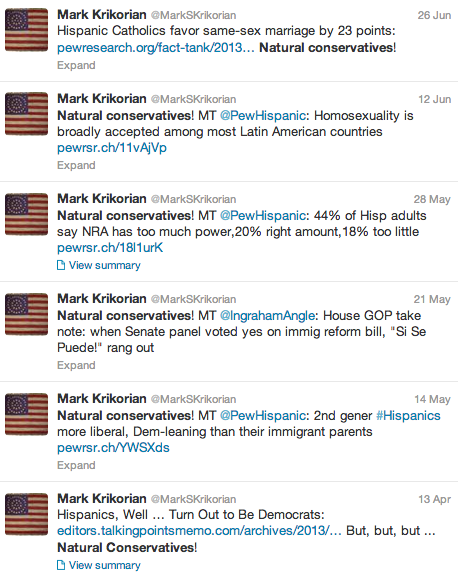
According to Krikorian, his group doesn’t have a “thought-out strategy” when it comes to undercutting pro-reform political arguments, but they try to showcase evidence as it arises.
“The debunking of this ‘natural conservatives’ storyline isn’t ongoing: it’s over,” he told msnbc. “You only really see Lindsey Graham making this kind of argument and nobody takes him seriously,” he said of the South Carolina senator.
To further stiffen wavering conservative spines, CIS sponsored a study by University of Houston researcher George Hawley in February demonstrating that Republican members of Congress who supported immigration reform in 2006 fared as poorly with Latino voters as those who opposed it. More brazenly (and less successfully), NumbersUSA president Roy Beck has tried to persuade Republicans that opposing immigration reform will actually endear them to Latinos.
Krikorian and his fellow activists have done a bang-up job convincing conservatives that Latinos won’t vote for them after they pass immigration reform. But that conclusion raises the obvious problem: Obama beat Romney by 5 million votes in 2012 in a lousy economy. If Latinos aren’t going to close that gap in 2016, who is?
The Case Of The Missing Whites In the run-up to the 2012 conventions, a Republican strategist predicted to the National Journal that Romney’s plan to run up the white vote at the expense of minorities would be “the last time anyone will try to do this.” Wrong. A new view on the right is taking hold: Romney lost because he didn’t go after whites hard enough. This will probably sound a little odd if you were watching TV on election night 2012. Romney won 59% of the white vote in exit polls, better than President Bush’s 58% in 2004. Unfortunately for Romney, the white share of the electorate declined from 79.2% to 73.7 % over the same period. The result: Obama won by an even bigger margin than Bush did thanks to blowout margins with minorities. But conservative commentators are convincing themselves they can find a few million more whites tucked between the couch cushions–at least enough for one more election. Two columnists have been particularly influential in this regard. Sean Trende at Real Clear Politics has argued that census data shows about 5 million mostly poor and rural white voters were “projected” to vote in 2012 based on population growth and past turnout but didn’t show up to the polls. Byron York, a columnist at the Washington Examiner, published a related piece noting that Romney would have lost even if he had racked up a majority of Latino voters. “Recent reports suggest as many as 5 million white voters simply stayed home on Election Day,” York wrote in May. “If they had voted at the same rate they did in 2004, even with the demographic changes since then, Romney would have won.” The problem is there’s no way Romney would have won all 5 million of those whites, so Obama’s lead would have held. But if Obama had failed to replicate his 2008 performance with minority voters and Romney had matched Bush’s 2004 performance with whites, the GOP could have narrowly prevailed. This was the exact scenario Romney was shooting for. York and Trende have some nuanced ideas about how the GOP can accomplish what Romney failed to do, many of which involve tacking left on the economy. But to the talk radio right, the main takeaway is that there are several million angry white votes ripe for the taking if the party can swing even more to the right. White voters stayed home, Limbaugh said in May, because “they didn’t think the Republican Party was conservative enough.” You can hear the “missing whites” thesis everywhere once you start looking for it. Hannity cited York’s piece in his column opposing the “Gang of Eight” bill. Social conservative leader Phyllis Schlafly recently told a radio host that “the people the Republicans should reach out to are the white votes, the white voters who didn’t vote in the last election and there are millions of them.” There’s “not any evidence at all that these Hispanics coming in from Mexico will vote Republican,” she said. “Their idea seems to be gaining currency,” Frank Sharry, executive director of immigration advocacy group America’s Voice, told msnbc. “Right after the election most of the conservative commentariat said they had to do something to get right with Latino voters. Now there seems to be this bizarre conversation that could only happen in the conservative bubble about how Romney didn’t win because he didn’t mobilize enough white voters.” Underlying these claims is a belief that Romney lost because he was a blue-blooded moderate who failed to connect to conservative white voters on a visceral level. Nominate an American bad-ass in 2016 and those missing whites will reappear in a hurry. Maybe it wouldn’t hurt to add a few Hispanic voters, but the GOP can do that with some kind of inoffensive “outreach” program instead. After all, look at Congressman Steve Pearce of New Mexico, an immigration hawk whose retail politicking has earned him an impressive Latino following. ‘The Demographic Death Spiral’ If Bachmann, Schlafly and Limbaugh are able to convince the party that it doesn’t need Latinos, then the GOP may be screwed for generations. That’s because the coming Latino wave isn’t some hypothetical outcome that can be undone by blocking “amnesty” or bringing a few more white voters to the polls. It’s already baked into the demographic cake. The Latino share of the electorate was 8.4% in 2012. What’s worrisome to the GOP is that the Latino share of the population in 2012 was 17.2% and growing. The reason for the disparity has much less to do with illegal immigration than it does with the relative youth of the Latino community, where the median age is 27 versus 42 for whites. According to Pew, there are about 7.1 million undocumented Latino adults who could become citizens under the Senate bill–and only some of them would do so, let alone vote. That group is dwarfed by the 17.6 million Latinos under-18, the overwhelming majority of whom (93%) are US-born citizens. Every election cycle, more of them will become eligible to vote, while the oldest, whitest and most Republican generations age out of the electorate on the other end. (“Age out of the electorate” is a euphemism for “die.”) It actually gets worse for the GOP. Hispanic turnout is extremely low–48% in 2012–in part because their eligible voters are so young. By comparison, white turnout was 64% and black turnout was 66%. That gives Democrats room to grow their Latino base through registration and voting drives–an area where they’ve been incredibly successful with black voters already–while Republicans may be operating near their ceiling with whites. The white vote also looks so GOP-friendly because the Deep South backs Republicans by huge margins: Obama won 51% of the white vote in Iowa, for example, but just 10% in Mississippi. And according to Trende’s analysis, a lot of the “missing” white vote is concentrated in rural portions of the Northeast. So even if Republicans boost white turnout, a bunch of the gains will go to running up the score in Southern states they already win or to improving their margin in Northern states they don’t contest. This is the “demographic death spiral” Sen. Graham is so worried about. And pro-reform Republicans are growing panicked as the new revisionism on Mitt Romney’s loss takes hold. Karl Rove, whose Crossroads group is spending millions promoting immigration reform, confronted his critics head on in the Wall Street Journal last month in an op-ed titled “More White Votes Won’t Save The GOP.” Graham and fellow immigration co-sponsor John McCain aren’t just warning of a 2016 loss anymore, they’ve taken to publicly guaranteeing one if their immigration bill fails. “[If] we don’t pass immigration reform, if we don’t get it off the table in a reasonable, practical way,” Graham said on Meet The Press last month, “it doesn’t matter who you run in 2016.” Correction: According to an earlier version of this story, Sean Hannity announced he supported immigration reform one day after Obama’s re-election. Hannity made his remarks two days after the 2012 presidential election.
Benjy Sarlin Recommended


