









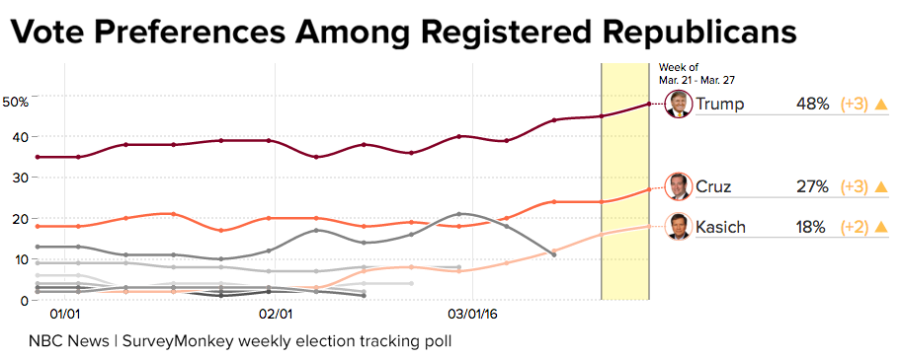
With just three candidates left in the Republican primary race, Donald Trump now holds 48 percent support of registered Republicans and Republican-leaners, according to the NBC News|SurveyMonkey Weekly Election Tracking poll. This is more than 20 points higher than his second-place competitor, Ted Cruz—who now enjoys 27 percent support. John Kasich got a boost of 2 points this week and holds third place with 18 percent support.
The question in the Republican race, however, is no longer whether Trump is the clear front-runner, but whether he will reach the magic delegate number of 1,237—and, if not, whether Republicans will support him as their party’s nominee going forward. These are big questions that have implications for the direction of the Republican Party and, ultimately, the outcome of the 2016 presidential race.
There has been intense discussion about whether the 2016 presidential primary season has caused permanent harm to the Republican Party with “establishment” candidates like Jeb Bush and Marco Rubio failing to gain traction and “outsider” candidates like Trump and Ben Carson performing well.
Although it is looking more and more certain that Trump will at least hold a plurality of delegates headed into the convention, not all Republicans agree that this means he should be the party’s nominee if he fails to get a majority.
There has been intense speculation that Republican Party leaders may put forth a new candidate at the Republican convention if Trump fails to win the requisite number of delegates to secure the nomination. After Rubio’s exit from the GOP race, former House Speaker John Boehner said, “If we don’t have a nominee who can win on the first ballot, I’m for none of the above. They all had a chance to win. None of them won. So I’m for none of the above.”
A majority—57 percent—of registered Republicans and Republican-leaners disagree, however, and say that Trump should win the Republican nomination for president if he wins a plurality (but not necessarily a majority) of delegates. About a quarter (27 percent) do not think he should win the nomination and 14 percent are not sure.

When looking at this question among Republicans who support someone other than Trump, however, a small majority (53 percent) say that he should not be the party’s nominee if he fails to win a majority of delegates before the convention. This opinion varies slightly between Cruz and Kasich voters, with more Cruz supporters (32 percent) saying Trump should be the nominee than Kasich supporters (24 percent).
The other critical question for the Republican Party and, ultimately, Trump’s campaign is whether he could effectively unite his party’s voters in order to beat the Democratic candidate in November. As Hillary Clinton and Trump emerge as the serious favorites, the question becomes: Would Republicans be satisfied with a Trump vs. Clinton match-up in the fall? Which Republicans would consider ditching their party for a third-party candidate? According to results from our latest weekly election tracking poll, just 52 percent of registered Republicans and Republican-leaners would be satisfied with a choice between Clinton and Trump on the general election ballot. Thirty percent say they would seriously consider a voting for a third party candidate. Of course, the primary has not yet been decided for either party and there are several months remaining until voters have to make their decision in the general election. Satisfaction with candidate choices will almost certainly vary depending on the remaining primaries as well as the months of campaigning left for any potential candidate. One thing is certain, however — a number of hurdles remain for any Republican candidate looking ahead to the general election this fall. The NBC News|SurveyMonkey Weekly Election Tracking poll was conducted online March 21 through March 27, 2016 among a national sample of 6,521adults aged 18 and over, including 5,741 who say they are registered to vote. Respondents for this non-probability survey were selected from the nearly three million people who take surveys on the SurveyMonkey platform each day. Results have an error estimate of plus or minus 1.7 percentage points. For full results and methodology for this weekly tracking poll, please click here.
Stephanie Psyllos
Hannah Hartig
Susan Del Percio is a Republican strategist and a political analyst for MS NOW. Recommended



