








Help us celebrate MSNBC’s first 25 years by joining us every day for 25 days as our anchors, hosts, and correspondents share their thoughts on where we’ve been — and where we’re going.
“America is back.” That was Joe Biden’s message to the world during his first overseas trip as U.S. president.
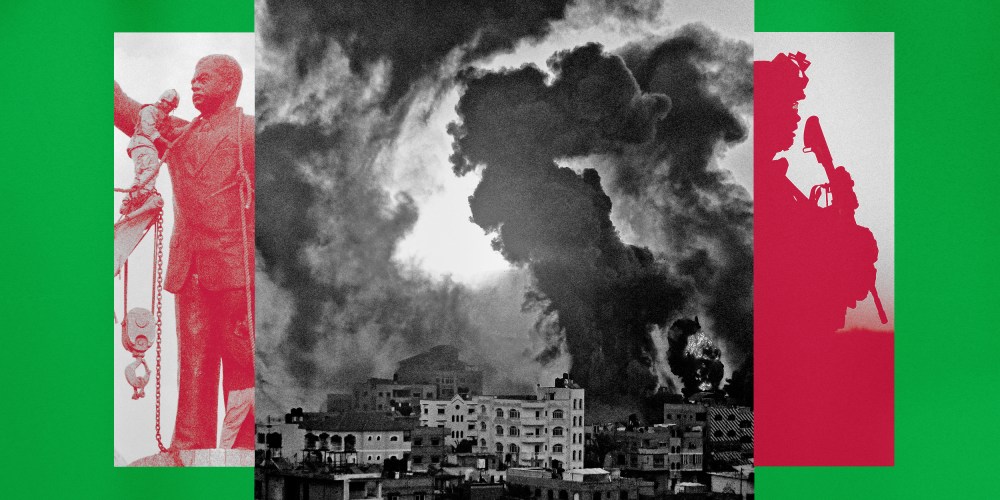
It’s a message that got a mixed reception across a Middle East that still steeped in conflict and, in some cases, bracing for more. Recent history demonstrates that America’s involvement in the region — because of its muddled goals and motivations — often makes things worse, not better. America says its aspirations are for equality and democracy in the region; but that’s often not been the case. And without a serious change in approach — one that the Biden administration shows no inclination toward — it’s likely the nations of the Middle East will be left to develop durable political structures on their own, or with the influence of Russia and China.
Recent history demonstrates that America’s involvement in the region — because of its muddled goals and motivations — often makes things worse, not better.
Take Iran, an actual theocracy. It’s about as far from democracy as you can get. Iran held presidential elections on June 18th that were neither free nor fair, with a hardline “candidate” prevailing. This outcome makes a new Iran nuclear deal arguably less likely. But no candidate can run for president in Iran unless approved by the “Guardian Council,” and Iran’s Supreme Leader Ayatollah Ali Khamenei must sign off on the winner.
It wasn’t always thus in Iran. The country once had a robust, secular, democratically elected parliament. Except by 1953, Iran wasn’t getting a square deal on royalties from its own oil, so then-Prime Minister Mohammad Mossadegh planned to nationalize it. A young CIA operative named Kermit Roosevelt — the grandson of former President Theodore Roosevelt — spread about a million dollars in cash around to goons, thugs, anti-government clergy, and monarchists, and had Mossadegh overthrown. American then elevated the shah of Iran, who turned out to be a remarkable buyer of American armaments for the next quarter century, until an unfortunate revolution in 1979 killed that sweet deal. That America’s lust for oil and arms sales ended Iran’s nascent experiment with democracy is not lost on any Iranian. Kermit was a covert operative, but he was far from a renegade.

To this day, Iran continues to struggle to reintegrate into the global community. After a brief leap forward with the Obama administration’s nuclear deal in 2015, President Donald Trump pulled America out, pushing Iran further into isolation. The Biden administration wants to reverse that backslide, but support for that has waned on the streets of America and Iran. Russia is already moving to fill the “superpower” gap.
Something similar happened in Afghanistan. Occupied by the Soviets in 1979 (the same year America lost influence in Iran), American lawmakers, led by Texas Rep. Charlie Wilson, began arming the rebels waging war against the godless Soviets. Fearing growing communist influence across Afghanistan’s strategic landmass, fundamentalist U.S. Christians decided they had more in common with fundamentalist Muslim guerillas, and found ways to supply them with rocket propelled grenades and, more importantly, shoulder-fired Stinger missiles capable of taking down Soviet helicopters. The several billion dollars that America spent on that effort worked, and within a decade the beleaguered Soviets pulled up stakes. America followed shortly thereafter, leaving the still warring, multi-ethnic and now heavily armed nation to its own devices. It quickly descended into chaos, with 9/11 and the resulting American invasion making a bad situation worse.
American troops are now once again leaving a country mired in sectarianism and civil war. The Taliban is once again ready — and likely — to regain control.
American troops are now once again leaving a country mired in sectarianism and civil war. The Taliban is once again ready — and likely — to regain control.
Meanwhile the Iraq War, launched in 2003 ostensibly to eliminate the dictator Saddam Hussein and find his elusive stash of “Weapons Of Mass Destruction” (WMDs), turned up no WMDs but did cost $800 billion from the U.S. Treasury, 4,500 American lives and well over 100,000 Iraqis killed. The outcome: Iraq is in worse shape today than it was before America got involved.
America’s fascination with taking out dictators is limitless. While Tunisia and Egypt both capitulated to the demands of the Arab Spring protestors in 2011, Libyan strongman Moammar Gadhafi held out. By March of 2011, American jets were leading the enforcement of a no-fly zone over Libya, and providing protection to anti-Gadhafi forces. On Oct. 20, Gadhafi — in office for 42 years — was captured and later killed. Libya now exists — barely — with two competing governments. It continues to be mostly unlivable. Arguably, the one place America can help materially — and quickly — is with Israel/Palestine. Former Israeli Prime Minister Benjamin Netanyahu told the U.S. Congress in 2011: “We defend ourselves.” That’s a two-Pinocchio lie. The true sentence should be: “We defend ourselves… with about $3 billion in annual grants from the U.S., about three quarters of which we use to buy U.S. made weaponry.” The Israeli military then turns around and uses those pricey U.S.-built weapons to help build and protect settlements on land that was seized in war. The U.N has attempted to pass a resolution recognizing that fact for decades; 42 times it has been blocked by a veto from a single powerful ally. That ally is America. Slowly, but surely, U.S. lawmakers are questioning why America can’t have a greater say in what Israel does with American made- and bought-hardware. It would be a simple matter to make any further aid contingent upon Israel stopping and, indeed, dismantling some of the settlements that have been developed illegally on occupied lands. Being a fair broker in this issue is low hanging fruit for America and, under presidents Carter and Clinton, America started to live up to that promise. Biden has, grudgingly, been dragged into this mess. It remains unclear what he plans to do about it. Ultimately, the Middle East needs to solve its own problems, but the U.S. can provide the space needed for the region to work out its territorial, sectarian, humanitarian and political issues. Historically, the U.S. has chosen to prioritize access to the Middle East’s buried “black gold” — and the rulers who control it — over the political aspirations of the people who live there. And when the rulers’ usefulness runs out, America topples them without a plan for what comes next. Given how attempts at democracy, liberty and press freedoms have failed across so much of the Middle East, America’s best chance of bringing stability to the region over the next 25 years may be to be honest, transparent, and consistent in its goals: People above oil, self-determination over the preservation of client dictators, and human rights ahead of, well, everything else.
Ali Velshi is the host of “Velshi,” which airs Saturdays and Sundays on MSNBC. He has been awarded the National Headliner Award for Business & Consumer Reporting for “How the Wheels Came Off,” a special on the near collapse of the American auto industry. His work on disabled workers and Chicago’s red-light camera scandal in 2016 earned him two News and Documentary Emmy Award nominations, adding to a nomination in 2010 for his terrorism coverage. Recommended


