








I feel like we’re living in a Peanuts cartoon. You know the one: Lucy holds the football for Charlie Brown to kick, but pulls it away at the last minute, causing Charlie to fall flat on his back. Replace Lucy with religious employers, Charlie Brown with women, and the football with birth control coverage, and you’ve got a real-life version of Charles Schulz’s cartoon — only what’s at stake is critical health care coverage for women.
Each time the government offers a new proposal to the employers waging the fight over the Affordable Care Act’s contraception benefit, it seems like they’ll accept it at first, but inevitably they pull the football away at the last minute. The briefs the employers filed this week and last week in the Supreme Court are no different.
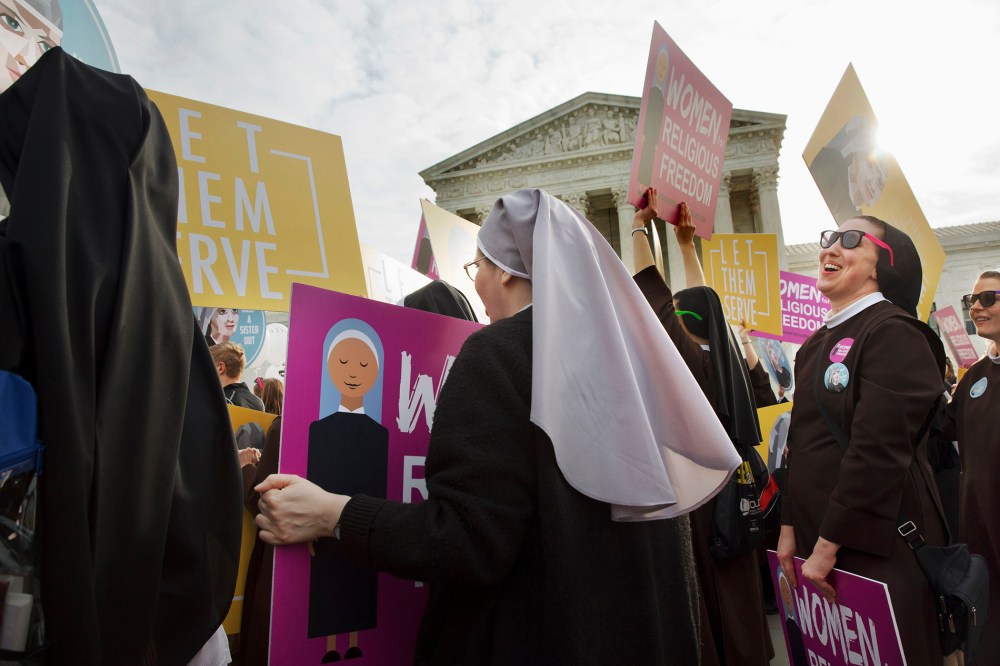
What’s at issue in the case, Zubik v. Burwell, is whether it is a substantial burden on the employers’ religious beliefs to fill out a one-page notice opting out of providing contraceptive coverage required under the ACA.
RELATED: Birth control dispute at the Supreme Court drags on
In a surprising move, after oral argument last month, the Supreme Court issued an order requesting additional briefs from both sides in the case. The parties were asked to weigh in on a court proposal in which “contraceptive coverage could be provided to petitioners’ employees, through petitioners’ insurance companies, without any such notice from petitioners.”
The employers filed their brief last week to respond to the court’s hypothetical. In that brief, they claim they are saying “yes” to the court’s proposal — but upon close read of the brief, they really are really saying “no.” They have essentially rewritten the court’s proposal in a way that is no different from the fictional and unworkable alternatives they have already proposed to the court. Specifically, the employers argue that women should be forced to obtain, and separately enroll in, a new health insurance policy for contraception. Then again, on Wednesday, they submitted a reply brief that rejects any proposal that ensures that women have seamless contraception coverage.
The problem is that “contraception-only plans” are a unicorn: They don’t exist. And there are a host of federal and state regulatory concerns that might prevent such plans from ever existing. In fact, the federal government even rejected a “contraception-only plan” proposal when it initially developed the existing opt-out a few years ago after receiving numerous letters from a range of experts, including from insurance companies, about why it would be unworkable. In the government’s reply brief this week, it reiterated that a contraception-only plan is fictional and unworkable.
But that’s not the only issue. A “contraception-only” plan also relegates women to second-class status. Only women would be forced to obtain a separate plan for basic health care. Women would have to learn about a new policy, figure out how to enroll, and do so only at certain times of the year when enrollment is permitted.
And what about women who are covered on an abusive spouse’s plan? The abusive spouse could reject coverage in attempt to control his wife. Or what about the woman who didn’t anticipate needing contraception during the enrollment period, but then meets the love of her life? Making women jump through unnecessarily hurdles is the complete opposite of what is guaranteed by the Affordable Care Act, and it’s demeaning. As the government said in its reply brief, “Requiring women to surmount these obstacles to get preventive care would frustrate the central purpose” of the ACA, and “requiring women alone to do so would thwart the fundamental goal of the Women’s Health Amendment, which sought to redress longstanding disparities in health coverage.” The employers’ rejection of the court’s recent proposal should really come as no surprise given the numerous other proposals they have rejected. When the contraception rule was first announced, there was no opt-out for religiously affiliated employers. There were loud objections, and the government adopted an opt-out for religiously affiliated nonprofit employers if they notified their insurance company. At first it seemed like the opt-out would assuage the employers’ concerns, but more than 35 suits were filed claiming that it was a substantial burden on their religious beliefs. As the cases were percolating, the Supreme Court issued a temporary order in Wheaton College v. Burwell, and suggested another proposal: That the employers could notify the federal government instead of the insurance company. The employers rejected that proposal. And now, even if they keep claiming they are accepting the court’s proposal in Zubik, they are really rejecting it. The proverbial football keeps getting yanked away. Lucy had her reasons for pulling the football away from Charlie Brown. The employers have theirs. They don’t want their employees to have contraception coverage in their basic health plans. Instead, they want a free pass to discriminate against their female employees. Contraception is crucial for women’s equal participation in society. Being able to decide whether and when to have children has a direct effect on women’s ability to make their own paths in terms of their schooling, their careers, and their families. Women’s reproductive health care should not be a political football. The court should rule in favor for the government, and put an end to this saga. It’s time to help Charlie Brown — or, in this case, women — land that kick once and for all. Brigitte Amiri is senior staff attorney at the American Civil Liberties Union.
Brigitte Amiri Recommended


