








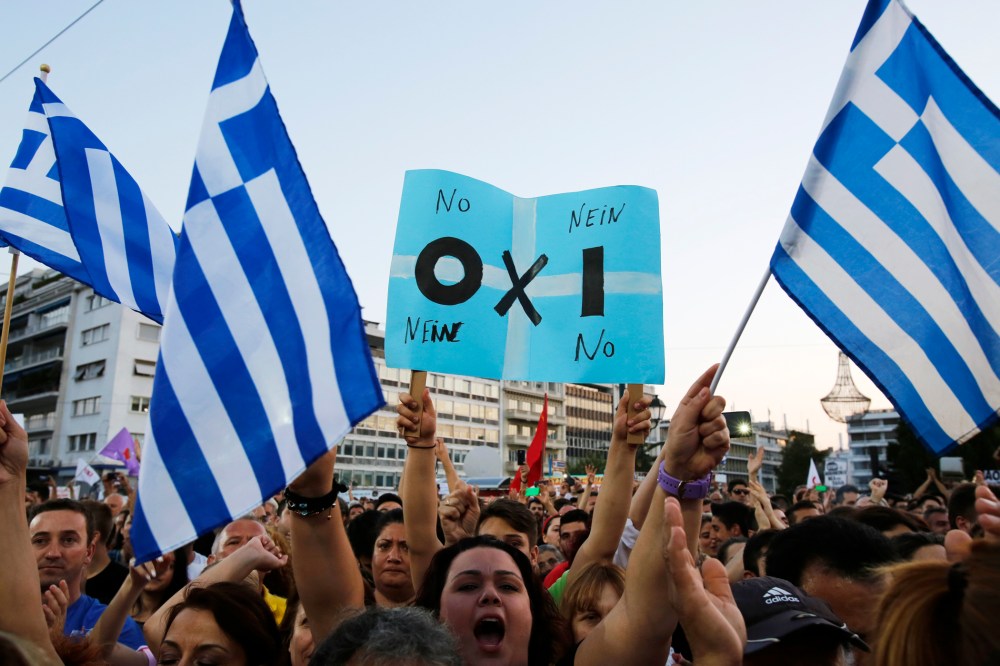
Having squarely rejected the terms of new financial aid for their cash-strapped country,Greece wakes up to an uncertain future on Monday.
But on Sunday night, thousands rejoiced at the outcome of a referendum that they said slapped down the architects of a five-year austerity drive that has ravaged the economy of this southern European nation.
In a result that was more definitive than polls had predicted, 61 percent of voters rejected creditors’ demands for Greek tax hikes and pension cuts.
At Syntagma square in central Athens, several thousand people waved “No” banners and chanted, “they will never win,” as the results of the referendum trickled in. Families wrapped themselves in the Greek flag and danced to traditional tunes, while others set off fireworks above the square’s blue-tinted fountain.
WATCH: Greeks head to polls in historic vote
“The ‘No’ message is that we’re not scared after all the pressure that have we have faced from both Europe and inside our country,” said Stathis Efthimiadis, a 47-year-old schoolteacher.
Like other “No” voters, Efthimiadis said he did not believe warnings by European and some Greek officials over the past week that a “No” vote would set off a cascade of events that would usher Greece out of the euro.
Instead, he and others said they looked forward to Prime Minister Alexis Tsipras returning to the negotiating table and extracting less grueling conditions for Greece in exchange for a new bailout package.
“Next week, the Greek government has the opportunity with this ‘No’, to expect from the Bruxelles’ technocrats a negotiation based on the values of democracy and equal rights in European Union,” echoed Konstantinos Petras, a 65-year-old retired mechanic.
Tsipras, who sprang the referendum on his country on June 26th after talks with creditors broke down, urged Greeks all week to vote no. In an address on Sunday night, he said that by heeding his advice, Greeks had now given him a strong mandate to reach a “viable solution” with European partners.
But European officials have said it would be difficult to sit down with Tsipras after a ‘No’ vote that they would interpret as a hostile act.
In the interim, Greeks are suffering through capital controls – restrictions on their financial lives imposed by the government to prevent a breakdown of the banking system.
Banks are expected to stay closed at least until Tuesday. Greeks also cannot take out more than 60 euros ($66) from cash machines and will not be able to withdraw cash from safety deposit boxes. Pensioners, meanwhile, face the uncertainty of whether they can cash in their retirement benefits. Michalis Tsatsakis, a 35-year-old bank employee who was celebrating in Syntagma, said he has faced difficult moments over the past week, telling many clients that they cannot access the money in their deposits. Tsatsakis also said that if banks stayed closed for days to come, he expected cash machines to run out of money soon. Still, he said Greeks would be resilient in the face of the financial squeeze. “I believe there will be some problems in the banking sector, but we should be able to handle them,” he said. ‘I want Mr. Tsipras to insist. He should be firm. We trust him.” Petras, the pensioner, whose retirement benefits have been cut over the past few years, said that he thought the banks would be operating again soon. “We can use a card anyway and buy whatever we want, we don’t need cash. And I don’t think that banks will block cards,” he said. “I hope not.” Sunday’s vote would have been a difficult choice for any country. In Greece, people headed into the vote tired and angry after five years of cuts to wages, pensions and public services – a toxic combination of austerity that has reduced household incomes by a third and left one out of four out of a job. Yet on Sunday evening, many said that the country had united around the referendum, in which 62 percent of the voting population had cast a ballot. “‘No’ means we can all agree, and this verdict unites us around something,” said Odysseas Konstantinou, a 25-year-old actor. “Big changes need big sacrifices. Now we need to keep calm.”
Reuters Recommended


