








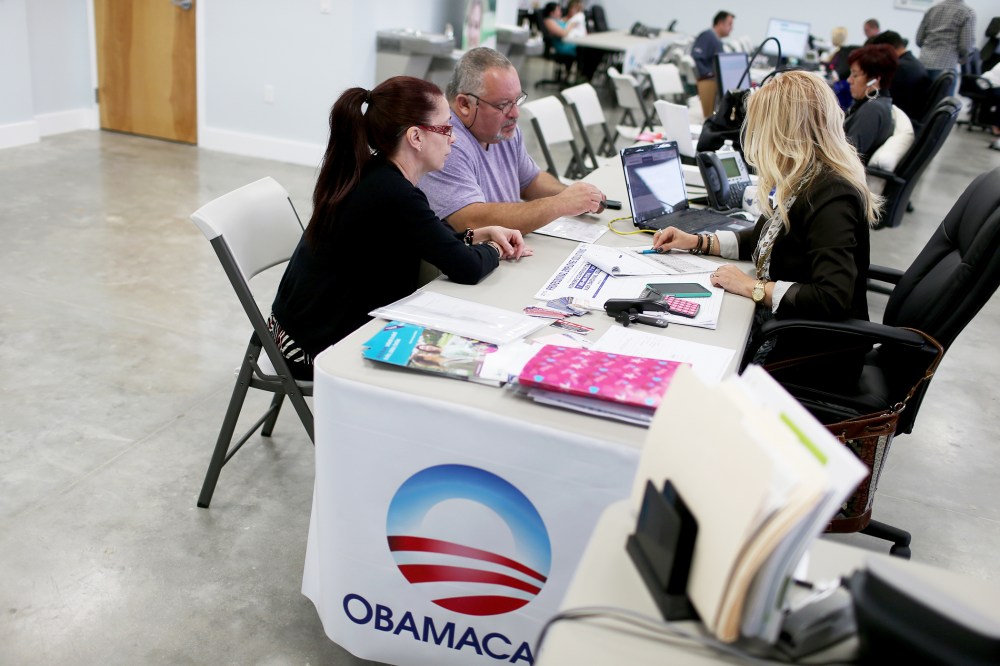
Approaching Sunday’s open enrollment deadline, the good news for Obamacare may be how little bad news there is this year compared to 2014’s disastrous launch of healthcare.gov.
As of Wednesday, an estimated 10 million Americans have already signed up for or been automatically renewed for coverage on Obamacare’s exchanges, according to the Health and Human Services Department (HHS). That means the Obama administration is on track to exceed its target of having 9.1 million Americans covered through the marketplace, though it’s significantly lower than the Congressional Budget Office’s own estimate of 13 million.
Open enrollment for 2015 coverage began on November 15 and ends this Sunday. Those who signed up for coverage still need to pay their first month’s premiums to be considered fully enrolled. About 7.1 million Americans were fully enrolled last year.
“The enrollment infrastructure is in a much stronger place than it was last year,” says Anne Filipic, president of Enroll America, a non-profit group that helps sign people up for coverage.
“It’s remarkable how little drama there’s been this year, which is probably a good thing,” says Larry Levitt, senior vice-president at the Kaiser Family Foundation, comparing the current enrollment period to the technical glitches during healthcare.gov’s launch last year. “It’s apparent that the program is stable and significant at this point.”
WATCH: Will Republican Congress repeal Obamacare?
More Americans may be responding to the penalties for not having insurance as well. The individual mandate went into effect in 2014, though Americans will only begin feeling the hit when they file their taxes for the year. Those who didn’t have health coverage that met Obamacare’s minimum standards last year will have to pay $95 per person or 1% of their yearly household income—whichever is higher—with a maximum penalty of $2,448. The penalties go up to $325 per person or 2% of yearly household income.
Many of those continuing coverage are likely paying more for their insurance coverage than they did last year. Though overall premium increases were quite modest, with an average 2% increase for the benchmark “silver” plan — the second-to-least expensive plan in that category of benefits — and 4% increase for the benchmark “bronze” plan, according to the Kaiser Family Foundation.
Early data suggests that those enrolling in 2015 coverage are paying significantly more for insurance. As of January 30, the average premium is $105 per month after insurance subsidies, which more than 87% of Americans who signed up are qualified to receive, according to HHS. That’s more than 28% more than the average premium in 2014, which was $82 after subsidies were factored in.
Levitt guesses that the steep increase is largely because people already enrolled kept the same insurance for 2015. Average premiums stayed low in part because 25% of insurers participating, creating greater competition. But taking advantage of lower prices in 2015 would mean researching the alternatives and changing plans, for those already enrolled in insurance. “It looks like many people who renewed coverage didn’t shop around and switch plans,” says Levitt. “It’s likely that people who renewed coverage are paying more than they have to.” Nearly 80% of those who enrolled before January 30 could have been enrolled a plan with monthly premiums below $100 after subsidies, but only 53% actually selected or re-enrolled in those plans, according to the administration. These are just preliminary numbers, however. There’s expected to a last-minute surge of young people and Latinos signing up for coverage right before Sunday’s deadline, as happened last year. Enroll America is planning 275 large-scale enrollment events across the country this weekend to accommodate them, particularly as Latinos were less likely to be sign up compared to other groups in 2014. But while the marketplace appears to be on track this year, an upcoming Supreme Court case could put Obamacare’s entire future in jeopardy. The Court has taken up King vs. Burwell, which challenges the government subsidies for those enrolled through the federally-operated insurance exchanges. An estimated 13.4 million Americans are expected to receive subsidies through the exchanges in 2016, most of whom would not be able to afford insurance without that financial support.
Suzy Khimm Recommended


