








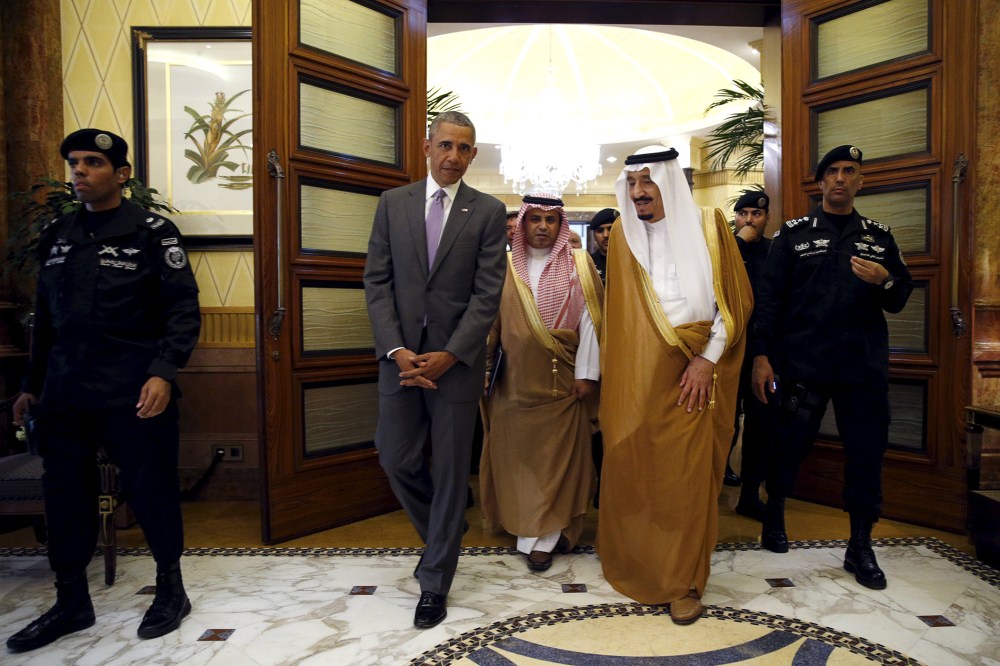
President Barack Obama landed in Saudi Arabia on Wednesday to meet with King Salman — but his reception could well be a chilly one.
The American president’s visit comes during one of the most public rifts between the two countries in their 83-year-old alliance.
Amid ongoing strategic disagreements with Riyadh over the Obama administration’s policies in the Middle East — namely the U.S.’s rapprochement with Iran and its refusal to become more involved in Syria’s civil war — senior American officials have recently directed harsh public rhetoric at Saudi Arabia.
Obama himself has long referred to the Saudis as a “so-called ally,” according to a recent high-profile article in The Atlantic magazine.
For decades considered one of the cornerstones of American energy policy and military strategy in the Middle East, Saudi Arabia spends billions of dollars on U.S.-made arms and armaments.
Its role as one of the few stable governments in a volatile region made it an essential U.S. ally in the view of many analysts in the foreign policy establishment.
But progressive and conservative politicians in the U.S. are increasingly highlighting the connections between Saudi Arabia — the birthplace of Wahhabism, an austere form of Islam that the kingdom exports to other Muslim countries — and Islamist extremism.
“For all of the positive aspects of our alliance with Saudi Arabia, there is another side to Saudi Arabia than the one that faces us in our bilateral relationship, and it is a side that we can no longer afford to ignore as our fight against Islamic extremism becomes more focused and more complicated,” Chris Murphy, a Democratic senator from Connecticut said in a speech to the Council on Foreign Relations in January.
Fueled by the conviction that members of the Saudi establishment support extremism — a charge Riyadh denies — Congress is considering a bill that would allow relatives of victims of 9/11 terror attacks to sue the Kingdom directly over its perceived complicity. Not only was al Qaeda founder Osama bin Laden a member of a powerful Saudi family, 15 of the 19 hijackers were from the Kingdom.
Congress’ moves have infuriated the Saudi Arabian government, which has threatened to sell $750 billion in U.S. assets should the bill pass.
It has also alarmed Saudi allies in the Gulf.
“If this measure goes into effect it could well be the straw that breaks the camel’s back,” said Khalaf Al Habtoor, a billionaire construction baron based in the United Arab Emirates who made headlines worldwide when he publicly withdrew his support for Donald Trump.
“On Wednesday, Obama is scheduled to arrive in Riyadh on a charm offensive; he will need every ounce he can muster, especially when he is responsible for rearranging the regional geopolitical deckchairs with a deal with Iran,” he said in a statement emailed to NBC News before the president arrived in Saudi Arabia.
Although the White House has said the 9/11 bill is unlikely to become law, it betrays the high levels of anger toward Saudi Arabia in the U.S.
“Friends do not fund jihadists that are seeking to murder us. And when it comes to Saudi Arabia, we need to have real scrutiny and real pressure,” GOP presidential hopeful Ted Cruz said during a debate in February.
Simon Henderson of the Washington Institute for Near East Policy think tank said this kind of rhetoric from a presidential candidate should be taken with a grain of salt. He added that it is different for a sitting president to say negative things about the relationship.
“I don’t think Obama cares about Saudi Arabia,” Henderson said. “I think the administration as a whole understands the relationship with Saudi Arabia needs to be carefully handled and calibrated.”
He added that in Obama’s worldview allies like Saudi Arabia are more trouble than they’re worth in the long run. Publicly stating such views has damaged Saudi perceptions of America’s commitment to regional stability.
“I think the Saudis do care, because they think of their challenges on a day-to-day basis,” Henderson said. “They fear he will damage the relationship more, or that Iran will take advantage of the waning days of the Obama administration to do something destabilizing.” According to Manal Faisal, a Saudi student of international relations at King’s College London, the harm to the relationship between the two countries may be irreparable. “I think that he is coming to salvage a relationship that he has spent most of his time as president neglecting,” the 21-year-old said in Riyadh, adding that the U.S. needed to take Saudi Arabia “more seriously as a global partner.” The feeling that Saudi Arabia faces existential threats is at the heart of the unease many in Kingdom feel, according to Anthony Cordesman of the Center for Strategic and International Studies. “The last time I checked Yemen was a lot closer to Saudi Arabia than the United States,” he said, referring to Saudi Arabia’s southern neighbor where a Riyadh-led campaign to drive out Iran-allied Houthi rebels and Islamist insurgents has killed thousands. Meanwhile, the devastating civil war in Syria, the rise of ISIS, the collapse of established regimes across the region during the Arab Spring, and this year’s dramatic fall in oil prices have worsened a sense of vulnerability among Riyadh’s ruling class. Many in Saudi Arabia’s establishment feel the U.S. turned its back on longtime Egyptian ally President Hosni Mubarak during the 2011 popular uprising, and allowed his regime to fall. Since then, the fear has been that Washington would do something similar if Saudi Arabia’s government faced a similar threat. “You’d have to go back to [Egyptian General Gamal Abdel] Nasser and 1967 to find a period of equivalent instability,” Cordesman said, referring to the pan-Arab military leader who overthrew the Egyptian royal family, challenged Western dominance of the Suez Canal and fought a disastrous war with Israel. He added: “At the end of the day, all of the countries in the region would like the U.S. to act in a way that helps them secure their future.” This article originally appeared on NBCNews.com.
Mac William Bishop Recommended


