








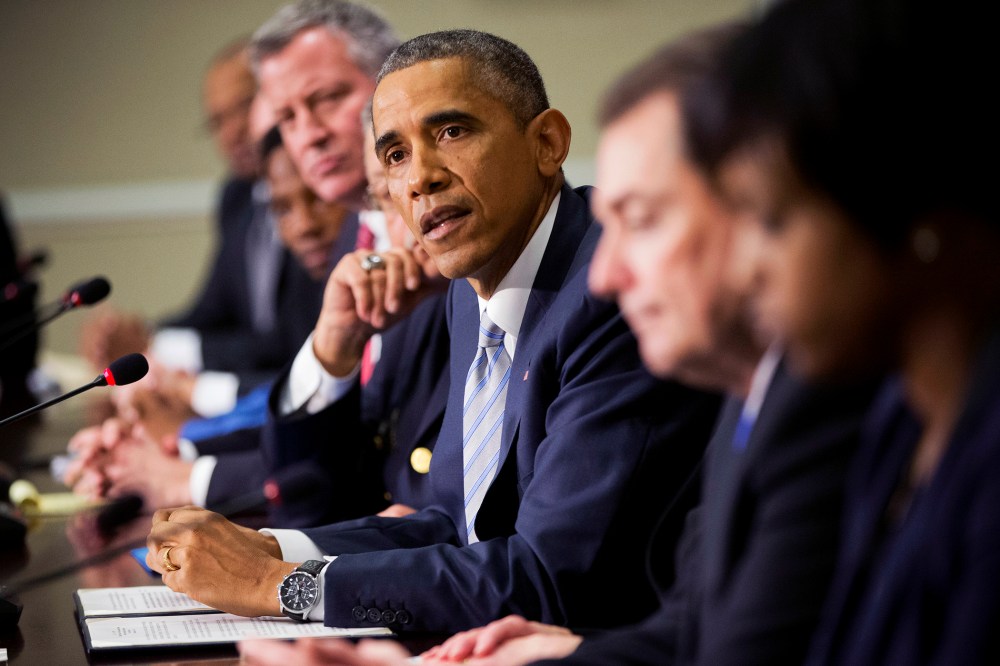
President Barack Obama said the deep social disparities highlighted by the events in Ferguson, Missouri, are so stark that he’ll spend the remainder of his presidency trying mend the country’s most basic, broken promises of equality.
“There have been task forces before, commissions before, and nothing happens. This time will be different. The president of the United States is deeply invested in making sure this time is different,” Obama said at the White House on Monday during a meeting with youth, community and civil rights leaders. “In the two years I have remaining, I’m gonna make sure we follow through, not to solve every problem, tear down every barrier, but to make things better, that’s how progress is always done.”
Obama’s bold declaration comes just a week after a grand jury in Missouri announced that it would not indict Ferguson police officer Darren Wilson, who in August shot and killed unarmed black teenager Michael Brown Jr. in the small St. Louis suburb.
The president made the remarks during a meeting he convened to discuss the tough lessons learned from the ongoing unrest in Ferguson.
He met with inspired, if sometimes outright angry, young people from groups based in Ferguson and across the country. He spoke with mayors and law enforcement officials about the withering relationship between police and the communities they served and made assurances to help bridge the gap that has only widened since Brown’s killing.
The young organizers respectfully pushed a list of demands during their meeting that included the appointment of special prosecutors when police use deadly force, the establishment of community review boards to monitor police misconduct, the defunding of law enforcement agencies that use excessive force or racially profile, as well as the broad demilitarization of local police departments.
PHOTOS: How the crisis in Ferguson unfolded, in photographs
“The president requested this meeting because this is a movement that cannot be ignored,” said Ashley Yates, co-founder of Millennial Activists United, a St. Louis based organization. “We have two sets of laws in America – one for young black and brown people, and one for the police. We are sick and tired of our lives not mattering, and our organized movement will not relent until we see justice.”
%22We%20are%20sick%20and%20tired%20of%20our%20lives%20not%20mattering%2C%20and%20our%20organized%20movement%20will%20not%20relent%20until%20we%20see%20justice.%22′
Among the young people who met with the president at the White House were two members of the newly formed Ferguson Commission, in addition to a local rap artist, a handful of rising stars in the Ferguson protest movement, and nationally known grassroots organizers.
James Hayes, political director for the Ohio Students Association, said that he appreciates that the president wanted to meet with them, “but now he must deliver with meaningful policy.”
“We are calling on everyone who believes that black lives matter to continue taking to the streets until we get real change for our communities,” said Hayes. His group has been active in calling for justice in the shooting death of John Crawford, who was gunned down just days before Brown by police in an Ohio Walmart while carrying a toy gun he picked up off a store shelf.
A Vein Sliced Wide Open
A string of killings by police of unarmed black men all across America this summer and the months before have sparked a kind of national parade of protests and pain stretching from east to west.
In Staten Island, New York, Eric Garner was killed in a police chokehold in July after being confronted for selling individual, untaxed cigarettes; Crawford was shot down in Beavercreek, Ohio, in August; and Ezell Ford was felled by police bullets in Los Angeles — the same month after police stopped him on a sidewalk, at which point they say he made “suspicious movements” before attempting to take an officer’s gun.
Ford was killed four days before Crawford and two days after Michael Brown.
%22When%20I%20hear%20about%20young%20people%20around%20this%20table%20talking%20about%20their%20experiences%2C%20it%20violates%20my%20belief%20in%20what%20this%20country%20can%20be.%20That%E2%80%99s%20not%20who%20we%20are.%22′
To say the pulse of America’s black communities is throbbing over what many believe is an assault on black life — and outright contempt of the pain and angst that has followed — would be an understatement. The vein seems to be ruptured. Obama said on Monday that the disparities in experiences that Americans face is a stain that surely few Americans want to bear.
“When I hear about young people around this table talking about their experiences, it violates my belief in what this country can be. That’s not who we are. I don’t think that’s who the overwhelming majority of Americans want us to be,” Obama said during the meeting.
Following the grand jury’s announcement in Ferguson last week, protesters took to the streets in about 100 American cities. They shut down highways, blocked intersections, took over shopping malls and big box stores — many uniting under the now ubiquitous banner of “black lives matter.”
One White House official told reporters that the growing abyss of distrust between police and citizens threatens to undermine the legitimacy of the entire criminal justice system.
“As the country has witnessed, disintegration of trust between law enforcement agencies and the people they protect and serve can destabilize communities, undermine the legitimacy of the criminal justice system, undermine public safety, create resentment in local communities, and make the job of delivering police services less safe and more difficult,” the officials said.
As part of a day full of events and meetings built around Ferguson and race, Obama and members of his administration also met with a host of mayors, civil rights leaders, law enforcement officials and academics from across the country.
RELATED: Life and death along Canfield Drive in Ferguson
New York City Mayor Bill de Blasio called the meeting a “powerful, important moment to gather leaders in common course.”
“We all feel it from a family perspective. People wonder if their child will come home at night,” de Blasio said. “The president referred to my son, Dante. I think about him every night, making sure he comes home safely. That’s what this meeting was about and there was tremendous resolve.”
In New York — where de Blasio was whisked into office largely on his condemnation of the New York Police Department’s controversial stop-and-frisk tactic, which overwhelmingly targeted blacks and Hispanics for random stops — a grand jury is expected to announce its decision in the Garner case.
No Trip to Ferguson, but Eric Holder Talks Race in Atlanta
Obama and Holder have so far steered clear of traveling to Ferguson in the wake of the grand jury’s decision, which sparked a night of bedlam in the city’s streets and launched protests locally and nationwide.
Darren Wilson, the man at the center of the firestorm, resigned from the Ferguson police department over the weekend citing threats of violence against himself and his fellow officers. The department is still being investigated in a civil rights probe by the Justice Department, and many have called for the president to become more directly involved and visit the community that’s been physically and emotionally ravaged by racial tensions, all while mourning the loss of one of their own.
But the meetings on Monday signal that the president, a former community organizer, is hoping to use the event that captured America’s attention to foster a larger conversation about race in the country. That conversation that may very well be moderated by the president from a distance — at least for now.
RELATED: Obama to Ferguson: ‘Keep protests peaceful’
On Sunday, Gov. Deval Patrick said he didn’t expect to see the president visiting soon because of the investigation.
“I think the reason it’s a quandary is because the federal government is investigating right now,” the Massachusetts Democrat said on “Meet The Press.” “And you don’t want to appear to influence that investigation.”
Patrick was quick to note he didn’t have direct knowledge of the president’s plans but thought that was likely the cause. Holder and Valerie Jarrett — two high-level administration officials and people of color — visited Ferguson in August.
Obama said that he has called on Holder to convene forums across the country and focus on where the issues that have engulfed Ferguson are now simmering on the surface. Just hours after the meeting with the organizers, Holder hopped on a plane to Georgia where he was scheduled to deliver a talk on Ferguson, race, and reconciliation at the famed Ebenezer Baptist Church.
RELATED: Justice Department offers police training in Ferguson
The event included a closed “community forum,” a silent prayer vigil and then Holder’s speech during an interfaith service. The list of expected attendees was studded with key local community and law enforcement stakeholders, including the civil rights leader C.T Vivian, Atlanta Mayor Kasim Reed and a host of other clergy and law enforcement officials.
Holder, the nation’s first black attorney general, has long operated as the president’s proxy and emissary on thorny matters of race. This summer, he traveled to Ferguson and met with residents, students and community leaders and assured them that the Department of Justice would conduct a thorough parallel investigation into Brown’s death while also helping to train local police on community and non-biased policing. He famously told a group of college students in Ferguson that he understands the mistrust many in the black community feel toward the police and that “I am the attorney general of the United States. But I am also a black man.” Congressional Black Caucus to Address “Fergusons” Across the Country Meanwhile, after returning to Washington after the Thanksgiving recess on Monday, members of the Congressional Black Caucus on Monday have planned to use their allotted “special order” speeches to discuss the Michael Brown killing and the ongoing unrest in Ferguson and the national implications. While members of the Congressional Black Caucus applauded Obama’s meeting with activists and civil rights leaders from Ferguson, some questioned why not a single member of the CBC was invited to sit in on the meeting, said a CBC staffer, who asked to remain anonymous so not to distract from the importance of the planned speeches. White House Releases Report on Militarized Police Earlier on Monday, as the president was meeting with the group from Ferguson, the administration released a review commissioned by the White House in the weeks after Brown’s killing on federal funding and programs that provided equipment and weapons to local law enforcement agencies. In the early days of protests in Ferguson, local agencies deployed heavily armed officers and mine-resistant vehicles, some equipped with sniper rifles and with officers peering down their scopes at peaceful protesters. The para-military showing drew anger from many protesters and condemnation from many local, state and federal officials. Critics said the outsize show of force and the heavy-handed response by law enforcement exacerbated an already volatile situation. %22There%20is%20a%20big%20difference%20between%20our%20military%20and%20our%20local%20law%20enforcement%20and%20we%20don%E2%80%99t%20want%20those%20lines%20blurred.%22′ In light of that scene in Ferguson, the broader militarization of local police forces drew bipartisan scrutiny. “There is a big difference between our military and our local law enforcement and we don’t want those lines blurred,” Obama said in August as he called for the review. As Ferguson boiled over in protests, Sen. Claire McCaskill, a Democrat from Missouri, led a Senate hearing into the arming of local police forces via federal programs and dollars. Since the early 1990s, the federal government, via a program with the Defense Department, has provided local law enforcement agencies with more than $5 billion worth of surplus military weapons, body armor and armored vehicles, said McCaskill, chair of the Senate Homeland Security panel. “The Pentagon says the program is intended to help police combat terrorists and drug cartels, but the senators suggested some police departments may be overstepping their authority by using this military equipment for crowd control at riots,” McCaskill said during the hearing in September. During testimony, it was revealed that there is virtually no federal oversight on how the weapons and equipment are used once procured by local agencies. Obama Pledges $75 Million for Body Cameras Monday’s report by the White House, “Federal Support for Local Law Enforcement Equipment Acquisition,” found a lack of consistency in how federal programs are “structured, implemented and audited.” The report also offered suggestions on how the programs could be honed to ensure the safety and security of offices and citizens, including more local community engagement, federal coordination and oversight, training requirements and a community policing model. RELATED: Obama to announce $75 million for body cameras The White House says the report is one of a number of steps President Obama is taking to build trust and transparency between police and the communities they serve. In conjunction with the report is a proposal by Obama for a three-year $263 million investment package that will, among other things, vastly increase the number of body-worn cameras used by local police. A component of the proposal, the Body Worn Camera Partnership Program would provide a 50% match to states and localities who purchase body worn cameras. Overall $75 million over that three-year period could go toward the purchase 50,000 body worn cameras, according to a White House release on the initiative. The White House announced that the president would sign an executive order that aims to streamline federal and local law enforcement communication and create a “Task Force on 21st Century Policing,” which will report on best practices in three months. Mr. President, “We are in crisis” Rasheen Aldridge, Jr., 20, the director of Young Activists United St. Louis, said he attended the meeting to make one point clear to Obama. “We attended this meeting to make it clear to President Obama that we are in crisis, and police officers must be held accountable,” said Aldridge, the youngest member of the Ferguson Commission, which held its first meeting back in Missouri on Monday. “It is a crisis when a Black American can get locked up for traffic fines, but police officers are rarely prosecuted for killing unarmed children,” he said. “Black communities have suffered under racially biased policing and unconstitutional law enforcement policies for far too long. This has to stop.” RELATED: Ferguson Commission meets for the first time, promises change Eldridge was joined in Washington by fellow commission member Brittany Packnett, the executive director of Teach for America in St. Louis. “In previous remarks, the president has used language that criminalizes our movement, lumping in the vast majority of peaceful protesters with violence and bad actors,” said Packnett. “In our meeting, we explained that most violence in our community is coming from the police department, and something needs to be done about it.”
Trymaine Lee
Trymaine Lee is an NBC News correspondent. Recommended


