








Even as President Obama’s administration seeks to stem the growing global outrage over its eavesdropping, a movement to curb government snooping is gaining ground in Congress.
Six members of Congress who voted against the effort to defund the National Security Agency’s communications data collection program late last July will now be among the co-sponsors of surveillance reform legislation meant to rein in the NSA. The proposal would outlaw the NSA’s bulk data collection program, make the secret Foreign Intelligence Surveillance court more transparent, and place new restrictions on the government’s handling of the data it collects.
According to a Republican House aide, Reps. Duncan Hunter of California, Lee Terry of Nebraska, and Darrell Issa of California, who chairs of the House government oversight committee, will be among those co-sponsoring the legislation. On the Democratic side, Rep. Sheila Jackson Lee of Texas, Rep. Hank Johnson of Georgia, and Mike Quigley of Illinois will co-sponsor. All six voted against an amendment in late July sponsored by two Michigan congressmen, Republican Justin Amash and Democrat John Conyers, that would have defunded the NSA’s bulk data collection program. Republicans Todd Rokita of Indiana and Howard Coble of North Carolina, who did not vote on the Amash-Conyers amendment, will also support the surveillance reform legislation.
The Amash-Conyers amendment was defeated by only 12 votes.
Ever since former NSA contractor Edward Snowden began dispatching secret U.S. documents outlining the government’s vast surveillance programs–from tapping the phones of 35 global leaders to scooping up the emails, phone data, and even instant message chat lists of Americans and others–support for government surveillance in the name of national security has waned.
The administration is also facing growing criticism abroad Snowden’s leaks showed that the NSA gathered intelligence on U.S. allies, including Chancellor Angela Merkel of Germany. President Obama has apologized to several world leaders in recent months as information leaked by Snowden continues to make the rounds in domestic and international press.
The new legislation will be introduced by Wisconsin Republican Rep. Jim Sensenbrenner and Conyers in the House and Vermont Democratic Senator Patrick Leahy in the Senate. Sensenbrenner was one of the key legislators behind the original Patriot Act, but has changed positions since the scope of NSA surveillance programs was made public through leaks facilitated by Snowden.
“It’s really important that people get behind Sensenbrenner-Leahy, which is a true reform bill,” said Michelle Richardson of the ACLU. “Most of Congress did not realize what programs were being run, how broad they were and how many Americans were being swept into these authorities.” Though classified reports were made available to members of Congress, Richardson calls the reports “worthless” because “they lack substantive information and because members don’t read them.”
The Sensenbrenner-Leahy legislation would outlaw the use of Section 215 of the Patriot Act to collect Americans’ communications data in bulk, create a special advocate to argue against government spying requests before the secret Foreign Intelligence Surveillance Court (FISC), and make significant decisions reached by the secret court public.
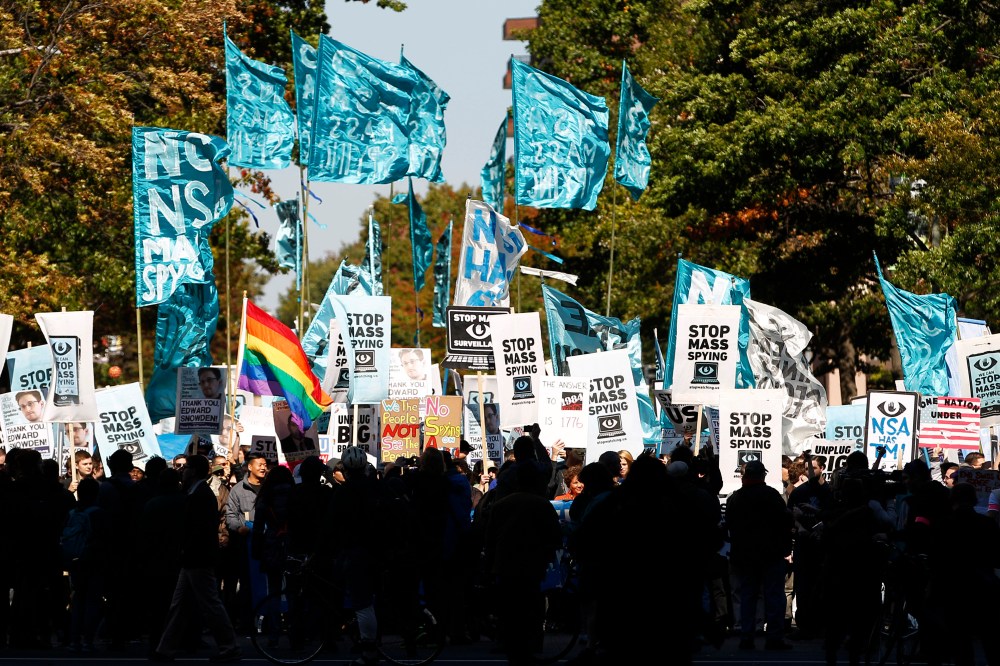
The proposal would also compel the government to release public reports about disclosing how often certain spying powers are used, and would change the law to ensure that bulk collection would not continue under a separate section of the Patriot Act. It also places new requirements on the NSA to dispose of information on American citizens inadvertently collected under Section 702 of the Patriot Act, which includes the Prism program. Supporters of the USA Freedom Act believe that they have the votes to pass their legislation this time around. The Amash-Conyers amendment was a last minute response to the Snowden revelations. They believe members of Congress are more likely to support actual legislation than an amendment to a budget bill, because some legislators oppose making major changes through budget amendments on principle. Section 215 expires in 2015, so Freedom Act supporters are betting that the Obama administration would prefer putting some limits on 215 now rather than risk losing it entirely later on. Democratic Sen. Dianne Feinstein of California is also expected to introduce NSA-related legislation this week, but her proposal would explicitly authorize the powers the Sensenbrenner-Leahy bill aims to circumscribe. Although the text of Feinstein’s legislation hasn’t been released yet, she described her approach in an op-ed for USA Today last week, in which she states the bulk data collection program should continue with more “transparency and privacy protections.” Michigan Republican Mike Rogers, the chair of the House Intelligence Committee, is expected to introduce legislation similar to Feinstein’s. The Senate Intelligence Committee will hold a closed markup on Feinstein’s secret NSA and transparency legislation on Tuesday. “It would be the first time you would have Congress on record as intentionally permitting mass surveillance of innocent Americans on US soil ever,” Richardson said of the Feinstein bill. Prior to the Snowden leaks, a small handful of senators, such as Oregon Democratic Senator Ron Wyden, had attempted to compel more disclosure by the NSA or reform government surveillance powers. Those efforts were stymied by a majority of their Senate colleagues, who consistently voted them down. Supporters of the Sensenbrenner-Leahy legislation believe that the recent leaks have shifted public opinion far enough to make the outcome different this time. Amash addressed a crowd of about 2,000 at the Capitol on Saturday protesting the NSA, telling them that they were the reason the politics of surveillance in Congress had changed. “Keep fighting the fight,” Amash said. “We’re gonna make a difference.”
Adam Serwer Recommended


