








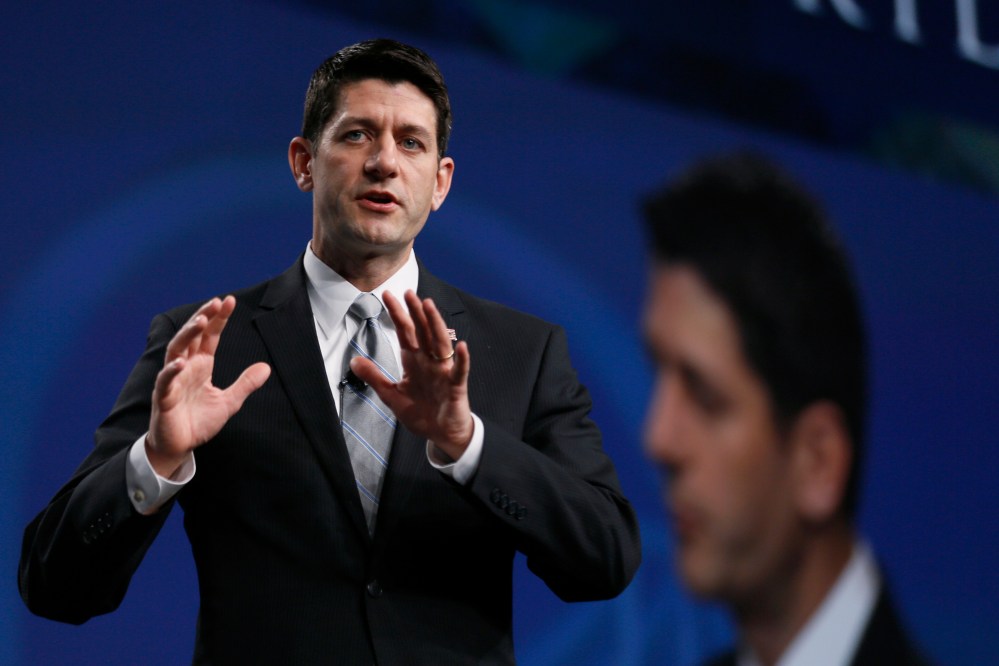
Rep. Paul Ryan believes that charitable organizations should be a guiding light for the federal government — the anti-thesis of a Washington bureaucracy that he says is bloated and ineffective.
“It is their intimate knowledge of the people they serve — as well as their ability to take the long view — that makes these groups so successful. They are more effective than distant federal bureaucracies for a simple reason: They don’t just relieve the pain of poverty; they give people the means to get out of poverty,” the Wisconsin Republican said in his new plan, which highlights the work of nonprofits like Catholic Charities USA.
But the kind of intensive case management that he’s proposed for every recipient of major federal benefits — ranging from food stamps and heating aid to housing vouchers and child-care assistance — isn’t cheap. Ryan hasn’t accounted for the costs and suggested Wednesday that charitable organizations, state, and local governments should help foot the bill.
“The wrong way to look at this is, take just the federal money and then assume some cost for casework management,” Ryan said. “The point is to do this in conjunction with the private sector, the public sector, and the charitable sector. Leverage other dollars that are already out there, that are working at odds with the federal government.”
He added: “You can combine dollars from the charitable sector, from other local governments, with federal funding streams to achieve the goals we’re trying to achieve here. “
In other words, in addition to streamlining 11 separate federal programs into a single grant to states, Ryan’s plan would also streamline revenue sources by combining federal, state, local, and nonprofit dollars to fund the new system.
The problem is that the dollars outside of Washington are already being stretched thin, in both the public and nonprofit sector. In addition, the federal government has a long history of underestimating the cost of services rendered by nonprofits — and overestimating the amount that state and local governments will contribute to federal initiatives.
While charitable organizations across the country are already strapped for resources as demand for social services has increased, the government has increasingly relied on the nonprofit sector to fill in the gap.
“Governments are offloading their responsibilities, expecting nonprofits to fill the void,” said Tim Delaney, president and CEO of the National Council of Nonprofits, the country’s largest network of nonprofit groups. And it’s a mistake to think that any charity can just rely on volunteerism and good will to support its activities.
“Churches and faith-based groups — it’s not through magic they perform miracles either. They have to have the wherewithal to get things done. The notion that any organization or any individual can do it on a sustainable basis without required basic resources, it just doesn’t fly in the face of reality,” said Delaney.
In fact, nonprofits rely heavily on government grants and contracts to keep afloat in the first place. About 33% of all U.S. nonprofit revenue comes from the government, according to 2011 data from the Urban Institute. By comparison, private charitable giving made up only 13% of all revenue. (Most of the remainder comes from fees for private goods and services like tuition, ticket sales, hospital fees, etc.)
Even Catholic Charities USA, which Ryan celebrates as an alternative to the federal bureaucracy, relies heavily on federal dollars: More than half of Catholic Charities USA’s annual funding comes from the federal government, Manhattan Institute senior fellow James Piereson writes in The Wall Street Journal,. That totaled $554 million in 2010. (Catholic Charities USA did not respond a request for comment.) Oftentimes, those dollars don’t cover the full cost of administering social services, furthering exhausting nonprofit resources. More than 50% of nonprofits said that government payments don’t cover the full cost of contracted services, particularly in terms of administrative and overhead costs, according to a 2013 national survey conducted by the Urban Institute. “They still don’t pay the full cost and expect us to deliver miracles,” says Delaney. State and local governments have also been strapped for resources, which could make it challenging for them to pony up additional funds for a large-scale poverty case management plan like Ryan’s. Though their fiscal health has slowly been improving, they suffered from massive revenue losses during the recession, prompting many to make draconian budget cuts. State and local governments cut more than 500,000 jobs during the recession, and it’s during economic downturns that anti-poverty measures are often needed the most. What’s more, Ryan’s plan could prompt state and local governments to use federal dollars to supplant their own spending, rather than redirect or increase it, argues Bob Greenstein, president of the Center on Budget and Policy Priorities (CBPP). “When you combine various federal funding streams into a block grant that states can use for a broad array of services, the practice on the part of many states is to use portion as a substitute for state and local dollars,” Greenstein said. Ryan’s plan would forbid states from using federal funds for other purposes. But there are other tactics that states could use: CBPP points to welfare reform as one instance where states have used funds “to substitute for (or ‘supplant’) existing state spending and thereby help plug holes in state budgets or free up funds for purposes unrelated to low-income families or children.” Ryan stressed that his plan doesn’t force states to adopt a case management system. But the concept is central to Ryan’s proposal — and falls in line with other conservative exhortations to let charitable groups and the states to take up the slack, taking the emphasis off the role of the federal government. And the money for services — no matter whether they’re coming from the public or nonprofit sector—still has to come from somewhere.
Suzy Khimm Recommended


