








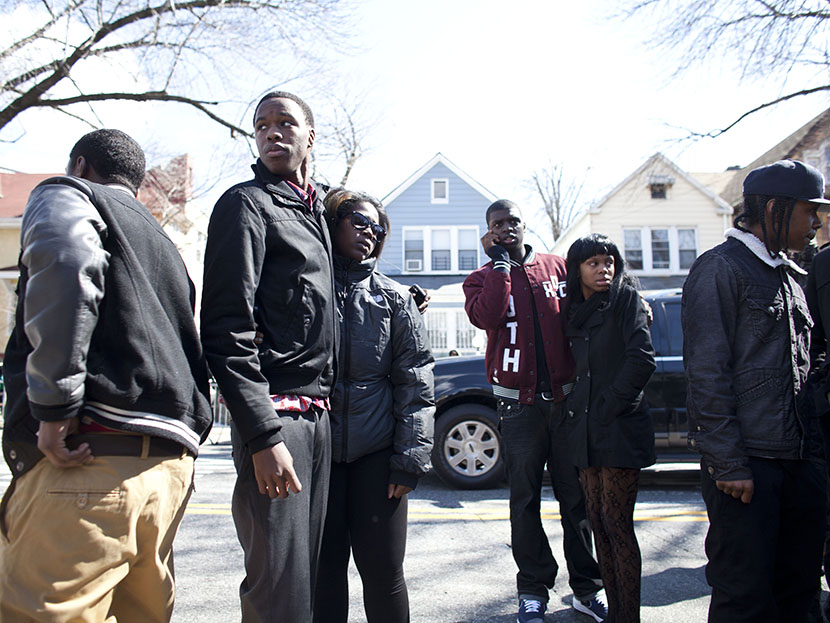
BROOKLYN, NY— Tameka Darden, a doting mother of an 8-year-old boy says she’s been stopped and frisked by the New York Police Department at least three times. Each time, she said, left her humiliated and angry.Miakata Marshall and Chelsie Charles said almost everyone in their circle of friends has been stopped at least once. But the teenagers couldn’t recall a time when anyone had actually been charged with a crime.The unwarranted stops have come so frequently, said Jermaine Brown, that as soon as an officer approaches him he pulls out his pockets, lifts his shirt and offers them a little dance.“I’ve been stopped at least 50 times by the police in the last 5 years,” Brown, a commercial truck driver estimated. “I didn’t need a judge to tell me what they were doing was wrong. The biggest gang in this city is the NYPD and they don’t have any respect for anyone out here,” he said in a street interview.Like more than 4 million other New Yorkers over the past decade, Brown and the others have been the target of the NYPD’s much maligned “stop-and-frisk” program, in which officers target mostly poor and mostly minority neighborhoods for random stops, questioning and searches. Often it takes little more than a so-called furtive movement or being in a particular place at a particular time. That place can be a public sidewalk, a park bench, outside a subway stop or around one of the city’s public housing complexes.On Monday, a federal judge ruled that the NYPD violated the constitutional rights of those it targeted, overwhelmingly blacks and Latinos. Judge Shira Scheindlin found the department “adopted a policy of indirect racial profiling” and called for a federal monitor to oversee sweeping reforms to the police department’s policy. While she did not order the program halted, Scheindlin blasted city leaders, writing in her decision that “the city’s highest officials have turned a blind eye to the evidence that officers are conducting stops in a racially discriminatory manner.”
Related: NY mayoral candidates vie for advantage on ‘stop-and-frisk’ ruling
There has been perhaps no bigger cheerleader for the program than New York City’s Mayor Michael Bloomberg, who along with police commissioner Ray Kelly, have championed the practice as key to the city’s dwindling murder rate. In a press conference shortly after the judge’s decision, Bloomberg stood by the program.”Our crime strategies and tools—including stop-question-frisk—have made New York City the safest big city in America,” Bloomberg said, adding that the tactic has taken 8,000 guns off the street over the past decade. “The fact that fewer guns are on the street now shows that our efforts have been successful.” He claimed it has saved lives, including the lives of “black and Hispanic young men.”But crime has fallen nationally—not just in New York City—and opponents say the program is little more than racial profiling with few discernible results. Of the 4.4 million people stopped, and the 2.3 million people frisked between 2004 and 2012, a weapon was found in less than 1% of the cases.”As the decision exhaustively documents, the NYPD’s stop and frisk policy clearly violated the 4th and 14th Amendments, subjecting millions of innocent New Yorkers – overwhelmingly black and Latino—to unlawful searches through systemic racial profiling,” Ezekiel Edwards, director of the American Civil Liberties Union’s Criminal Law Reform Project, said in a statement. “We hope that today’s decision, and the robust remedies the court has put in place, will mark the end to this dark chapter in the NYPD’s history.”Nowhere has stop-and-frisk been used more frequently than in the 75th police precinct in East New York, a hard-scrabble enclave in central Brooklyn where last year alone more than 24,000 people were stopped.On Monday, not long after the judge’s ruling, residents recounted the shame, anger and embarrassment of being stopped. Many of them said they’ve been stopped multiple times.Devante Bridgewater, 16, spent Monday afternoon walking his dog through the Linden Houses, one of East New York’s sprawling public housing complexes. He said he was first stopped earlier this summer on his way with friends from a party around 11 p.m.“We were just talking and laughing,” he recalled. “Then they just started asking a bunch of questions like: where do we live, what were we doing, did we have any drugs or anything on us? I was just like, why us. I’ve never been in trouble or anything.”While black and Latino men between the age of 14 and 24 only make up 4.7% of the city’s population, in 2012 they made up about 41% of the stops. In recent years, more minority men in that age bracket have been stopped than actually live in the city.
Related: Judge in ‘stop-and-frisk’ case cites Trayvon Martin’s death Winchester Key, president and CEO of the East New York Urban Youth Corps., a housing and youth education advocacy group, said most of the young people stopped by the police fit the demographic most likely to shoot or be shot in communities like East New York, which often lead the city in murders.“I got mixed feelings about this. We have black-on-black crime, it’s happening and we know it,” Key said from his backroom office at the ENYC offices. “We know we are killing each other and there may be a need for stop-and-frisk. But not to the level that we’ve seen, where the police are going around and jacking up every young black man with hat on or his pants falling off. They can’t just violate their rights. It’s gone too far.”Key said while it’s easy for the mayor and police brass to tout the dwindling homicide numbers that may or may not be a result of stop and frisk, the more lasting impression is on the innocent young people forever marked by the experience of being profiled.“It happens again and again. And they become angry because nobody hears their cry. So that hurt, it stays right there,” Kay said, pointing to his chest.Bloomberg has defended targeting the city’s minorities because proportionately, he said, they commit more crime. But various analyses, including a report by the New York City Public Advocate’s office, found that the likelihood of a stop of an African-American New Yorker with a weapon was half that of white New Yorkers stopped. According to the report, the NYPD found a weapon in one out of every 49 stops of whites in the city in 2012, compared to one in every 71 stops of Latinos and one in every 93 stops of African-Americans.A couple blocks from the 75th Precinct headquarters, Llionto Jonhson, 17, said everyone in the neighborhood knows the routine: You keep your hands by your side, you don’t make any quick movements and no matter what, no slick talk.“We know they’re going after us because we’re black,” said Johnson, sitting on the steps of an apartment building on Dumont Avenue and Cleveland Street, with a couple other teens. “It makes you angry. You want to do something but there’s not much you can do.”Tameka Darden, 36, said she assumed she was well past the age of fitting the description of a suspect or anyone up to no good. On Monday afternoon she stood directly across from the 75th police precinct headquarters waiting for the bus, periodically stepping off the curb to peer down the block. Her 8-year-old sat on the bench behind her listening to music.She said the last time she was stopped by the police was on her way from a barbecue with some friends.“The only thing I had was a black bag from the store with an Arizona Ice Tea in it,” Darden said, her bus pulling up. “If that’s all it takes for them to stop me, a grown woman, I wonder what it’ll take for them to stop my son.”Correction: An earlier version of this article incorrectly stated the name of the East New York youth group. It is the East New York Urban Youth Corps.
Trymaine Lee
Trymaine Lee is an NBC News correspondent. Recommended


