








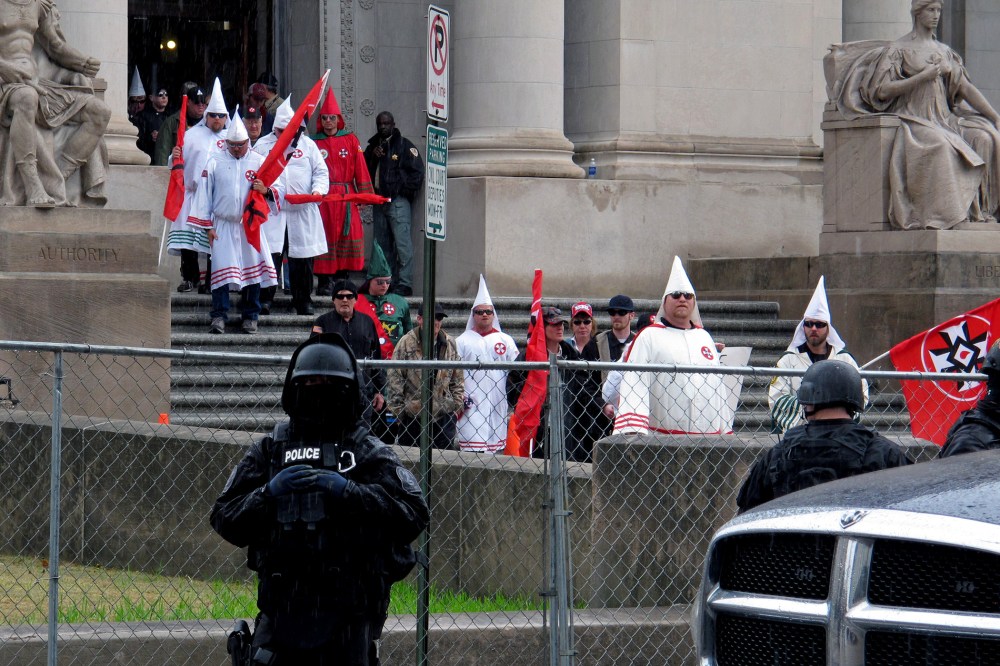
Times are getting tougher for racists, a new report issued by the Southern Poverty Law Center (SPLC) confirms.
According to “The Year in Hate and Extremism,” the number of traditional, organized hate groups in the United States dramatically shrunk in 2014, from 939 to 784 groups nationwide. The SPLC’s report found that, for the second year in a row since President Barack Obama’s election in 2008, conventional hate groups in America — the Ku Klux Klan, Neo-Nazis, White Nationalists, etc. — are less popular than they used to be.

When Republican congressman Steve Scalise admitted last year to speaking to a white supremacist group back in 2002, he was widely criticized by the White House and Democratic members of Congress, and it was suggested by the Democratic National Committee that he step down from leadership. While Scalise remains House Majority Whip, associating with a hate group created a frenzy of negative attention for the number-three ranking Republican.
For Scalise, a single appearance at a controversial event almost cost the congressman his career. Similarly, according to the SPLC report, the “high social cost of being known to affiliate with [hate groups]” has turned extremists away from organized groups in droves.
RELATED: Fraternity: We foster ‘role models,’ not racists
As advancements for same-sex marriage and racial and religious diversity continue to gain ground, racial extremists seem to be more inclined to shy away from the public eye.
Does this mean American bigots are disappearing for good?
Well, no. Instead, former members of extremist groups are turning towards the anonymity of cyberspace — where they can find like-minded people without the public association or social stigma of an organized group. While popular social networks like Facebook and Twitter censor hate speech, other sites are more welcoming to those with radical views. Examples include VK, a Russian social network where alleged Boston bomber Dzhokhar Tsarnaev had an account, and Stormfront, “the largest and most active radical-right Web forum in America,” according to the SPLC. Additionally, Reddit allows for uncensored forums and has accumulated many hateful “subreddits” including one incredibly offensive, anti-black section dubbed “the chimpire.” Some suggest that posting hateful content online likely leads to less violence than real-world organizing, but a 2014 SPLC study found that registered users of Stormfront alone “murdered close to 100 people” between 2010 and 2014. While the long-term trend for organized hate groups remains to be seen, the internet is clearly a powerful medium both for radical extremists themselves, but also for exposing hate and ensuring that justice is served: Just this week, two fraternity brothers from the University of Oklahoma were expelled after video surfaced online of their participation in a racist chant.
Emily Samsel Recommended


