








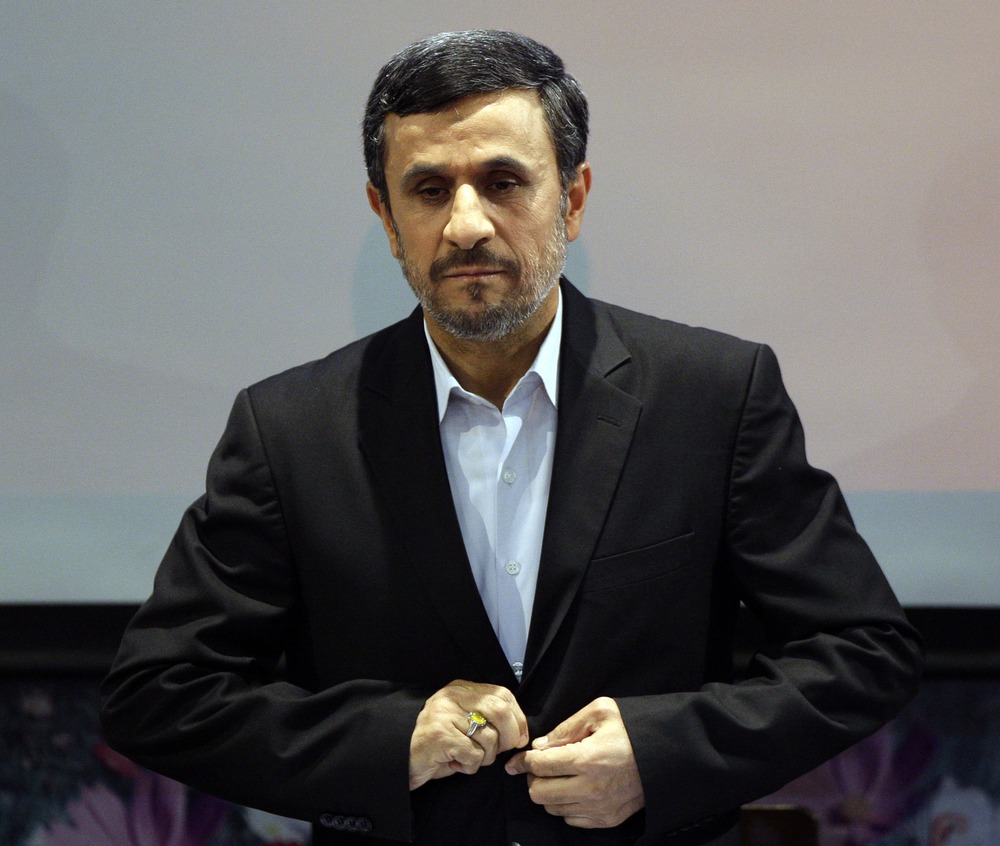
Mitt Romney raised a few eyebrows in Monday night’s presidential debate on foreign policy when he vowed, as president, to have Iranian President Mahmoud Ahmedinejad indicted under the United Nations’ Genocide Convention for “genocide incitation.”
Many of Romney’s advisers on foreign policy—people such as former U.N. ambassador John Bolton and former Iraqi occupation spokesperson Dan Senor—tend to support aggressive unilateral military action, rather than the use of international criminal law and courts.
Bolton, who is on the campaign trail for Romney and did not respond to requests for comment, even referred to the International Criminal Court as “one of the world’s most illegitimate multilateral institutions.”
Given all of that, one might expect that neoconservatives outside of the Romney campaign would reject the candidate’s proposal to invoke international law against Ahmadinejad. However, at least two prominent members of the post-Bush neocon diaspora have no problem with the plan.
“I’m not someone who personally puts a lot of stock in international law … but I certainly don’t have a problem with it,” said Michael Goldfarb, a contributing editor for the Weekly Standard and former deputy communications director to the 2008 McCain campaign. “You want to throw the kitchen sink at these guys.”
American Enterprise Institute fellow Richard Perle—once described as a “neoconservative mastermind” by the Washington Post’s Dana Milbank—described Romney’s proposal as an “interesting idea,” but added: “I don’t think that’s likely to get very far.”
“It sounds like a way of focusing attention on Ahmadinejad’s bluster,” he told msnbc.com. “And, I suppose, to call out Obama for not having been very active when these threats were being made, and having persisted in, I think, a naive policy that he’s going to be able to do some business with Ahmedinejad.”
Goldfarb took a similarly instrumentalist view of international courts, arguing that they could be acceptable means to a specific end.
“I do think that a principal goal of Romney policy toward Iran ought to be delegitmizing the regime,” Goldfarb said. “It strikes me that using international courts and international institutions to advance that goal is a pretty reasonable approach, if only a first step.”
Eric Posner, a scholar in international law at the University of Chicago, described that outlook as “extremely cynical.” “It’s extremely cynical because the U.S., and especially the neocons, have always opposed the International Criminal Court,” he said. “And the Bush administration did work with them a little bit in connection with Sudan, but it would be seen as a pretty cynical ploy by the entire world.” Moreover, Romney won’t have much of a legal case. “As a legal matter, it would be pretty implausible, because [Ahmadinejad] hasn’t committed genocide yet, if he will,” said Posner. “He hasn’t started committing genocide, and I doubt anyone would consider his statements incitement to genocide.” Perle disagreed. “I don’t know how else you can understand” the Iranian president, he said. “He’s been careful about the way he’s phrased things, but there’s no question what impression his language leaves, that Israel has no right to exist and should be eliminated. So yes, that amounts to a threat to commit genocide.”
Ned Resnikoff is an urban policy analyst, researcher, writer, and editor. His byline has appeared in a variety of publications, including the New York Times, San Francisco Chronicle, Dissent, and The Nation. He writes the newsletter Public Comment, which can be found at publiccomment.blog. Recommended


