








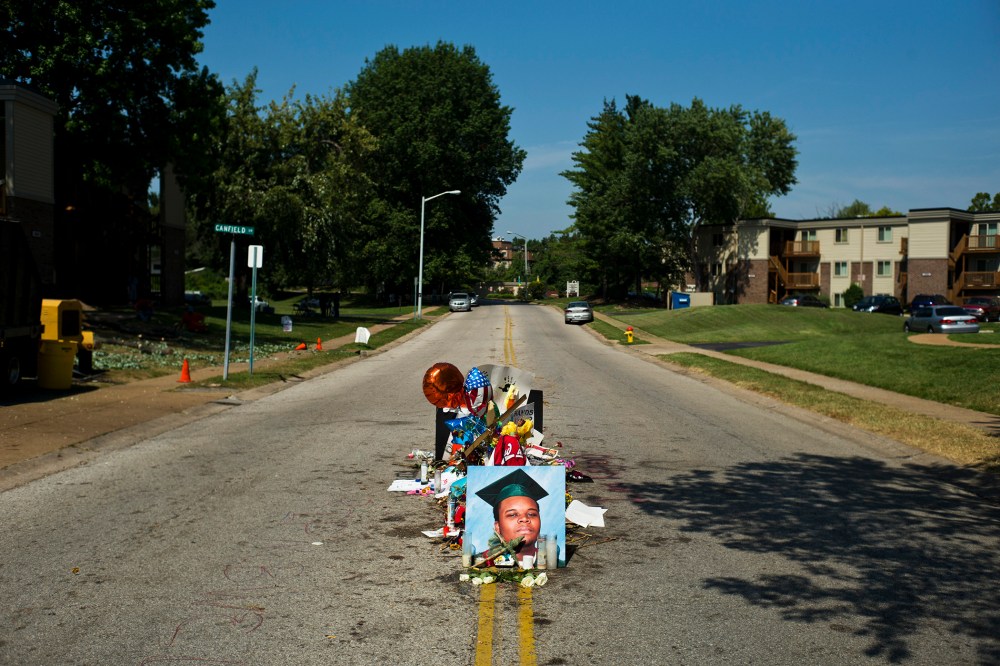
In just four weeks, Missouri has carried out an execution, imposed a 72-hour waiting period on women seeking abortions, expanded gun rights and become the poster child for the militarization of police and racial discord. Its public school system is struggling beneath the weight of an ongoing funding crisis, and an entire local police force is under federal investigation.
Related: Missouri lawmaker suing to deny daughters birth control access
While the killing of unarmed black teen Michael Brown by a small-city cop and the fiery protests and heavy-handed police response that followed has drawn national attention and scorn, the incident is but a glimpse into the current social and political mess in the ‘Show-Me State.’
Lawmakers on Thursday delivered Democratic Gov. Jay Nixon a 16-hour blistering legislative veto session, overriding a record number of his earlier vetoes — 47 in all. In doing so, the Republican-controlled Legislature in a broad stroke expanded gun laws that could allow teachers to carry guns into the classroom and became one of the most repressive states in terms of a woman’s right to abortion.
In 30 days, women seeking an abortion must wait 72 hours to get one. The law is among the most stringent in the nation and puts Missouri among South Dakota and Utah as the only states that make women wait three full days before terminating an unwanted pregnancy.
The literal scorched earth in Ferguson, where Brown’s killing set off more than a month of protests and clashes, and the figurative burning in the State House, seems indicative of just how deep the state’s troubles have risen.
“Missouri is a perfect example of what a purple state looks like,” State Sen. Maria Chappelle-Nadal, a Democrat, told msnbc. “As we review all of the changes in our laws and statutes we’re going to have to have some tough and honest conversations. But it’s Missouri, you never know what you’re going to get.”
Decades ago Democrats ruled both houses of the State Legislature. They were Missouri Democrats for certain — the yellow dog sort who were pro-life and pro-gun but, Democrats nonetheless. They formed an odd family with big-city Democrats from St. Louis and Kansas city, walling off Republican control. But soon the Republicans began to gain support and momentum behind drawing tighter around core conservative values and drawing the contrasts between the national Democratic Party and themselves, putting pressure on old-line Democrats who would be considered Republicans by most litmus tests.
Jeffery Smith, a former state senator and one-time rising star in the Democratic Party who was forced from office in disgrace, wrote about the cleaving of political power in The Atlantic Magazine in 2012. Under the headline, “What’s the Matter With Missouri?,” Smith wrote of the out-sized role a radically conservative agenda was reshaping policy in the state.
“The more retrograde the political debate, the more progressives left or never came in the first place. And the more progressives left or stayed away, the more conservative the electorate became, and the more reactionary the debate,” Smith wrote.
Smith noted the role of interest groups like the NRA and Missouri Right to Life and the Missouri Family Network, all heavy players in bolstering gun rights for Missourians and limiting women’s rights to abortions. These groups influenced the crafting of “castle laws” and the expansion of self-defense laws that allowed citizens to shoot and kill anyone who so much as reached into their vehicles. The groups pushed the state Legislature to require parental consent for abortions and make it harder for abortion clinics to operate.
Missouri Right to Life, Smith wrote, pushed so hard that they even sought to criminalize research on stem cells.
“No hot-button cultural issue escaped attention,” he wrote. “Laws prohibiting gay marriage were now deemed insufficient, so Republicans demanded a redundant constitutional amendment (which garnered 72% of the vote). It wasn’t enough to crack down on undocumented immigrants in the workplace. Republicans demanded a constitutional amendment making English the state’s official language, though there was no evidence anyone had ever conducted state business in any other language (until, of course, the day I filibustered that proposed amendment in French).”
This is the short but direct pathway, in part at least, to how Missouri has become somewhat of a Florida of the Midwest, where a combination of policy, political extremism and other factors have brought national attention for what some could say is for all that’s wrong with state politics.
Chappelle-Nadal and others say that for better and worse, the state has historically fallen down the center in terms of political and social ideology but has recently moved further to the right. The more the Legislature falls from the fence, the more a divisive brand of conservatism whacks at the old Missouri convention of practicality and pragmatism, analysts say.
“The majority ideology in Missouri past and present has been moderately conservative,” said E. Terrence Jones, a professor of political science at the University of Missouri – St. Louis. “Over the past decades it has become slightly more conservative. That’s been reflected in a low-tax, low-service set of policies and it has also been reflected in policies that are socially conservative such as choice and gun rights.”
The current political climate and the broad push around a more conservative agenda has roiled cross-aisle alliances and even sparked some infighting within the Democratic Party, of which Gov. Jay Nixon is a member.
“At the moment it has been reflected in the tension within the Democratic Party. In order to be a successful statewide candidate in Missouri you have to be a moderate conservative,” Jones said. “You couldn’t be an all-out liberal. You have to do well enough in the non-urban areas and let the strong urban majority put you over the top.”
%22The%20governor%20does%20not%20communicate%20well%20with%20the%20Republican%20Party%20nor%20the%20Democrat%20Party.%22′
That dance, or that failure to dance, has generated considerable consternation within Nixon’s urban constituents, many of whom have criticized his handling of issues that impact the state’s minority residents. It has vexed Gov. Nixon and hampered efforts for the party to fight back against aggressive Republican efforts on many important issues including education funding, the expansion of gun rights and abortion law, analysts say.
Thursday’s success by Republicans and the failures of Democrats to put up a fight are Nixon’s “failures alone,” Chappelle-Nadal said. “The governor does not communicate well with the Republican Party nor the Democrat Party. This is like the third time in the history of Missouri that the governor has been overridden so much,” Chappelle-Nadal said. “He kind of sits in his office and is protected by his handlers but he doesn’t communicate with his legislative body.”
For days after Michael Brown’s killing, as thousands took to the streets to protest and parts of Ferguson burned, the governor remained mum on the incident and maintained a relatively normal schedule. Days into the protest, he even found time to attend the state fair.
Related: Portrait of a protester in Ferguson, Missouri
But Brown’s killing has drawn national attention to Ferguson and to the broader plight of African-Americans who are often profiled and targeted by police, sometimes with deadly results. The Department of Justice, which is conducting a parallel investigation into the killing, has announced that it would also be launching a civil rights investigation into the entire Ferguson Police Department. While African-Americans represent about 70% of the city’s residents, the police force and most of the city’s public institutions are run and employed by whites. Of the 53 officers, only three are black.
During Thursday’s legislative session, in her first address to fellow legislators since Brown’s Aug. 9 killing, Chappelle-Nadal blasted Nixon, calling him a “coward” and saying that “You’ve done nothing for black people.”
“Many of my colleagues in the Senate, conservative members, feel that what happened to my constituents in Ferguson was wrong,” the senator, whose district includes parts of Ferguson, told msnbc. “They don’t support any of the militarized, tactical operations used against them or the behavior of the governor or his ineptness in approaching the situation.”
The events in the streets of Ferguson and in the halls of the Capital in recent weeks have aligned Missouri with other states that critics have described as politically and socially repressive. Think Florida, where headlines are often filled with bizarre crimes, political chicanery and in recent years, the killings of unarmed black men. In just nine months in 2012 the shooting deaths of two unarmed black teenagers sparked national outcry over the value and treatment of black youth. In February 2012, Trayvon Martin, 17, was shot and killed by a neighborhood watch volunteer in Sanford, Florida. In November of that same year Jordan Davis, also 17, was shot by a customer at a Jacksonville gas station after an argument over loud music.
At the same time, Florida was in a state of upheaval over strict new voting laws including limits on early voting and restrictions on registering new voters. Both were seen as attempts by Florida republicans to suppress the black and minority vote. In the wake of Brown’s killing, the protests and the violent response from police in which innocent protestors were hit with rubber bullets and tear gas, questions about the treatment of African-American young men has again been raised. And more broadly, the militarized response from local law enforcement has brought to light a number of other troubling questions. %22What%20has%20changed%20is%20a%20much%20clearer%20link%20between%20political%20policy%20and%20political%20ideology.%22′ The federal government has given nearly $1 billion a year to police departments in grants and equipment. Some of that includes military surplus items like armored and bomb-proof vehicles designed to absorb roadside bombs in theaters of war like Iraq and Afghanistan. But they have also shown up as part of the emergency response apparatus of local law enforcement, the likes seen in Ferguson during the height of clashes between the police and protesters last month. The federal government has little oversight on how the weapons or funding is used by local law enforcement. The events in Missouri have led Congress to probe “police militarization.” Missouri Sen. Clair McCaskill, a Democrat, who has condemned the heavy-handed police response in her state, has led the hearings. Back in Missouri, Chappelle-Nadal has emerged as one of Gov. Nixon’s harshest critics. Her voice is among the loudest of a growing chorus of lawmakers who have ramped up their criticisms of Nixon, saying that among other failings, Nixon has failed to rally and grow Democratic ranks in the Legislature in the face of mounting Republican pressure that has marked the state with black eye after political black eye. Chappelle-Nadal said since she was first elected to the Legislature in 2005, the number of Democrats in both the House and Senate have fallen. She said there are about 50 Democrats currently in the House, down from about 74 when she first took office. And in the last couple years, the number of Democrats in the Senate had fallen to 9 from 11. She says Nixon’s unwillingness to effectively lead has bordered on the obscene, setting the stage for this week’s Republican steam-rolling. The expanded gun-rights legislation could allow teachers to could bring their guns to schools and more residents to openly carry their weapons in public places, including cities and towns that bar open carry. And the age that residents can become concealed-carry permit holders was dropped from 21 to 19. Pro-choice and women’s advocates say the abortion bill sets the clock back on women’s rights. As for why it’s happening, Jones said it’s not that the politics of the state have changed much, but that over time the influence of political ideology on actual policy has gotten stronger. But more than this latest string of controversies, there are lingering issues that continue to burden the state. Earlier this year after a string of botched executions in other states, the U.S. Supreme Court temporarily halted executions in Missouri amid appeals that the state disclose information about the cocktail of drugs used in killing prisoners and details about the often unregulated pharmacies from which the drugs are obtained. Across the country, the condemned and their lawyers are filing appeals that have risen to the highest courts, as a scarcity of lethal injection drugs from federally regulated pharmacies has states turning to the shadowy world of compounding pharmacies, which fall under the purview of states rather than the Federal Drug Administration. All death penalty states now use lethal injection. States including Louisiana, Missouri, Oklahoma, and Texas have turned to compounding pharmacies. The relationships between the states and the pharmacies have been shrouded in secrecy, and corrections departments have gone to great lengths to protect the identities of their drug suppliers. In some states, as is the case in Missouri, the pharmacies are legally shielded from public disclosure and are extended the privilege of anonymity afforded members of the official execution team. This week, the state executed its eighth inmate of the year. Amid a rising clamor to halt executions as the death-drugs are further scrutinized, Gov. Jay Nixon refused to stay the execution of the inmate, double-murderer Earl Ringo Jr., despite pleas from Ringo’s attorney that the drugs used in the execution could cause Ringo to suffer. “I would submit, talking in neutral terms, that my first point is not that anything has changed that much over time,” Jones said. “What has changed is a much clearer link between political policy and political ideology.” Chappelle-Nadal, who during protests in Ferguson carried a large cutout of Nixon’s face with the acronym, “M.I.A Again,” scrawled across his forehead, said the Missouri’s mess has lumped her great state in dubious company. “This is a purple state so of course we’re going to have a lot of pro-life and gun rights measures similar to Texas or Alabama,” she said. “When it comes to keeping school children safe from guns and women who want to have a right to choose, the state is very conservative and it’s an uphill battle.”
Trymaine Lee
Trymaine Lee is an NBC News correspondent. Recommended


