








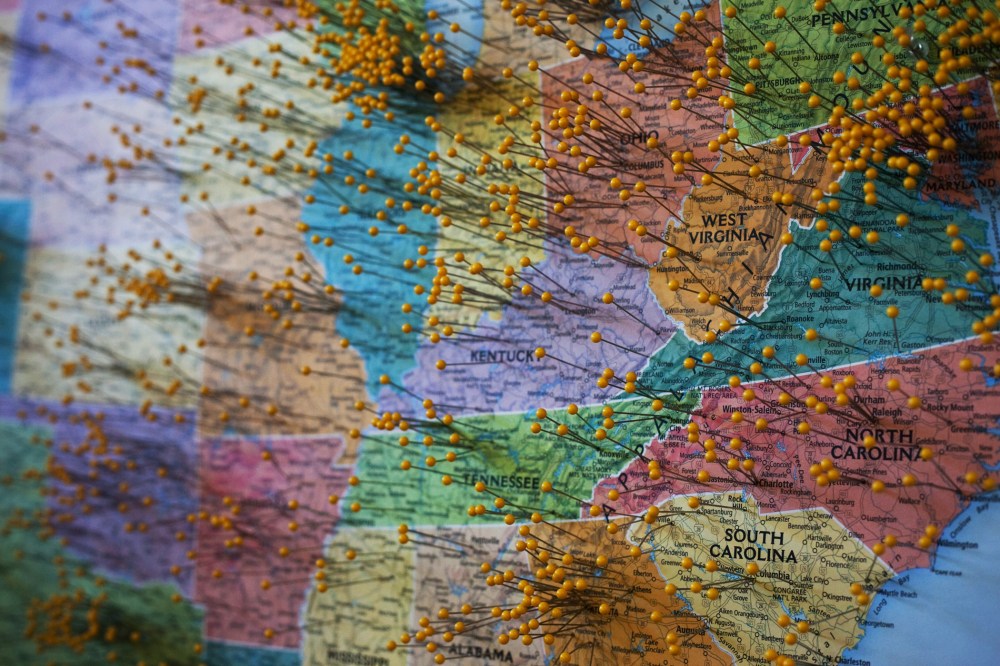
You can learn an awful lot about a country by looking at its migratory patterns. The New York Times this week published some striking interactive charts showing where the people in each of the 50 U.S. states were born and how that changed between 1900 and the present. What they mostly show is that American migrants — both foreign- and native-born — aren’t nearly so numerous as you might think from listening to political debate about immigration reform, or by pondering the legacy of the journalist and political reformer Horace Greeley (“Go west, young man”).
To be sure, the United States contains more people who were born in another country — about 46 million — than any other nation on Earth. But America’s foreign-born still represent only about 15% of the total population. The principal driver of population growth in the U.S. remains native births minus native-born deaths, even though the U.S. birth rate is, by world standards, comparatively low. That will likely change within the next quarter-century, as immigration displaces native births as the main factor driving U.S. population growth. But a major reason is that the birth rate is projected to keep dropping.
The source of greatest political concern is, of course, undocumented immigrants. But their number, which grew steadily from 3.5 million in 1990 to a peak of 12.2 million in 2007, leveled off at about 12 million after that. And while that halt in growth surely had something to do with the Great Recession, no such slowdowns occurred during the prior two recessions.
The U.S. is currently grappling with a crisis in which about 63,000 children have been caught at the border over the past year. But the larger context is that border patrol apprehensions dropped dramatically at the start of this century, from 1.7 million in 2000 to 365,000 in 2012. They dropped not because border enforcement slackened — quite the contrary, it intensified considerably — but because far fewer Mexicans have sought to enter the U.S. without documentation. That drop preceded the Great Recession, and likely was driven mainly by an improving Mexican economy.
The states that today contain the highest proportion of foreign-born residents are New York, New Jersey, and California. In all three, the Times charts show, that proportion is about the same as it was in 1900, during an earlier immigration wave that the country somehow managed to survive. The foreign-born account for 24% of New York’s population (26% in 1900); 23% In New Jersey (23% in 1900); and 28% of California’s population (25% in 1900).
The states in which immigration has created the most controversy tend, ironically, to be ones that have a relatively small proportion of foreign-born residents. Alabama: 4%. Indiana: 5%. South Carolina: 6%. Utah: 9%. Georgia: 11%. Virginia, whose 7th congressional district Republicans recently tossed out House Majority Leader Eric Cantor for being soft on immigration, has 13%. Even Arizona, which lies on the Mexican border, has only 15%. In most of these places, though, the proportion of foreign-born residents was, historically, much lower. As recently as 1970 the foreign-born represented less than 1% in Alabama and South Carolina, only 1% in Georgia, and a mere 3% in Virginia. Indiana, Utah, and Arizona also had a lot fewer foreign-born in 1970 than today, but looking further back to 1900 they had more foreign-born than today—in the cases of Utah and Arizona, considerably more. (Perhaps those are days they’d like to forget; Utah and Arizona had both, within living memory, belonged to Mexico, making their acquisition a sort of mass immigration into the United States.)
Another lesson of The New York Times charts is that, except in California, New York, and (by a whisker) Massachusetts, most migrants come not from other countries but from other U.S. states. That’s true even in Hawaii, which is geographically closer to many foreign countries than to the continental U.S., and in Alaska, which is geographically adjacent to a foreign country (Canada). The principal form of migration is from one part of the U.S. to another. “If any young man is about to commence the world,” Horace Greeley wrote in 1838, “we say to him, publicly and privately, Go to the West.” What Greeley really meant was get out of New York, because the Panic of 1837 had destroyed New York’s economy. Go anyplace you can thrive. Americans followed that advice ever after.
But take another look at those Times charts. The 10 states with the highest median income—i.e., the states that logically ought to provide the most economic opportunity—are (according to the Census Bureau, based on three-year averages) Maryland, New Hampshire, Connecticut, New Jersey, Massachusetts, Virginia, Alaska, the District of Columbia (technically not a state), Colorado, and Washington. None of these places has, since 1980, seen any notable growth in the proportion of its residents born in another state. Indeed, in Alaska, New Jersey, and DC the proportion of such residents has shrunk. Although they occupy all points of the compass, these are the places Greeley meant when he said, “Go west.” Why aren’t people going there?
Because (as I noted late last year in The Washington Monthly) the percentage of American households moving from one state to another in any given year has been falling for the past quarter-century, from 3.5% to less than 2%. That percentage has fallen even more steeply, and over a longer period of time, for unemployed males, from 7.6% in 1956 to 2.7% in 2012. This would make sense if the economic differences among the states were disappearing. But in fact, those disparities are growing. Connecticut, for example saw its per capita income rise from 21% above the national average in 1980 to 39% in 2011.
The more benign explanations for this change don’t seem to add up. Yes, the population is getting older, which is going to reduce mobility, but that turns out to account for only one-tenth the decline, according to a 2011 study by Raven Malloy of the Federal Reserve Board. Telecommuting’s impact is negligible (for most people, telecommuting is merely a way to extend the workday from the time you leave work until the moment your head hits the pillow). The rise in two-earner couples might explain it—two jobs is likelier to cement a family in place—except that the percentage of two-earner couples is about what it was three decades ago. The sub-prime bust no doubt made it difficult for more Americans to sell their houses than was previously the case; but, as the data cited above demonstrate, the decline in interstate migration began well before 2007. A likelier explanation is income inequality, which has narrowed economic opportunity to a relatively small slice of the population, combined with a brisk rise in housing costs in the more economically prosperous areas. Taken together, these trends make it difficult to move toward economic opportunity. A notable exception is North Dakota, where the fracking boom has created opportunity for a broad range of workers, and where housing prices started out about as close to zero as you can get. The Times charts show North Dakota’s native population shrinking from 72% of the total in 2000 to 66% in 2012. But even that is, in the larger scheme of things, a relatively modest shift. Sadly, to the diminished extent that Americans continue to move from one job market to another, it tends these days to be away from economic opportunity rather than toward it. That’s because the overriding factor is cheaper housing. Between 2005 and 2009 the biggest county-to-county migration in the U.S. was from Los Angeles County, where there were jobs, to San Bernardino County, where there were relatively few. (San Bernardino went bankrupt in 2012.) The reason was that housing was cheaper in San Berdoo. Take one final look at the Times charts. Where is the proportion of out-of-staters rising? In the south, the nation’s poorest region. Alabama, Arkansas, Georgia, Kentucky, North Carolina, Tennessee, West Virginia, and Mississippi are all seeing a big increase. These are the increases you would expect to be seeing in prosperous Maryland and Connecticut and D.C. Instead, they’re occurring in states whose median incomes all rank them in the bottom 15, according to the Census. This is a migration driven less by opportunity than by thrift. The result is, in effect, a second closing of the American frontier—not the western frontier, but the frontier of new places that the native-born can move to for a greater promise of prosperity. That frontier hasn’t disappeared entirely, but today it exists mainly for people who had the misfortune to be born in much poorer nations.
Timothy Noah Recommended


