








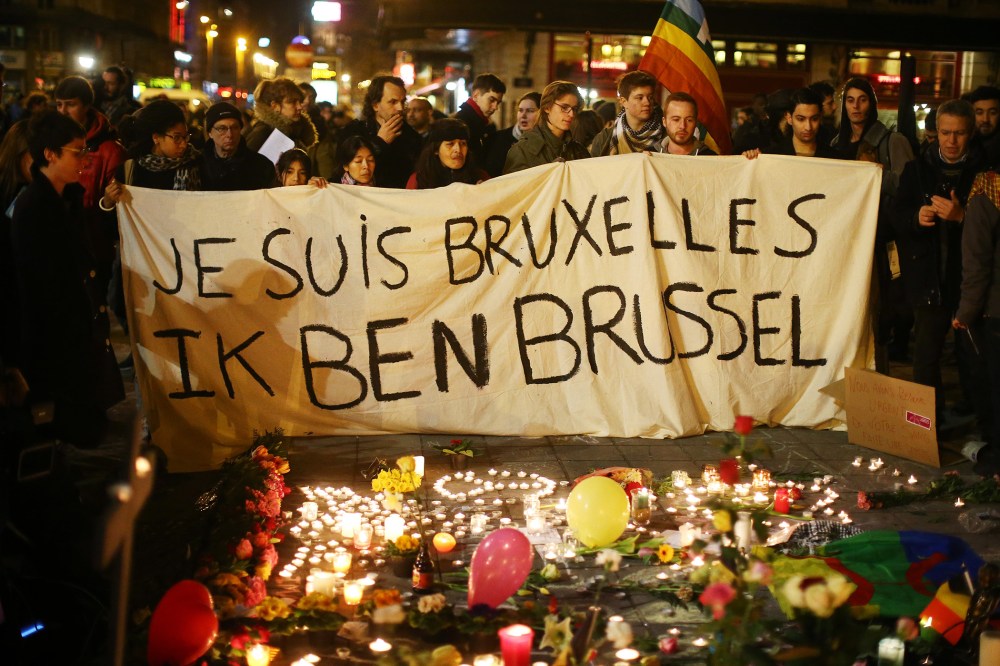
Belgium officials rushed to restore a sense of security on Tuesday in the face of a horrific string of terror attacks that have left at least 31 dead and dozens more injured.
Authorities responded by freezing all public transport flowing into the heart of Brussels and implementing checkpoints at sections of the border.
RELATED: Police hunt Brussels suspect, find bomb and ISIS flag
But working on the backdrop of the emergency response are growing concerns of potential cracks in security from yet another ongoing crisis — a massive migration wave that has made it all but impossible for countries to monitor who comes and goes.
European leaders are caught amid a reckoning over a humanitarian crisis of catastrophic scale. The International Organization for Migration (IOM) estimates that 1.2 million migrants have flooded Europe since the start of 2015, fleeing conditions of extreme violence and unrest.
Countries along the migration routes have already absorbed thousands of refugees and migrants who have escaped Syria and neighboring countries. But with hundreds more migrants overwhelming borders by the day, international leaders have struggled to maintain a compassionate approach to the crisis while keeping security interests in mind.
Policy experts caution that anxieties around the migration crisis should not be conflated with fears associated with Tuesday’s tragedy in Brussels.
“When we look at the evidence, it doesn’t hold,” said Matteo Garavoglia, a fellow at the Brookings Institute who focuses on common foreign and security policy of the European Union. “The idea that terrorists would risk a journey from a dinghy rubber boat and hopefully make their way into Europe to carry out an attack is a silly way to go about it. It simply makes no sense.”
A point of vulnerability arises when dealing with assailants who have European roots. As past tragedies show, terror affiliates may still take advantage of a member’s dual-citizenship status and travel by more traditional routes, for example by air or train. Not only is that method of travel more difficult for authorities to thwart, but it lends itself to the type of precise planning often necessary to carry out coordinated attacks.
Under the Schengen Treaty, which was originally adopted in 1985, 26 European countries currently enjoy what is essentially an open-borders policy that allows unfettered travel between member states. But in light of the massive migration surge, international leaders are caught in an impasse over how governments should maintain their borders and where to draw the line.
RELATED: What we know about the terrorist attacks in Brussels
EU member states have set up barricades and hundreds of miles of fencing to block external borders. Hungary declared a state of emergency in early March and threatened to deploy 1,500 soldiers to reinforce the border. Balkan states, meanwhile, have begun implementing border checks that require EU visas. The Union’s leaders this month reached a deal with Turkey to stem the flow of people crossing the Aegean Sea to Greece. The agreement set up a so-called “one in, one out” system that returns all migrants to Turkey once their asylum claims are registered. The EU in turn agreed that for every refugee resettled in Turkey, another will be allowed into Europe. The UN High Commissioner for Refugees, the agency that vets candidates seeking to resettle in communities around the globe, stresses that the perpetrators of the attacks should be treated as criminals who deserve to face the full force of the law. The refugee crisis is another issue entirely, spokesperson Christopher Boian said. “We are very wary of rhetoric and efforts that would blur the lines and conflate refugees, which is a very specific category of very vulnerable people, with all other types of migrants,” he added. “That is a dangerous connection to make.” The tragedy in Brussels comes just days after authorities arrested the suspected leader of the of the Paris terror attacks, Salah Abdeslam. That massacre, paired with the series of explosions Tuesday, highlight Brussels’ contentious reputation as the “Jihadist Capital of Europe,” where reports suggest ISIS trained fighters are known to live. Demetrios Papademetriou, the Brussels-based president of the non-partisan think tank The Migration Policy Institute, says policy failures start from within borders when communities alienate minorities who are already at risk of being lured by extremism. “This has led to isolation, political and social marginalization, to become the enemy that is reflected in the attacks today,” Papademetriou said. “They reflect sustained, long-term failures on the part of the majority community to incorporate minority communities.”
Amanda Sakuma Recommended


