








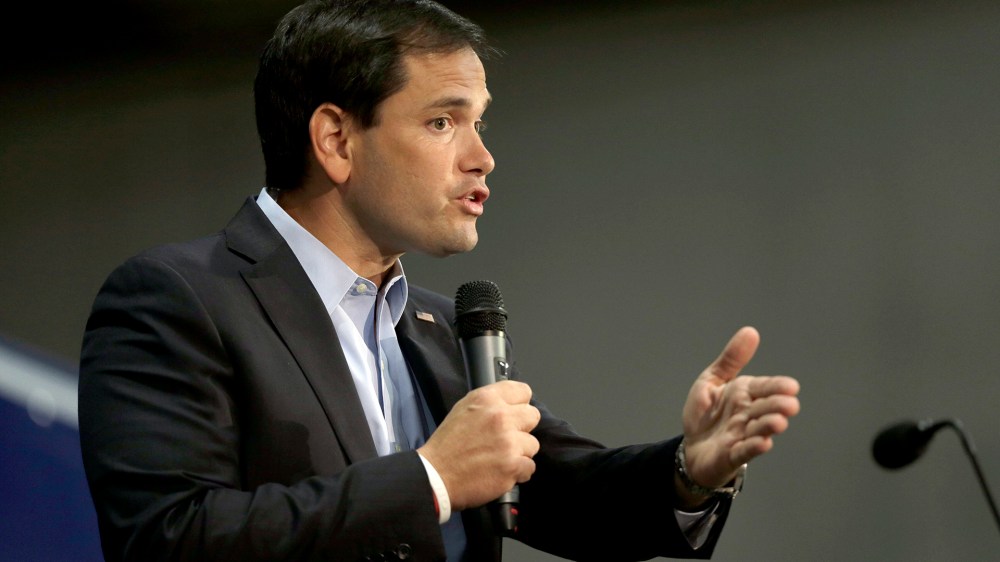
In a preview of the 2016 presidential contest, Florida Sen. Marco Rubio took what appeared to be a thinly veiled shot at fellow Republican Sen. Rand Paul of Kentucky for waffling on military action against the Islamic State of Iraq and Syria.
“What is unfortunate is that too many leaders in both parties, including our president and some who aspire to be president, have shown they would rather wait for poll numbers to change than to demonstrate the leadership necessary to shape them,” Rubio said in a speech hosted by the John Hay Initiative in Washington.
Earlier this month, Paul announced that if he were in President Obama’s position he would “seek congressional authorization to destroy ISIS militarily,” a new position that came only after several months in which he expressed strong skepticism about American involvement in the conflict. That drew an implicit rebuke from Rubio.
“Instead of outlining the cost of inaction to our people months ago when they should have they were content to take the political path of least resistance,” Rubio said in his speech. “They advocated leaving our allies to fend for themselves, they proposed and defended massive reductions to defense spending and they tried to convince Americans the world would be fine without our leadership.”
Rubio has spent the last several years staking out a position with the party’s more hawkish wing, setting up an inevitable confrontation with Paul, the party’s leading non-interventionist, should the two compete for the 2016 GOP nomination.
Paul’s argument appeared to be gaining the upper hand for the last several years as Republican voters, weary of war and skeptical of Obama’s leadership, resisted White House arguments for intervention in Libya in 2011 and in Syria in 2013. But recent polls show Republicans overwhelmingly favor taking military action to defeat ISIS, putting pressure on politicians like Paul to get in line and giving hawks like Rubio an opportunity to press their case.
Rubio faced similar pressure himself from Paul’s wing of the party during the 2013 debate over whether to bomb Syrian regime targets in response to allegations of chemical weapons use. After spending months demanding the White House arm rebels to topple Syrian dictator Bashar al-Assad, Rubio declared that “the time for passive engagement in this conflict must come to an end” in response to reports of chemical attacks in April 2013. But as polls came out showing overwhelming Republican opposition to American military involvement there, Rubio eventually bucked White House calls for punitive air attacks and voted against authorizing strikes. Obama eventually avoided conflict by securing a deal to remove the chemical stockpiles. In his speech on Wednesday, however, Rubio appeared willing to get ahead of public opinion by criticizing President Obama for ruling out the use of American combat troops against ISIS. “While we hope that may never have to happen, it might if we’re serious” about defeating the group, Rubio said.
Benjy Sarlin Recommended


