








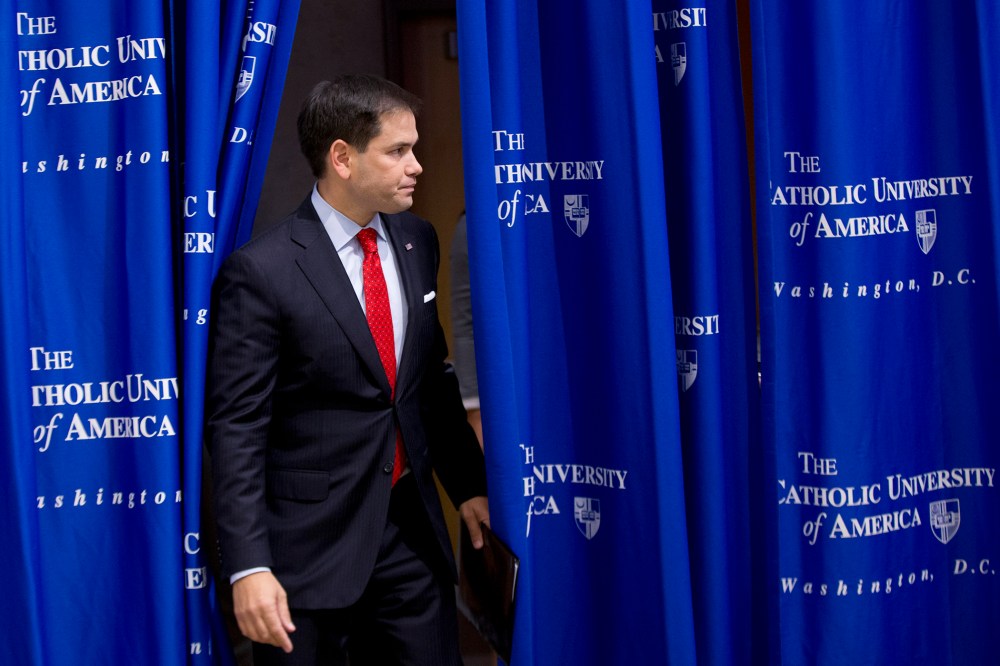
Florida Republican Sen. Marco Rubio acknowledged Wednesday that American history was “marred by discrimination against gays and lesbians.” But in a speech at Catholic University in Washington, Rubio drew the line sharply at marriage equality and accused supporters of same sex unions of “intolerance.”
“I promise you even before this speech is over I’ll be attacked as a hater or a bigot or someone who is anti-gay,” Rubio said. “This intolerance in the name of tolerance is hypocrisy. Support for the definition of marriage as one man and one woman is not anti-gay, it is pro-traditional marriage.”
Noting President Obama didn’t declare his support for gay marriage until 2012, Rubio said, “If support for traditional marriage is bigotry, then Barack Obama was a bigot until just before 2012 election.”
Gay rights issues were not the sole focus of Rubio’s speech, which was billed by his staff as an address on “the breakdown of the American family and the erosion of fundamental values that has followed.” He also discussed policies that he argued would support families by improving access to education, reducing tax penalties on married couples, and bolstering tax credits for single parents with jobs.
But the marriage issue presents unique problem for Rubio as he weighs a potential 2016 presidential campaign.
Rubio said this week that the next Republican nominee should compete against Hillary Clinton if she chooses to run by labeling her “a 20th century candidate.” The problem is that Americans increasingly see opposition to gay marriage as a fundamentally retrograde position. The Republican National Committee’s own report on the party’s 2012 election loss concluded, “for many younger voters, [gay rights] issues are a gateway into whether the Party is a place they want to be.”
A Gallup poll in May pegged support for gay marriage at 55%, a record high, but only 30% among Republicans. Support increased dramatically the younger respondents were: 78% of 18-29 year olds backed gay marriage versus 42% of senior citizens.
In addressing the issue, Rubio tried to thread the needle between courting 21st century voters while defending his 20th century position on gay marriage. He opened his remarks with an extended condemnation of other forms of discrimination against gays.
“There was once a time when our federal government not only banned the hiring of gay employers, it required contractors to identify and fire them,” Rubio said. “Some laws prohibited gays from being served in bars and restaurants and many cities carried out law enforcement efforts targeting gay Americans.” Rubio also acknowledged that many gay couples “feel humiliated by the law’s failure to recognize their relationship as a marriage.” While he said he respected those arguments as well as the rights of states to recognize same sex unions, Rubio argued that “thousands of years of human history have shown that the ideal setting for children to grow up is with a mother and father” and this ideal “deserves to be elevated in our laws.” “Those who support same sex marriage have a right to lobby their state legislatures to change state laws,” he said. “But Americans who support keeping the traditional definition of marriage also have a right to work to keep the traditional definition of marriage in our laws without seeing that overturned by a judge.”
Benjy Sarlin Recommended


