








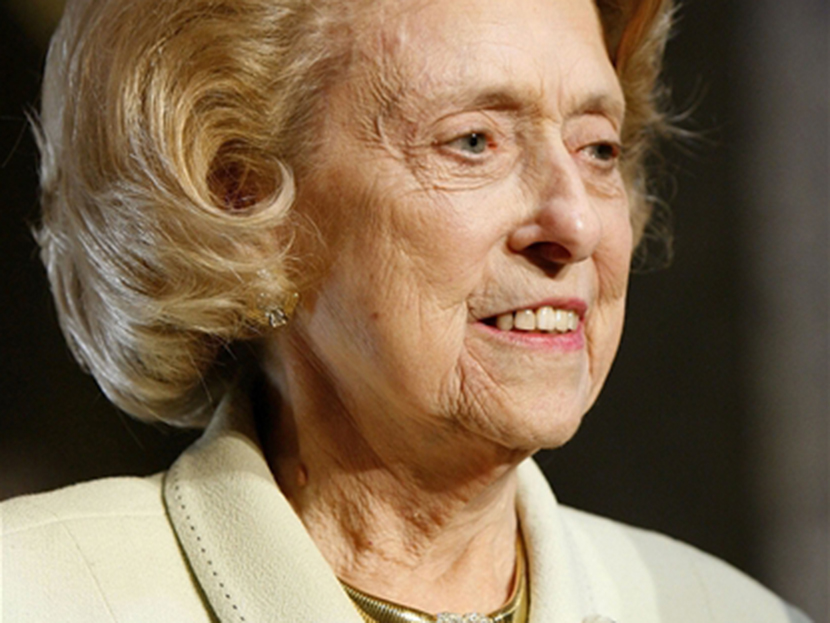
Lindy Boggs, who took over her husband’s congressional seat to become a crusader for women’s equality and civil rights, died Saturday at 97. Her death was confirmed by ABC News, where Boggs’ daughter, Cokie Roberts, is a journalist.
The matriarch of a powerful Washington family, Boggs served in the U.S. House of Representatives as a Louisiana Democrat for 18 years, beginning in 1973, when she become the first woman elected to Congress from her state.
She was a permanent chairwoman of the 1976 Democratic National Convention and also served as U.S. ambassador to the Vatican from 1997 to 2001.
The Boggs children came to prominence in politics, law and the media. In addition to Roberts, an author and journalist at National Public Radio as well as ABC TV, Boggs’ son Thomas Hale Boggs Jr. is an influential Washington lawyer. Another daughter, Barbara Boggs Sigmund, died of cancer in 1990 while she was mayor of Princeton, New Jersey.
Boggs won a special election to Congress six months after the death of her husband, House Majority Leader Thomas Hale Boggs. He was presumed to have died in a plane crash in a remote part of Alaska, although his body was never found.
In Congress, Mrs. Boggs was elected to her first full term in 1974 and re-elected seven times after that, always by wide margins, and four times unopposed in a district that after the 1980 census was redrawn to include an African American majority.
Born Marie Corinne Morrison Claiborne in Brunswick Plantation in Pointe Coupee Parish, Boggs attended Sophie Newcomb College at Tulane University, a premier institution of higher education for young Louisiana women.
With a political family pedigree that stretched back to George Washington’s day and included governors of Louisiana and Mississippi, Boggs came to Washington at 24 with her newly elected husband to exert behind-the-scenes influence until she herself was elected to office.
In her 1994 memoir, “Washington Through a Purple Veil,” Boggs described her attempt to enter the 1941 House of Representatives to hear her husband deliver a speech. She was so simply dressed that the guard kept her out until she returned, draped in a purple veil. She recalled that a friend had told her that “the most sophisticated and becoming thing a woman could wear was a purple veil.”
She worked for the Civil Rights Acts of 1965 and 1968, Head Start and other programs to help minorities, the poor and women. Boggs used her seat on the House Appropriations Committee to steer money to New Orleans and the rest of Louisiana, and on the House Banking and Currency Committee managed to include women in the Equal Credit and Opportunity Act of 1974. A strong Southern “steel magnolia” before that term entered the vernacular, Boggs recalled how she managed to include women in the credit act by writing in that the law should help people regardless of “sex and marital status” on the bill and making a copy for all of the committee’s members. “Knowing the members composing this committee as well as I do, I’m sure it was just an oversight that we didn’t have ‘sex’ or ‘marital status’ included,” she said she told her congressional colleagues. “I’ve taken care of that, and I trust it meets with the committee’s approval.” After her political and ambassadorial service, Boggs returned to New Orleans, where her Bourbon Street home was damaged in Hurricane Katrina in 2005. She later moved to Chevy Chase, Maryland.
Deborah Zabarenko Recommended


