








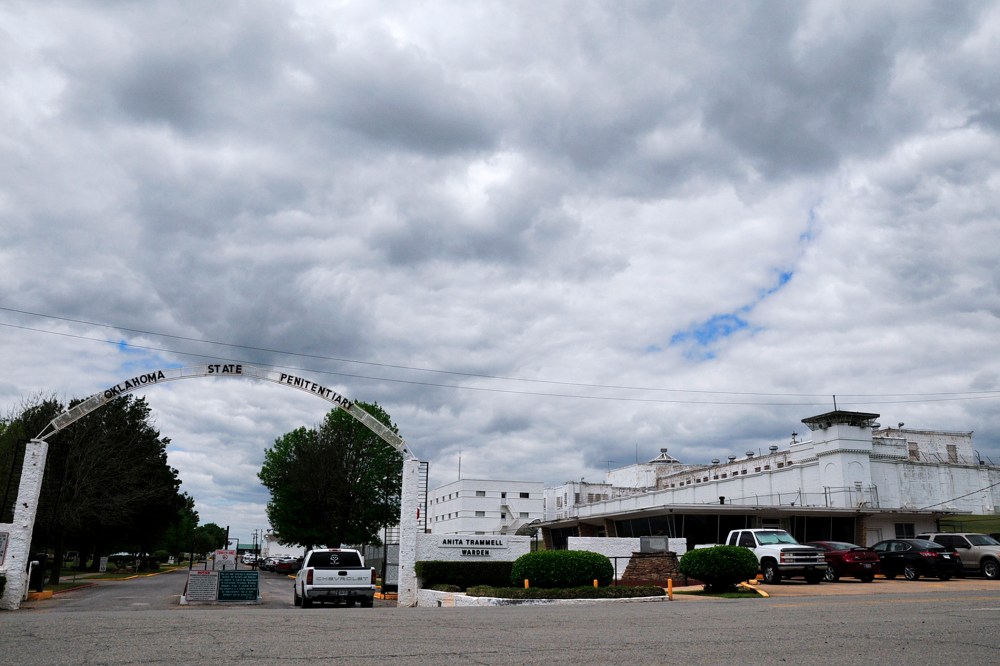
Officials in charge of carrying out the now-infamous botched execution of Clayton Lockett in Oklahoma last April knew it wasn’t going well, as medics quickly tried to locate a vein on the inmate and begin the lethal injection, according to records recently released to The Tulsa World.
Lockett and another inmate, Charles Warner, were scheduled to be executed hours apart with previously untested drugs last April 29 at the Oklahoma State Penitentiary. Lockett, the first to die, suffered a heart attack after officials injected him with a drug. He reportedly shook uncontrollably and gritted his teeth, even licking his lips, before the eventual failure of his vein. At one point, he sat up from the gurney to speak when he was supposed to be unconscious.
RELATED: Supreme Court grants stay of execution for three Oklahoma inmates
The team administering Lockett’s execution allegedly felt under pressure because of Warner’s scheduled death not long after his, the Tulsa World reported this week. They failed after trying multiple times to put the IV into Lockett’s arms, neck, and feet. Then, upon Lockett’s request, officials “reluctantly decided” to start the IV in his femoral vein, near the groin, according to the local report.
After the 43-minute botched execution of Lockett, Oklahoma’s attorney general agreed to a stay of execution for Warner. Nine months later, Warner — who was convicted of the 1997 rape and murder of his girlfriend’s 11-month-old baby — died by lethal injection this year on Jan. 15.
Lockett was found guilty of the 1999 murder of a 19-year-old woman who was raped, shot, and buried alive.
During Locket’s death, officials used a three-drug cocktail, never used before in Oklahoma, to first cause unconsciousness, then stop respiration, and ultimately end the beating of the heart. But the first drug wasn’t administered correctly, which subsequently caused the other two to falter.
The botched execution wasn’t an isolated incident in Oklahoma. Last January in Ohio, for example, Dennis McGuire was executed using a combination of intravenous drugs that had not been used previously in a lethal injection execution. The killing took nearly 25 minutes, marked by 10 minutes of the inmate gasping for air and struggling to breathe.
High-profile botched executions last year drew intense public scrutiny, and questions arose about new drug cocktails used in lethal injections. Officials in Oklahoma and the 31 other states that enforce the death penalty have been scrambling to find new suppliers of lethal injection drugs after several pharmaceutical companies stopped carrying the medication because of criticism based on ethical concerns. In some cases, authorities have executed prisoners with drugs — often obtained in secrecy — never before used for the purpose.
RELATED: Effort to end death penalty fails by a vote
The Department of Public Safety released more than 5,000 pages of documents after the newspaper sued the state. Executions currently are on hold in Oklahoma because the U.S. Supreme Court decided to take up a challenge presented by three inmates there of the controversial sedative midazolam. The drug was used in problematic executions in Arizona, Ohio, and Oklahoma. The case focuses on whether the sedative effectively makes an inmate unconscious before officials administer the second and third drugs. A hearing on the lawsuit is scheduled for March 27, and a decision is expected this spring. Meanwhile, Republican lawmakers are advocating for Oklahoma to become the first state in the country to execute death row inmates with nitrogen in a gas chamber. They argue that using nitrogen would be more practical than requiring doctors for executions or using poisonous drugs like cyanide. The 8th Amendment of the U.S. Constitution protects Americans from cruel and unusual punishments, including torture. The standard remains that the death penalty is constitutional if it imposes on individuals no more pain than is necessary. There have been 112 executions in Oklahoma since 1976. The first execution by lethal injection in Oklahoma took place in September 1990. The state authorizes electrocution as a mean of execution if a court ever deems lethal injection unconstitutional. Today, one woman and 48 men remain on death row.
Michele Richinick Recommended


