








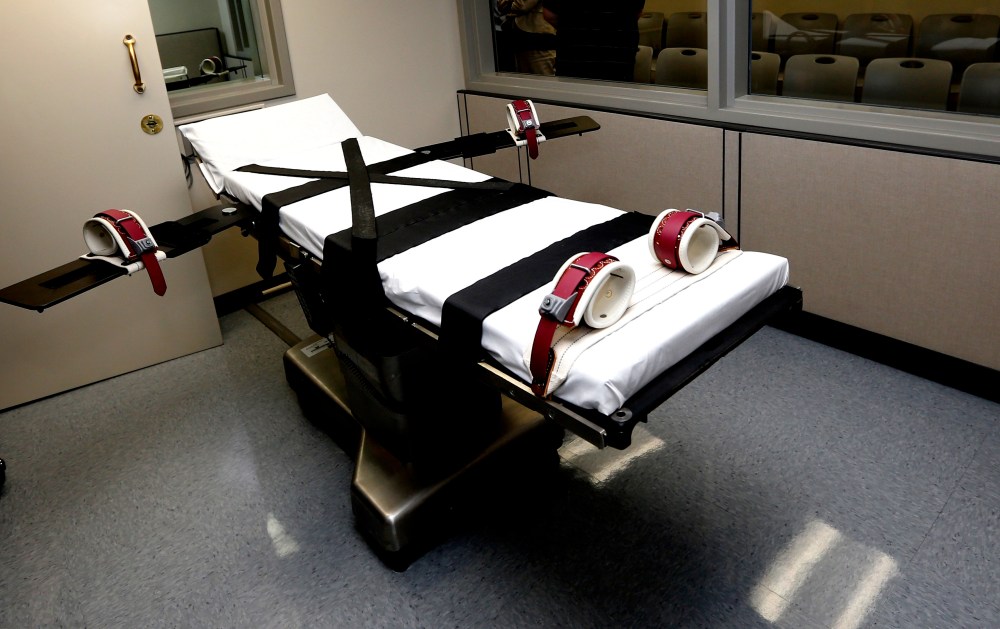
Republicans in Oklahoma are advocating for the state to become the country’s first to execute death row inmates with nitrogen in a gas chamber. Executions currently are on hold in Oklahoma, pending a decision by the U.S. Supreme Court on a case involving the controversial sedative midazolam.
Legislative hearings on a House and Senate bill regarding the issue are scheduled for this week. If a court finds the state’s lethal injection procedures unconstitutional, the new measures would make death through the use of nitrogen an alternative plan for execution in Oklahoma. By using nitrogen gas, the inmate would die from hypoxia, or the depletion of oxygen to the bloodstream.
RELATED: Supreme Court grants stay of execution for three Oklahoma inmates
Republican state Rep. Mike Christian, who conducted a hearing last summer on hypoxia, did not immediately respond to msnbc’s request for comment. But he told The Associated Press that using nitrogen would be “a lot more practical” than requiring medical doctors for executions or using poisonous drugs like cyanide.
If passed, the method would become effective on Nov. 1. It would cost about $300,000 to build a gas chamber at the Oklahoma State Penitentiary in McAlester, according to afiscal analysis.
Four states — Arizona, California, Missouri, and Wyoming — currently have gas chamber procedures in place, but lethal injection remains the primary method of execution, according to the Death Penalty Information Center. Since 1976, 11 inmates have been executed in a gas chamber. Prisoners in Arizona, California, and Missouri can choose to die in a gas chamber. Inmates in Wyoming, however, are only authorized to be executed in gas chambers if the lethal injection statute is held unconstitutional. Lethal injection involves using drugs like cyanide or midazolam.
Last month, the Supreme Court decided to take up the challenge over the use of midazolam, which was used recently in problematic executions in Arizona, Ohio, and Oklahoma. The case focuses on whether the sedative effectively makes an inmate unconscious before officials administer the second and third drugs. Following their decision for review, the justices granted a stay of execution for three death row inmates in Oklahoma. The prisoners include Richard Glossip, who was scheduled to die in January, as well as Benjamin Cole and John Grant, who were to be executed in February and March, respectively.
Legislators in Oklahoma are “grasping at ways to kill people that at first blush seem an improvement or humane, but when you actually do these things is when the problems arise,” Richard Dieter, executive director of the Death Penalty Information Center, told msnbc.
RELATED: Executions in US at 20-year low, report finds
Dieter said it appears the lawmakers are trying to divert attention from the controversial drugs by introducing a new process, which remains untried and unexplored.
“I think this is their effort to say, ‘Allow us to have our lethal injection drugs, our old drugs, lest we go to something even more novel and perhaps risky,’” he told msnbc.
Inmates Clayton Lockett and Charles Warner were scheduled to be executed with previously untested drugs two hours apart from one another last April at the Oklahoma State Penitentiary. Lockett, the first to die, suffered a heart attack after officials injected him with a lethal drug. As it was being administered, Lockett reportedly shook uncontrollably and gritted his teeth before the eventual failure of his vein.
After Lockett’s death, Oklahoma’s attorney general agreed to stay Warner’s execution until Jan. 15, when he became Oklahoma’s first inmate to die by lethal injection since Lockett’s botched execution. Diann Rust-Tierney, executive director of the National Coalition to Abolish the Death Penalty, said capital punishment is an outdated practice and hopes the introduction of the two bills this week begins a conversation about whether or not the death penalty is necessary for the country. “We need leadership that’s going to be moving the country forward and leaving gas chambers and electric chairs in the history books, where they belong,” she told msnbc. “Instead of these folks looking backward, they need to be looking forward.” Oklahoma legislators enacted the current lethal injection death penalty law in 1977, according to the Oklahoma Department of Corrections. The first execution by lethal injection in Oklahoma took place in September 1990. Since then, 110 other people have been killed using the method. The state also authorizes electrocution if a court ever deems lethal injection unconstitutional. Oklahoma also allows the firing squad, but only if lethal injection and electrocution are found unconstitutional. RELATED: Ohio postpones all 2015 executions The United States saw the lowest number of executions in two decades in 2014, a year in which several high-profile, botched executions drew intense public scrutiny, and questions about new drug cocktails used in the procedure. Thirty-five people were executed nationwide last year, down from 39 who were executed in 2013, according to a report released in December by the Death Penalty Information Center. Officials in the 32 states that enforce the death penalty have scrambled to find new suppliers of lethal injection drugs after several pharmaceutical companies stopped carrying the medication because of criticism based on ethical concerns. In some cases, authorities have executed prisoners hastily with drugs — often obtained in secrecy — never before used for the purpose.
Michele Richinick Recommended


