








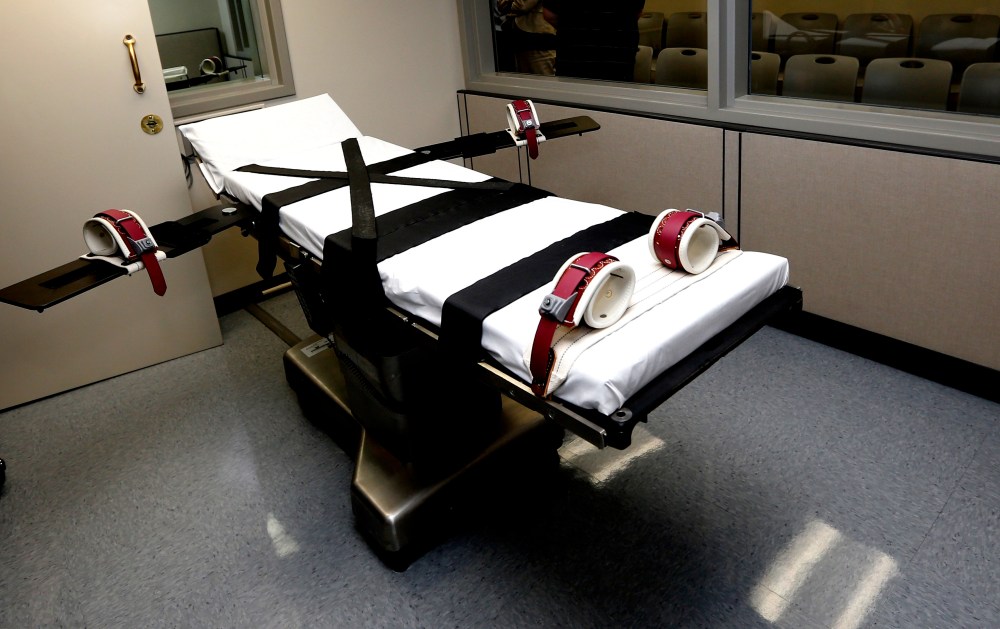
The execution “was like a horror movie,” witnesses said. The warden at the Oklahoma State Penitentiary described the inside of the death chamber as “a bloody mess.” Clayton Lockett, a condemned man convicted of murdering a 19-year-old and having her buried alive, spent his final moments groaning, writhing and bucking on a gurney. Unable set up a viable intravenous line anywhere else, doctors searched for an available vein in Lockett’s groin. Instead of finding a vein, the executioner punched an artery.
Court filings have peeled back layers of secrecy to reveal numerous issues that went awry during that botched April 29, 2014, execution. The night was scheduled to end with a double execution — the state’s first in 80 years. Lockett was supposed to die within minutes after the lethal drugs began pumping through his veins. But it took 43 minutes of suffering before he was finally pronounced dead.
Death row inmate Charles Warner was supposed to be the next.
Warner was waiting to be escorted to the death chamber when he found out his life would be spared — but only temporarily. Oklahoma officials called off the execution in the face of what swelled to national and even global outrage over the state’s failed capital punishment protocols.
RELATED: Vietnam vet with PTSD Andrew Brannan first man executed in 2015
But now, nine months later, Warner — who was convicted of the 1997 rape and murder of his girlfriend’s 11-month-old baby — faced the death chamber once again. The U.S. Supreme Court declined a last-ditch appeal to call off the execution, and on Thursday night, Warner died by lethal injection.
“My body is on fire,” Warner said when the lethal dose was administered, according to the Associated Press, though he showed no other signs of distress.
In a rare 8-page dissent to the Supreme Court’s decision, Justice Sonia Sotomayor wrote that she wished the justices had agreed to stay the execution, pointing to the many issues raised in Lockett’s lethal injection. “The questions before us are especially important now, given States’ increasing reliance on new and scientifically untested methods of execution,” Sotomayor wrote. “I hope that our failure to act today does not portend our unwillingness to consider these questions.
Much has changed since the botched execution in April. The state of Oklahoma invested more than $100,000 to revamp its death chamber. New guidelines require additional training for execution staff. The policy also sharply cuts the number of media observers allowed to view the executions down — from 12 to five.
What hasn’t changed is the three-drug cocktail of choice used to end a death row inmate’s life. When Warner is put to death Thursday night, his executioners will be using the same lethal drug combination that failed in Lockett’s case.
The drug under particular scrutiny is midazolam, a sedative designed to first knock an inmate unconscious. States that allow the death penalty have resorted to this three-drug cocktail amid a massive lethal drug shortage driven by a European-led boycott on moral grounds against selling the chemicals.
Lethal injection opponents have raised concerns that midazolam does not adequately sedate inmates. In Lockett’s case, the death row inmate appeared to be conscious halfway through the procedure — at one point he reportedly attempted to speak. It was the first time the state had used the sedative midazolam. Ohio and Arizona had similar problems in the past. Arizona got rid of its lethal injection protocol in December after an execution in July took more than two hours and 15 doses to complete. Ohio just last week opted to do the same. Under the new guidelines brought by Oklahoma, executioners must now increase the doses of midazolam beyond what was used on Locket. An independent autopsy report into Lockett’s execution found that it wasn’t the drug combination that triggered his death. Instead, his death was a fatal mistake caused by his execution team’s failure to properly place the IV in the inmate’s groin. RELATED: Arizona scraps drug cocktail after two-hour execution On Monday, federal appeals panel rejected arguments that the use of midazolam poses a risk to Warner and other death-row inmates scheduled to be executed in quick succession in Oklahoma. Four justices dissented from the Supreme Court’s decision to decline a stay of execution in Warner’s case. In her dissent, Sotomayor pointed to “numerous reasons to be skeptical of the evidence” underlying the lower court’s decision on the potential harm in the drug cocktails used to kill death row inmates. “I am deeply troubled by this evidence suggesting that midazolam cannot constitutionally be used as the first drug in a three-drug lethal injection protocol,” Sotomayor wrote, citing issues with the expert testimony presented in the lower courts. Shonda Waller, the murdered infant’s mother and ex-girlfriend to Warner, has said that she’s forgiven the death row inmate and that she believes it would be a “dishonor” for him to be executed. “I don’t see any justice in just sentencing someone to die,” Waller said in a videotaped statement to Warner’s defense attorneys. “To me, the justice is in someone living with what they have done to you, your family, and having to live with that for the rest of their life knowing they will never walk out those bars.”
Amanda Sakuma Recommended


