








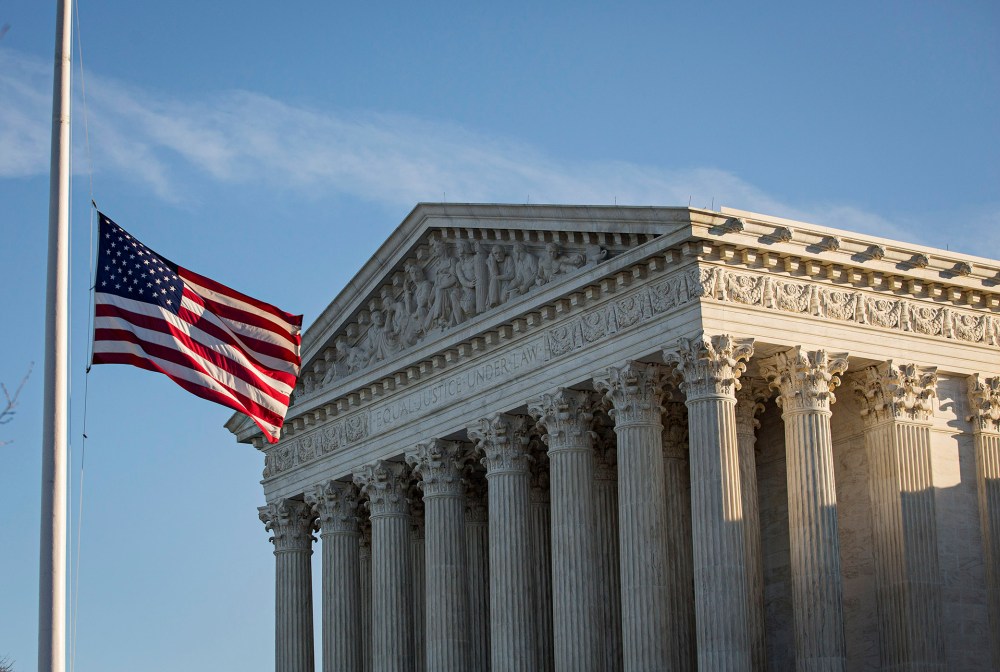
With the unexpected death of Justice Antonin Scalia, much of the nation’s attention is locked on who President Barack Obama will nominate to the Supreme Court and the ensuing confirmation battle.
That has some judicial insiders concerned that another important judicial issue — filling vacancies on the federal district and appeals courts — will get short shrift until the political theater surrounding Scalia’s successor subsides. There are currently 81 federal judicial vacancies and 39 nominees pending, according to the U.S. Federal Courts.
While the Supreme Court gets most public attention, it is worth remembering that it only takes up about 1 percent of the cases that make their way to its august chambers.
Many more are decided in federal, district and appellate courts by judges who are appointed by the president and must be confirmed by the Senate. As a result, the languishing nominees awaiting confirmation votes could have a significant impact for years to come.
RELATED: How Obama could win Supreme Court battle — even if Republicans take the White House
Already, the Federal Bar Association, the professional organization for private and government lawyers and judges practicing and sitting in federal courts, has stated that “high numbers of vacancies on the federal bench, coupled with increasing caseloads, are creating significant and unprecedented obstacles for the prompt administration of justice in our federal courts.”
There currently are nine vacancies on the powerful circuit courts of appeals and 62 on the lower district courts. The remainder are on the U.S. Court of International Trade or the U.S. Court of Federal Claims.
The Senate Judiciary Committee, which is tasked with approving nominees, has recently given bipartisan support for 11 district court nominations and sent them to the Senate floor. But no floor vote has yet been scheduled.
Russell Wheeler, an expert on the federal judiciary and visiting fellow in governance studies at the Brookings Institution, said some of the nominees who have cleared the committee have been awaiting confirmation votes since the middle of last year.
“It’s a very slow pace,” he said.
Wheeler said the situation is especially bad in Texas, which has “10 or 11 vacancies that don’t even have nominees. … I think in Texas it’s difficult to get a civil case heard now because criminal cases get priority.”

Democrats say the reason for the building backlog is pure politics driven by the ideological right.
To understand the politics, though, it’s imperative to understand the procedure.
For decades, it was expected that the president would consult the home state senators of judges put up for nomination, get their approval and then have them shepherd the nomination through the Senate. The unofficial process was meant to help fill vacancies even when political tensions were running high.
It worked like a charm to begin with when Obama nominated Judge Waverly Crenshaw to fill a vacancy for a district court vacancy in Tennessee in February 2015, with the blessing of both Republican senators from Tennessee, Lamar Alexander and Bob Corker.
Then, in a bipartisan vote, the Senate Judiciary Committee overwhelmingly approved Crenshaw’s nomination in July. It has stuck in limbo ever since.
The reason has something to do with building sentiment among conservatives that finally found voice in a statement issued in last month by the influential conservative group Heritage Action, which called on the GOP-led Senate to not allow any more judicial nominees to go forward.
It said the action was justified because Obama “began his final year in office by taking aim at the Second Amendment and unilaterally shredding immigration caps set by Congress without congressional approval,” referring to recent executive actions announced aimed at expanding background checks for gun sales and protecting as many as 5 million undocumented immigrants from deportation. “Given the Obama administration’s disregard for Congress’ role in our constitutional system of government, the Senate should refuse to confirm the president’s nominees unless those nominees are directly related to our national security,” the group wrote. Senate Republican leaders have not publicly acknowledged that they are heeding the calls for a blockade on confirmation votes. Whatever the reason, Democrats say the holdup is extreme. “Refusing to confirm any judicial nominees for the rest of this year would make the high number of vacancies in our federal judiciary even worse,” Sen. Patrick Leahy of Vermont, the ranking Democrat on the Judiciary Committee, said in a statement. “This would hurt the American people and weaken our justice system. We cannot allow this to happen.” Leahy’s staff has noted that when he was the Judiciary chairman during the last two years of George W. Bush’s presidency, 68 judicial nominees were confirmed by the Senate. By contrast, the Judiciary Committee, under its Republican chairman, Sen. Chuck Grassley of Iowa, has confirmed only 16 Obama judicial nominees in the last two years. Republicans on the committee counter that with more than 90 percent of the seats on district and circuit courts filled, the vacancy rate on the federal courts was the lowest of Obama’s presidency in 2015 and among the lowest of the last 25 years. It’s unclear if Senate Majority Leader Mitch McConnell of Kentucky will be willing to proceed on any further Obama nominees, even if they are supported by the Republican senators from their home state and have been passed out of the Judiciary Committee in a bipartisan vote. But given the bad blood that will be stirred by Obama’s expected nomination of a successor to Scalia, it seems likely that 2016 could be a wash for federal judicial nominations. This story first appeared on NBCNews.com.
Luke Russert
Luke Russert is the host and creative director of MSNBC Live. He first joined NBC News in August 2008 as a correspondent based in Washington, D.C.. Russert reported from Capitol Hill on the House of Representatives for “Nightly News with Brian Williams,” “TODAY,” MSNBC and NBCNews.com. He has also served as a guest host on various MSNBC programs.
Mike Brunker Recommended


