








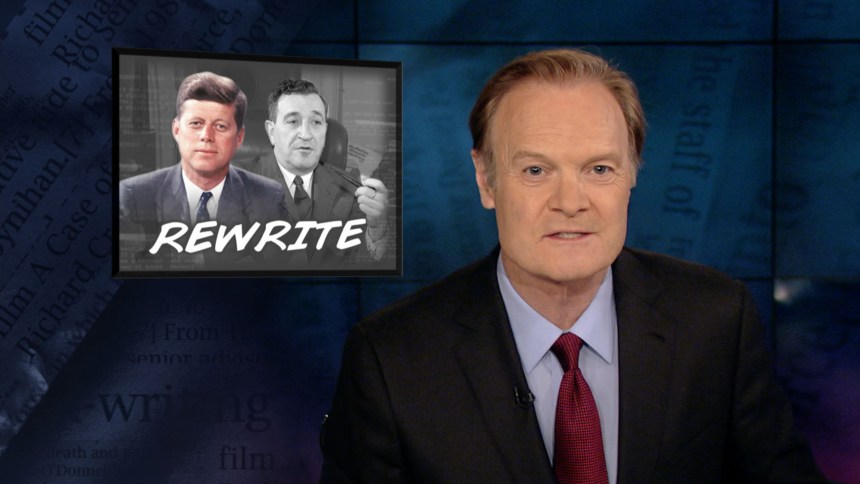
In one of his last speeches, President John F. Kennedy addressed the National Academy of Sciences on the importance of science and its role in government and public policy. The speech occurred on October 22, 1963, as the National Academy of Sciences was celebrating its 100th anniversary.
At the time of the speech, Kennedy had already set a national goal of landing a man on the moon. He, along with the rest of the world, had seen NASA astronaut John Glenn orbit the Earth. But instead of focusing on those successes, President Kennedy began his speech by noting the inauspicious beginning of the National Academy of Sciences in the middle of the Civil War.
“It is impressive to reflect that 100 years ago, in the midst of a savage fraternal war, the United States Congress established a body devoted to the advancement of scientific research,” Kennedy said. “The recognition then of the value of ‘abstract science’ ran against the grain of our traditional preoccupation with technology and engineering.”
With President Kennedy in Constitution Hall that day was Dr. Jerome Wiesner, his influential science advisor. As noted in Wiesner’s New York Times obituary, Dr. Wiesner played “a key role in trying to work a sensible public policy out of the increasingly complex interrelationships between Government and science,” and his counsel proved invaluable to President Kennedy in an age of atomic discovery and new space exploration.
President Kennedy’s own respect for science–including both the gifts it can offer mankind as well as the challenges it can pose–are evident in his words to the National Academy of Sciences: “In the last hundred years, science has thus emerged from a peripheral concern of Government to an active partner. The instrumentalities devised in recent times have given this partnership continuity and force. The question in all our minds today is how science can best continue its service to the Nation, to the people, to the world, in the years to come…” “If scientific discovery has not been an unalloyed blessing, if it has conferred on mankind the power not only to create, but also to annihilate, it has at the same time provided humanity with a supreme challenge and a supreme testing. If the challenge and the testing are too much for humanity, then we are all doomed. But I believe that the future can be bright, and I believe it can be certain… As we begin to master the destructive potentialities of modern science we move toward a new era in which science can fulfill its creative promise.” In his remarks that day President Kennedy noted science’s importance to all of humanity. “The ocean, the atmosphere, outer space, belong not to one nation or one ideology, but to all mankind, and as science carries out its tasks in the years ahead, it must enlist all its own disciplines, all nations prepared for the scientific quest, and all men capable of sympathizing with the scientific impulse.”
Nick Ramsey
Nick Ramsey is a senior producer with MSNBC’s “The Last Word with Lawrence O’Donnell.” Recommended


