








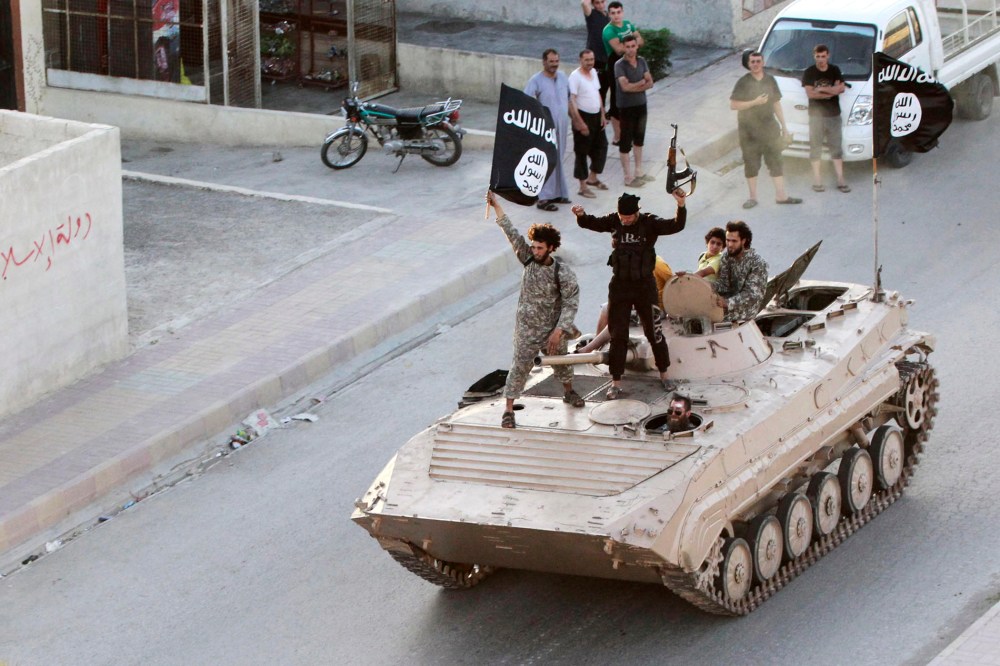
President Barack Obama has made a point of saying the Islamic State is “not Islamic,” despite pressure from critics to define America’s enemy as Islamic extremism. Last week, following the release of a video purporting to show Islamic State militants burning a Jordanian pilot alive, Obama referred to “whatever ideology” fueled the group’s barbarity. And later, at the National Prayer Breakfast, the president said Americans need to get off their “high horse” about religious extremism, invoking the Crusades, the Catholic Inquisition, and U.S. slavery.
Related video: President Obama, religion, and the Islamic State
But a closer look at the video of Lt. Muath al-Kasasbeh’s horrific death tells a different story. As Muslim-American journalists with expertise in Islam, Arabic and Hollywood, we analyzed the 22-minute propaganda film, and what we can clearly decipher is this: The terrorists of the Islamic State are very much about Islam.
The militants leverage symbols from three sources — the Qur’an, the holy book of Islam; the hadith, or sayings and traditions of the prophet Muhammad; and historical fatwas, or Islamic rulings — and blend them with historical grievances and highly-produced sequences incorporating battle scenes from Hollywood war movies to legitimize themselves as Rambo Muslims for jihad.
In the video, the Islamic State fighters are young men with runny noses that smear their ski masks, exploiting centuries-old grudges to justify their violence. They are, as former FBI agent Joe Navarro terms them, “wound collectors.”
For all the calls for “separating the brutal actions of ISIS from the faith of Islam,” as the Council on American-Islamic Relations puts it, the Islamic State squarely plants itself within Islam, with fighters as mu’mineen, or “believers,” a Qur’anic concept (23:1).
%22The%20answer%20to%20defeating%20the%20Islamic%20State%20rests%20not%20with%20denying%20the%20Islam%20in%20%22Islamic%20State%2C%22%20but%20rather%20addressing%20and%20rejecting%20the%20interpretation%20of%20Islam%20that%20the%20terrorist%20organization%20propagates%20and%20promoting%20a%20culture%20of%20productive%20solutions%20and%20healing.%22′
The answer to defeating the Islamic State, particularly in its propaganda and recruitment, rests not with denying the Islam in “Islamic State,” but rather addressing and rejecting the interpretation of Islam propagated by the terrorist organization and promoting a culture of productive solutions and healing.
As it is, the murder video is like a walk through the history of unhealthy expressions of Islamic theology and psychology.
In Arabic, the video’s title is Shifa’o El-Sodoor, which the video makers translate as “Healing the Believers’ Chest” — el-sodoor literally means “the chest,” but it is a deeper reference to “the heart.” Shifa’o means “healing” in Arabic. There is no mention of “believers” in the title, so it should be translated as “Healing the Heart.”
“Healing” appears in the Qur’an (9:14), revealed at a time when new Muslim converts were afraid of battling the rival Quraish tribe of Mecca. For militant Muslims, it is a battle cry for the violent expression of jihad, or “struggle,” which ignores the chapter’s other message to “remove the anger of hearts (9:15).” For liberal Muslims, it is a historical challenge that today should be answered with non-violent healing.
As if assigning the Islamic State a divine mandate, the video begins by invoking an Arabic salutation that Muslims learn from childhood to recite before starting any activity, from prayer to sports: “In the name of Allah, the most Beneficent, the most Merciful.” The video flashes to a slick new cube graphic for the terrorist organization, with the logo in Arabic script in a blue palette, reading, “Al-Dawla Al-Islameya” — “The Islamic State.”
Half a minute into the video, the producers slam Jordanian King Abdullah Hussain II as “Taghut of Jordan,” invoking a Qur’anic concept, taghut, which describes anyone who has crossed limits, becoming in this case “a tyrant (4:51, 4:60, 4:76).” Even though a verse cited by many liberal Muslims says there is “no compulsion in religion,” (2:256), that same verse extols Muslims to not believe in taghut, or “false gods.”
The producers flash scenes from Hollywood portrayals of valor in war as a narrator says, in Arabic: “As the crusaders’ campaign started against Muslim lands …”
But the actual images illustrating the “crusaders’ campaign” are war scenes from Hollywood movies against Nazi Germany and its allies. First, the video steals footage of a U.S. warship, the “Liberty Ship,” from the HBO mini-series “The Pacific,” which aired in 2010, and was created by the producers of “Band of Brothers” — actor Tom Hanks and director Steven Spielberg. Next come battle scenes from “Flags of Our Fathers,” the Clint Eastwood movie about America’s WWII victory on the Japanese island of Iwo Jima. These are followed by a scene from “Enemy at the Gates,” a 2001 film starring Jude Law as a Russian sniper fighting Nazi Germany in the Battle of Stalingrad.
The video’s themes move from protesting “apostasy and treason” to promoting “the application of sharia,” or Islamic laws. Protesting “the Jewish state,” the video invokes the divine value of the land of “Philistine,” or “Palestine,” with a reference to a mystical Qur’anic story in which the prophet Muhammad supposedly flew on a winged horse from Mecca to the now-contested Dome of the Rock in Jerusalem.
The video makes reference to the killing of Muslims “displaced from their homes” (probably Palestinians), “secret prisons” with “rotten smell” (probably so-called black sites), “tracking the mujahideen” (likely drone attacks), and “assassinating their leaders” (Osama bin Laden, among others). It gripes about the “invaders’ troops on Muslim lands,” like Afghanistan, and the “international coalition” to “stop the spread of the caliphate state,” “raining the fire of death on people of Islam.”
%22The%20murder%20video%20is%20like%20a%20walk%20through%20the%20history%20of%20unhealthy%20expressions%20of%20Islamic%20theology%20and%20psychology.%22′ After almost four minutes of the diatribe, Lt. Muath al-Kasasbeh appears in an orange jumpsuit, symbolic of another grievance: the detaining of prisoners in Guantanamo Bay, Cuba. His official ID photo flashes on the screen with “Aseer Saleebee” written above it. Saleebee is “crusader.” Aseer is “prisoner of war.” The video provides the translation: “Crusader Detainee.” Trying to appear like skilled interrogators, the video shows the young pilot outlining the details of Arab countries’ fleets and airbases — widely available information that is easily found with a simple Google search. To make a propaganda point, the the U.S., Canada, France, the U.K. and Australia, are described as the “Al-Tahalof Al-Saleebee,” translated on screen as “Crusader Coalition,” along with the countries of Jordan, the United Arab Emirates, Saudi Arabia, Kuwait, Qatar, Bahrain and Morocco. Related video: Will Jordan continue to target ISIS? In the corner of the screen is a graphic of a golden mosque with a crescent above it and the words, “Al-Furqan” — “The Standard” — the name of the twenty-fifth chapter of the Qur’an, which calls Muslims to respect the line between “good” and “evil,” or be prepared to be “thrown into a narrow place therein bound in chains,” which is “the Hellfire,” with “its fury and roaring.” The mosque symbol alternates with the image of a flapping black flag, reminiscent of a dubious hadith of the prophet Muhammad that says an army of “the Mahdi,” or “messiah,” will come from Khurasan, a region in northern Afghanistan and eastern Iran, to claim Jerusalem. It’s a key vision in Islamic eschatology, or the study of the apocalypse. In the video, the flag of Israel is simply labeled “Jews.” And the Islamic State invokes the grievance to “defend Al-Aqsa mosque,” the mosque beside the Dome of the Rock, “and what belongs to the Muslims in Philistine.” Images flash of burned children, followed by a fatwa by a 14th century Islamic scholar, Ibn Taymiyyah — a rock star for extremist Muslims — who declared it “legitimate” for Muslims to fight Mongol Muslims on the grounds that they did not follow sharia. After Muslim fighters “pray for them to become believers or call upon them to stop their aggression,” they quote Taymiyyah saying, it is “lawful jihad” to fight them. As the young pilot is burnt alive, a song breaks out: “Inside your own home, the wars will be waged, only for your destruction and suffering, my sword is sharpened.” Asra Q. Nomani is a former reporter for the Wall Street Journal, born in India. Hala Arafa, born in Egypt, is a former journalist with the Voice of America and other media channels.
Asra Nomani
Hala Arafa Recommended


