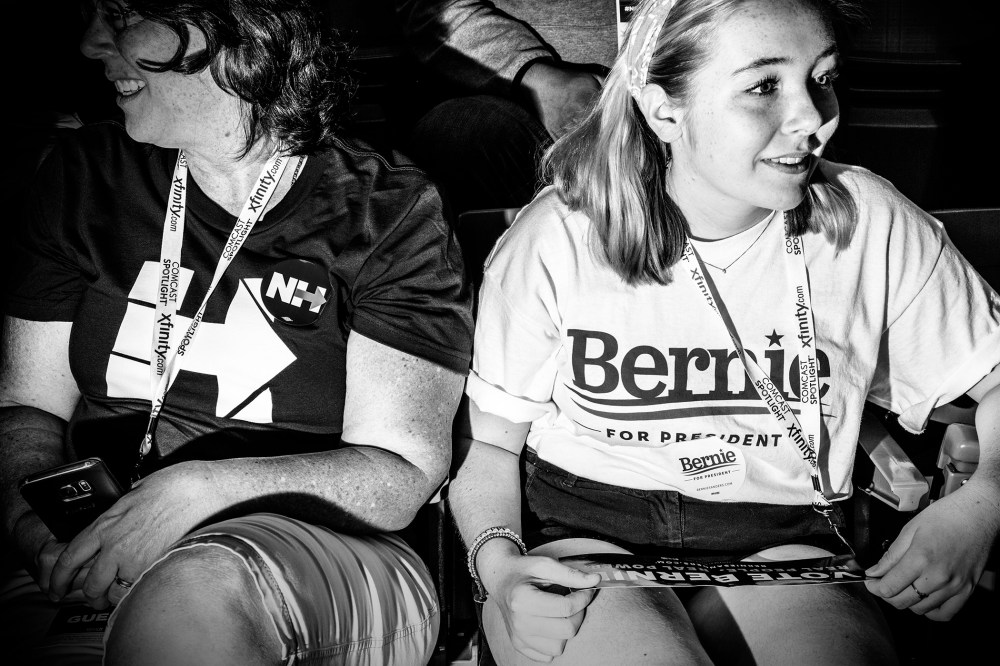
With the first round of primaries less than a month away, emotions are running high in the 2016 presidential race. A new NBC News|SurveyMonkey online poll found that Republicans and Democrats dislike each other, but the intensity of hostile feelings toward the opposition varies among those supporting different candidates.
While fans of establishment favorites like Marco Rubio and Hillary Clinton certainly do not like the other party, those supporting “outsider” contenders—like Bernie Sanders, Ben Carson, Ted Cruz, and Donald Trump—deeply loathe their partisan counterparts. These findings suggest grim prospects for political compromise in 2016 and possibly beyond

To explore these issues, we looked at how people answered a question called a “feeling thermometer.” These thermometers, which have been used by political scientists since the 1970s, ask people to rate political groups and public figures on a scale to get a sense of how positively or negatively they feel toward each. A response at the lower end of the scale indicates that the person very much dislikes the group or figure, and a response at the upper end indicates that the person very much likes that group or figure. A score at the halfway mark means that the person feels neither positively or negatively (that is, neutral).
While pollsters traditionally focus on the horse race among the candidates, employing a feeling thermometer is important because the responses reveal additional insights about the opinions of the survey takers. In particular, the responses allow us to get a bigger-picture understanding of how people think about politics, particularly when respondents rate things like the Democratic and Republican parties. Knowing how intensely people like or dislike the parties can tell us a lot about how motivated they are to participate in politics, have productive discussions with political rivals and reach compromises on important issues.
Feeling thermometers give us a sense of how people feel about the parties generally, but they can also show us how feelings change over the course of the election year in response to particular events. As the election draws nearer, these feelings are likely to intensify.
As part of our 2016 weekly election tracking online, NBC News and SurveyMonkey will be tracking feeling thermometer scores for the Democratic and Republican parties. Our first poll using these measures occurred from December 28, 2015 to January 3, 2016. In this survey, we asked nearly 3,200 registered voters to rate the Democratic and Republican parties on feeling thermometers with values ranging from from 0 (really cold, suggesting intense dislike) to 10 (really warm, suggesting strong support).
RELATED: Poll: Clinton maintains lead over Sanders heading into primaries
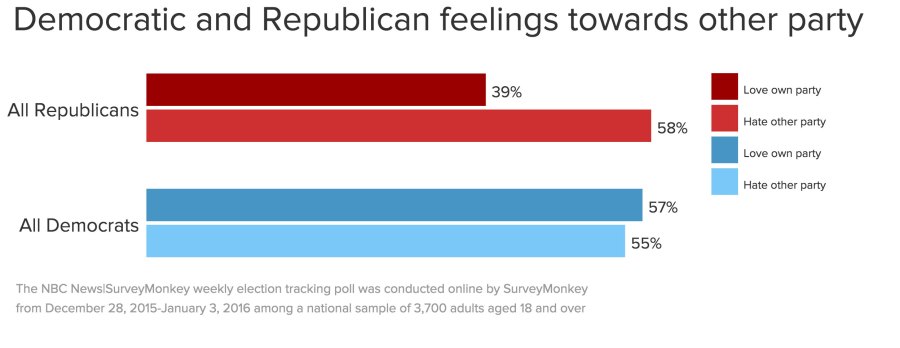
To summarize the intensity of these feelings, we grouped together Democrats and Republicans who said they “loved” their own party (that is, respondents who gave ratings of 8 or higher) versus those who said they “hated” the other party (giving ratings of 2 or below). Democrats and Republicans differ considerably in the amount that they like their own side. As the chart below reveals, 55% of Democrats reported loving their own party, but a much smaller percentage of Republicans—a mere 39%—said they felt the same level of affection toward their party. Republicans are clearly more dissatisfied with their own party than Democrats—a fact that may contribute to support that polls reveal for “outsider” candidates such as Carson, Cruz, or Trump.
When it comes to partisans’ feelings toward their opposition, however, Democrats and Republicans report hating the other side at nearly identical levels: 57% of Democrats gave highly negative ratings to the Republican Party, and 58% of Republicans reported intense dislike of the Democratic Party. Both Democrats and Republicans seem equally unlikely to trust or want to work with their opponents. We can also see how the percentages of people loving their own party or hating the opposition party differ based on the candidate being supported. On the Democratic side, a significantly higher percentage of Clinton supporters (64%) love the Democratic Party compared to Sanders followers (49%). Once again, however, Clinton and Sanders supporters are nearly identical in the amount that they dislike the opposition. This demonstrates that while Sanders’ supporters are less likely to be strongly supportive of the Democratic Party, they match Clinton supporters in the intensity of their dislike for Republicans. Substantial variation exists on the Republican side as well. Rubio’s supporters exhibit nearly identical levels of in-party love and out-party hate, but there are significant gaps in party evaluations among supporters of the other leading candidates. Carson and Trump supporters are similar in their lukewarm support for their own party (37% and 43%, respectively, report loving their own party), but Trump supporters are much more likely—by a margin of 12 percentage points—than Carson supporters to say that they hate the opposite party. By far the most extreme evaluations, however, appear among supporters of Cruz. Less than one third of his supporters feel strongly positive about their own party, while nearly 8 in 10 report loathing the Democrats. Results show that those candidates who represent the “extreme” branches of their parties—including Sanders, Carson, Trump and Cruz—tend to attract supporters with more negative evaluations of their own party. On the Republican side, supporters of these “outsider” candidates also report hating their partisan opponents in higher numbers than supporters of Rubio, considered to be a more “moderate” candidate. As a matter of ideology, this makes sense: While those who are very conservative dislike their own party—which they might believe to be too moderate—they hate the (more distant) opposition party even more intensely. On the other hand, the strength of these negative feelings among all Democrats and Republicans suggests that partisan conflict is not a mere matter of policy disagreement. With such hostility toward their political opposition, it seems unlikely these candidates or supporters will find any common ground because they simply do not trust one another to make good decisions. The prospect of more effective—or at least, more amicable—governance seems unlikely under the election of any new president. Graphics by Sam Petulla.
Carrie Roush
Susan Del Percio is a Republican strategist and a political analyst for MS NOW.
Josh Clinton Recommended