








A version of this story originally appeared on NBCLatino.com.
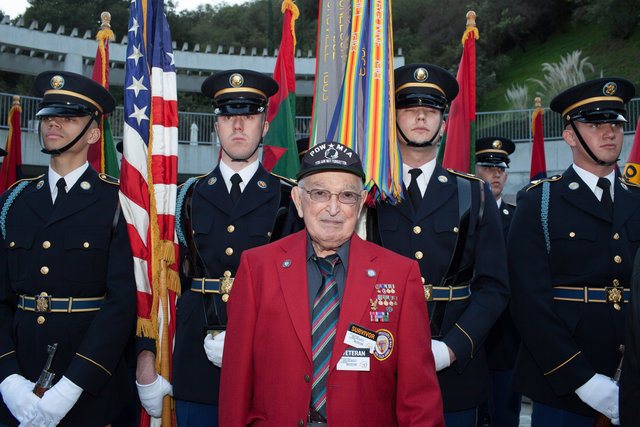
Anthony Acevedo is one of the World War II veterans being honored at the United States Holocaust Memorial Museum’s 20th Anniversary Tribute in Washington, D.C. But unlike his fellow honorees, Acevedo is also a Holocaust survivor.
At 88-years-old, Acevedo exudes life. His voice over the phone is a glimpse into his young spirit: He’s talkative, loves a punchline and is extremely warm. His memory: So sharp, he can recall even the smallest of details.
Acevedo became the first Mexican-American to be registered with the museum’s survivor database in 2010.
A medic assigned to the 70th Infantry Division during the war, Acevedo was one of the 350 U.S. soldiers captured during the Battle of the Bulge in France and sent to the Berga An Der Elster labor camp—a subcamp of the Buchenwald concentration camp in Germany from which only about 180 would survive by war’s end, he says.
It was during his time at Berga that Acevedo would begin writing in a diary, documenting everything he saw; logging information on the dead, sketching and pretty much doing whatever he could to keep his mind moving. This diary was his lifeline, he says.
“I used to write down recipes on a piece of paper and then discuss with my buddies what I would want to eat the minute I got home. I would say things like: ‘On this day, I want to be eating a hamburger,’” says Acevedo.
This diary is the first in the museum’s collection to be written by an American captive. Acevedo donated it during his first visit to the museum in 2010, along with his Red Cross arm band, a prayer-book he always carried during the war, a cross and numerous photographs, as well as a personal document of his father’s.
“I was scared but I tried to keep going with faith. Some didn’t have the faith but I always tried to remind myself that ‘Hey, you always have someone else to live for,’” he says.
For Acevedo, that person was his sweetheart, Dolores, who sent him care packages numerous times. Although they had never met, he had fallen in love with her just from those letters.
Born in San Bernardino, Calif., to Francisco and Maria Luisa Acevedo on July 31, 1924, Acevedo lost his mother as a baby and his father remarried four years later to a woman by the same name. They remained in California until the day his stepmother was deported and the family was faced with having to go back to Mexico. He has two full-blood sisters and three half-brothers from his father’s second marriage. Acevedo joined the U.S. army shortly after graduating high school, upon returning to the U.S. at the age of 18.
A difficult childhood stemming from an abusive father and memories of his nanny trying to drown him in the bathtub, Acevedo credits these events as the ones that built him up to sustain what lied ahead of him as a prisoner of war.
The awful conditions in the camp Acevedo remembers include once being fed boiled grass, not being allowed to bathe, sleeping in crowded barracks, wearing lice and flea-ridden clothing and being worked to the bone. Acevedo weighed 48 lbs by war’s end; the situation was enough to drive anyone mad. Acevedo recalls seeing many of the prisoners lose their minds. The worst part of it all was watching his buddies die, he says.
Upon the war’s end, Acevedo tells of the mistreatment the Berga survivors continued to receive but this time, from their own people. All of the survivors were forced to sign a document banning them from speaking of their experiences, somewhat of a death sentence.
It took nearly six decades, a divorce from his first wife, Amparo, and a lot of suffering before Acevedo’s story would come to life again. An article published by CNN in 2008 was ultimately the catalyst to getting the U.S. army to finally recognize that the Berga soldiers had been held prisoners in a concentration camp.
“The fact that you couldn’t imagine someone like Mr. Acevedo being stuck in the middle of this history, it’s just fascinating,” says Christina Chavarria, a teacher trainer and researcher at the museum who studies the effect the Holocaust had on Latin America. Chavarria said that Monday’s event deserved attention because it is the museum’s way of reminding a new generation that history doesn’t simply go away. As of Friday, 845 Holocaust survivors from around the world, WWII veterans and their families were confirmed to be attending. The event was to open with keynote speakers: the museum’s founding chairman, Elie Weisel and President Bill Clinton. “If we did this again in 20 years, chances are that we’d only have a handful of survivors…so it’s a day to remember the fact that this is a history that doesn’t go away and we need to make sure that it doesn’t go away. It’s important that young people who don’t necessarily feel connected to this history begin to connect too,” Chavarria said. The Acevedos are dearly loved at the museum. Anthony’s son Fernando says it’s the effect his father’s always had on everybody. Acevedo has always been the one wanting to take care of others, he says. The family was unable to make it out to Monday’s events but had the opportunity to participate with the museum during one of the events it held in the Los Angeles area earlier this year. The entire family went. “My dad’s story has brought together other families across the country and given them the closure they needed. My dad’s diary was able to answer many of the questions they had about their loved ones. For me, I can’t tell you what that makes me feel. It just shows the result of someone’s heart,” he says. ”I’ve been able to be with my dad at many events and his message to young people is always the same: ’We died for you out there, don’t throw away your life.’ Their truth deserves to be told,” says Fernando Acevedo. When asked what his interests are, Anthony Acevedo easily answers that he loves it all. He loves to BBQ—“I love my steaks and my carnitas,” he says; and loves to read books about the war and spending time with his family. His most precious possession still to this day, though: His sweetheart, Dolores. Soon after finalizing his divorce and doing a lot of personal work to heal from the war, Acevedo and Dolores reconnected through their mutual friend, Salvador. And while they didn’t get together right away—Dolores was still too hurt from that day when Acevedo failed to show up in Mexico all those years ago, they slowly worked things out and married in the 1980s. They’ve been together ever since. A version of this story originally appeared on NBCLatino.com.
Vanessa Alvarez Recommended


