








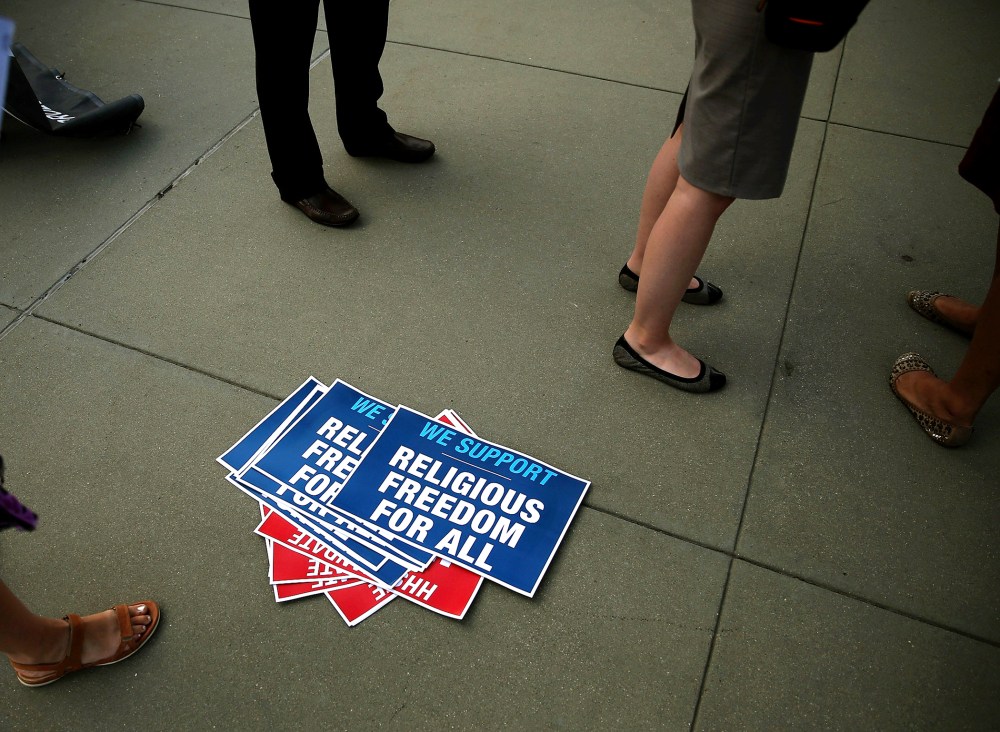
The Supreme Court’s decision in Hobby Lobby is already reshaping the legal and political landscape, with civil rights groups seeking to limit the fallout from the ruling and conservative religious groups hoping to press for more and greater exemptions.
“Whenever there’s a move for anti-discrimination measures, it comes along with a question of whether institutions can refuse to comply based on religious beliefs,” said Louise Melling, deputy legal director at the American Civil Liberties Union. “I think Hobby Lobby will embolden people to think they have a stronger claim to exemption, but it’s up to the legislatures and the courts going forward.”
Two weeks ago, the Supreme Court backed companies like Hobby Lobby with religious owners who were seeking to avoid providing their employees with health insurance plans that cover contraception, as required by the Affordable Care Act. Under the Religious Freedom Restoration Act, the high court ruled that the government had to accommodate the religious beliefs of “closely held” companies regarding contraception, a description that applies to potentially half the private sector employees in the United States.
The decision came down in the midst of a fierce argument already taking place over the appropriate breadth of religious exemptions from state and federal laws, with conservative lawmakers all over the country proposing measures that women’s and LGBT rights supporters claimed would sanction discrimination in the name of religion. Supporters of such laws will likely take the Hobby Lobby decision as a sign that the Supreme Court has their back.
The Hobby Lobby decision is already spurring changes.
Shortly after the decision, a group of faith leaders wrote President Barack Obama asking him to include a broad religious exemption in a forthcoming executive order barring anti-LGBT discrimination by federal contractors. LGBT rights groups soon withdrew their support for the Employment Non-Discrimination Act, which would have been the first federal law barring anti-LGBT discrimination in employment, because of fears of how its broad religious exemption could be applied after Hobby Lobby.
“This is a piece of legislation we have been working on for twenty years,” said Rea Carey, Director of the National Gay and Lesbian Task Force. “We started seeing how religious exemptions were being used across the country, that caused us to reconsider our position and now oppose the Employment Non-Discrimination Act.”
%22Historically%20claims%20for%20exemptions%20have%20been%20unsuccessful%2C%20but%20Hobby%20Lobby%20may%20generate%20more%20willingness%20by%20judges%20to%20uphold%20exemption%20claims.%22′
Carey emphasized that activists would be okay with a religious exemption — just not one as broad as in the current version of the bill. “What we are pushing for now, to be vary basic about it, is to be treated like everybody else. Legal equality is legal equality, it is not legal equality except for LGBT people. That’s all we’re asking for, nothing more, nothing less.”
Women’s and LGBT rights supporters fear that, emboldened by Hobby Lobby, businesses and conservative religious groups could push for much broader exemptions, not just from the Affordable Care Act’s requirement that insurance plans cover contraception but in matters of employment, housing, and in businesses serving the public. Refusing to pay benefits for an employee married to someone of the same gender, not renting an apartment to a single mother with children, turning away gay customers — activists are concerned those things could end up protected by the law if judges and legislatures continue to sanction broad religious exemptions. Even unions are now bracing themselves for corporations who having sudden and convenient realizations that collective bargaining burdens their deeply held religious beliefs.
“There’s always been a right to seek exemptions on the basis of religion,” said Adam Winkler, a professor at UCLA School of Law. “Historically claims for exemptions have been unsuccessful, but Hobby Lobby may generate more willingness by judges to uphold exemption claims.”
Political opposition to the Affordable Care Act, or to the Obama administration in general, Winkler said, could lead to any number of potential challenges. “I could see other religiously motivated firms bringing religious objections to a wide variety of requirements under Obamacare, we could see it under other kinds of laws as well,” said Winkler. “I think there’s new awareness of the availability of religious exemptions from the Hobby Lobby case, and that might spur more religious exemption claims than we might have seen otherwise.” Hobby Lobby itself provided insurance that covered contraception methods it later sued over — until after the Affordable Care Act was passed and its requirement that insurance plans cover contraception was publicized. Even before the Hobby Lobby decision, civil liberties and religious groups were fighting over religious exemptions to anti-discrimination laws, particularly with regard to employment. In Ohio, a Catholic school teacher sued after being fired because she became pregnant through artificial insemination, another teacher at a San Diego Christian school filed a lawsuit after being let go for becoming pregnant with the man she eventually married before they tied the knot. In Washington, a gay teacher at a Catholic school was fired after he married his longtime partner. Conservative lawmakers’ push for “religious freedom” laws at the state level began after business owners in New Mexico and Colorado were found to have violated state anti-discrimination laws by refusing services to same-sex couples. Those fears won’t necessarily come true. Corporations might see claiming a religious exemption as bad for business or for recruiting talent and refuse to follow Hobby Lobby’s lead. Courts might turn a skeptical eye towards new exemption claims, and rule against them. Popular support for LGBT rights and women’s rights could prevent legislatures from writing broader religious exemptions into law. But if a few months ago, it looked like religious conservatives were on the defense in their fight for broader religious exemptions, things no longer look that simple. “You have to be careful about predicting the future. Forty years ago we had a very vibrant women’s rights movement that you think would have overcome religious liberty claims, but today we still find women’s rights under attack,” said Winkler. Riffing off of one of President Obama’s favorite phrases, he added that “It’s hard to put much confidence in the inevitable direction of history, because the arc of history bends in different ways.”
Adam Serwer Recommended


