








Join Irin for a Live Chat on the decision at 4 p.m. ET today #msnbcchat
The Supreme Court has ruled in a 5-4 decision that a closely-held company can be exempt from contraceptive coverage under the Affordable Care Act.
The closely watched case pitted the administration and its allies, including women’s health advocates, against the religious right, which has repeatedly accused President Barack Obama of waging a war on religion in the public square.
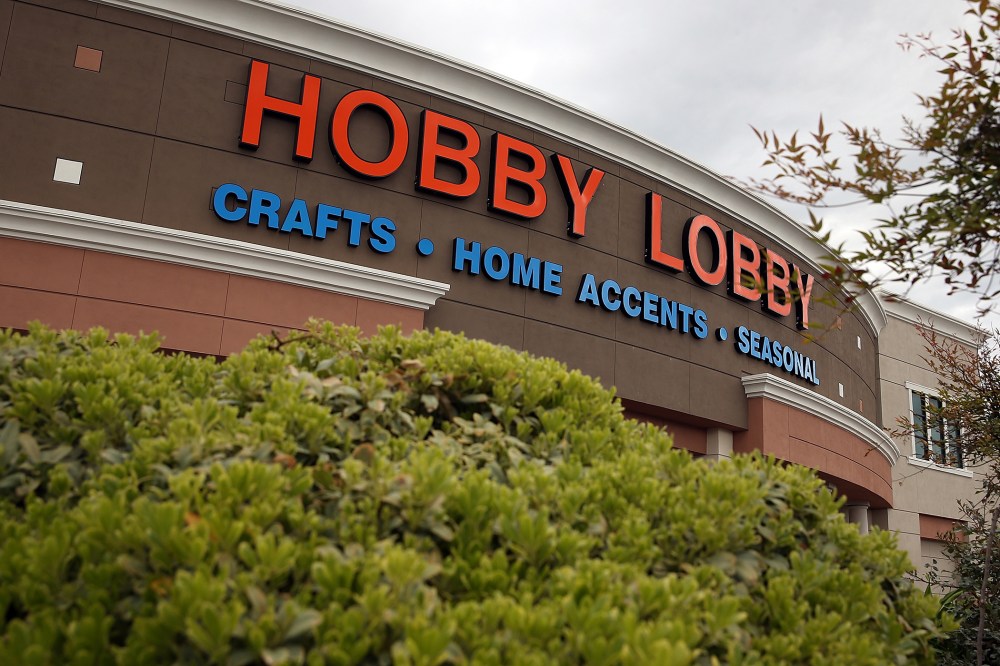
Hobby Lobby stores, an Oklahoma-based, evangelical-owned craft chain with about 13,000 employees, and Conestoga Wood Specialties, a small Mennonite-owned cabinet maker in Pennsylvania, were two of the 49 for-profit companies that said the requirement violated their religious freedom.
The Obama administration had provided exemptions for the law for houses of worship and an accommodation for religious nonprofits (the subject of pending litigation) but not for for-profit corporations.
The Religious Freedom Restoration Act, the law at issue in the case, has never been applied to for-profit entities. The Court had to decide whether corporations even have religious exercise rights – making the beliefs of the employer synonymous with the entire company – and weigh that question against the potential harms to the employees.
Hobby Lobby and Conestoga Wood objected to a handful of contraceptives that they speculate can block a fertilized egg, which is neither documented in the science nor the medical definition of abortion. Other for-profit plaintiffs object to any birth control coverage at all.
The case was the first time the Affordable Care Act returned to the nation’s highest Court since it was first largely upheld as constitutional, and was argued by current Solicitor General Don Verrilli and former Bush administration solicitor general Paul Clement.
Hobby Lobby and Conestoga Wood got two very different results at the appeals court. The Tenth Circuit Court of Appeals declared of Hobby Lobby that “such corporations can be ‘persons’ exercising religion.” In ruling on Conestoga’s bid for exemption from the requirement, the Third Circuit disagreed: “For-profit secular corporations cannot exercise in religious exercise.”
Kyle Duncan, lead attorney on the Hobby Lobby case and general counsel at the Becket Fund for Religious Liberty, told msnbc earlier this year. While employers can’t stop their employees from using birth control (including paying for it with their wages), Duncan said, “Their moral objection is being made to participate in the process.”
Republican Senate Minority Leader Mitch McConnell praised the ruling Monday. “Today’s Supreme Court decision makes clear that the Obama administration cannot trample on the religious freedoms that Americans hold dear,” he said in a statement.
Speaker of the House John Boehner (R-Ohio) weighed in, too, saying “The mandate overturned today would have required for-profit companies to choose between violating their constitutionally-protected faith or paying crippling fines, which would have forced them to lay off employees or close their doors.” He also renewed calls for the repeal of Obamacare.
Senate Majority Leader Harry Reid (D-Nev.) said in a statement: “Today’s decision jeopardizes women’s access to essential health care. Employers have no business intruding in the private health care decisions women make with their doctors.”
“This ruling ignores the scientific evidence showing that the health security of millions of American women is strengthened by access to these crucial services,” he added.
Reid pledged that Democrats would “continue to fight to preserve women’s access to contraceptive coverage and keep bosses out of the examination room.”
“Although the Court restricted their ruling to ‘closely-held’ companies, this ruling will immediately affect the lives of millions of women across the country. Over 90 percent of America’s businesses are ‘closely-held,’ including such large employers as Koch Industries and Bechtel,” said Democratic Leader Nancy Pelosi. “Women should not be forced to jump through extra hoops to secure the fundamental health care they need.”
The White House released a statement in disagreement with the decision, in which they said: “We’ll continue to look for ways to improve America’s health by helping women have more, not less, say over the personal health decisions that affect them and their families.” Related: Members of Congress take to Twitter on Hobby Lobby The decision was met with chants of “HOBBY LOBBY WINS, HOBBY LOBBY WINS” from a group gathered outside the courthouse in support of the company. One pro-Hobby Lobby woman reportedly ripped up her “losing speech” following the verdict. Barbara Green, the co-founder of Hobby Lobby, said she was “overjoyed” by the Supreme Court’s ruling. “The Court’s decision is a victory, not just for our family business, but for all who seek to live out their faith. We are grateful to God and to those who have supported us on this difficult journey,” said Green. Lori Windham, senior counsel at the Becket Fund for Religious Liberty, called it a “landmark decision” arguing that “American families do not lose their fundamental rights when they open a family business.” Most Americans disagree with the majority opinion of the Court. According to a March 2014 NBC/WSJ poll 53% of Americans believe that employers should not be able to be exempt from the Affordable Care Act’s requirement that health plans cover prescription birth control. “This is a deeply troubling decision. For the first time, the highest court in the country has said that business owners can use their religious beliefs to deny their employees a benefit that they are guaranteed by law,” said Louise Melling, deputy legal director of the ACLU. At oral argument, as hundreds of women rallied outside in support of birth control access, Paul Clement argued, “This is not about access to the contraception, it’s who’s going to pay for the government’s preferred subsidy.” Justice Elena Kagan, for her part, had a different answer: ”Congress has made a judgment and Congress has given a statutory entitlement and that entitlement is to women and includes contraceptive coverage, and when an employer says, no, I don’t want to give that, that woman is quite directly, quite tangibly harmed.” The contraceptive benefit was widely seen as a political win for Obama in the 2012 election, galvanizing single women to go to the polls. Democrats are hoping a similar strategy pays off in key elections this fall.
Irin Carmon Recommended


