








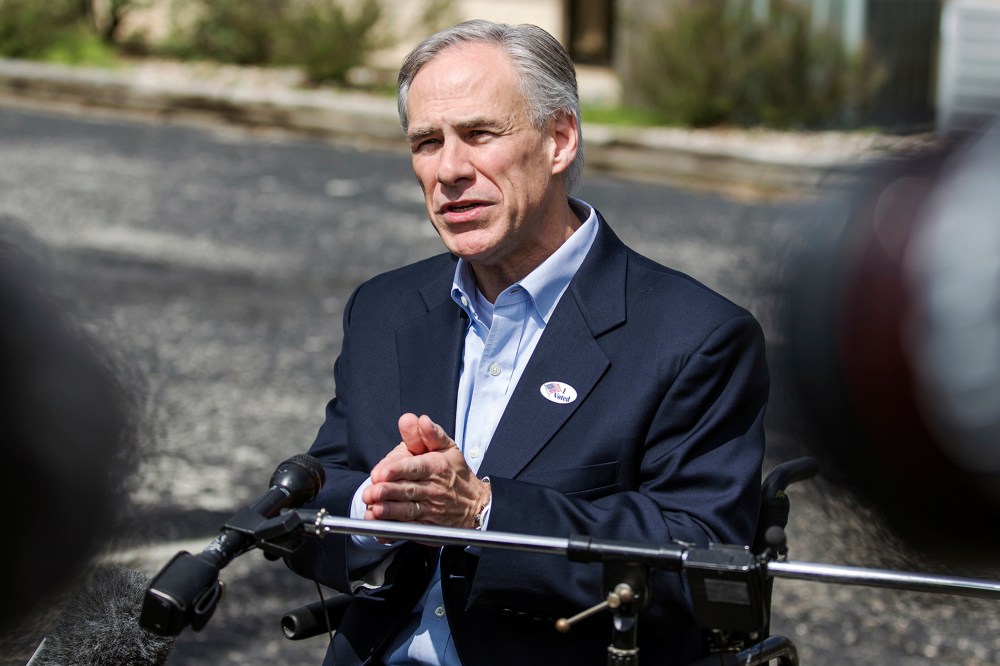
Texas Attorney General and gubernatorial candidate Greg Abbott is defending his state’s same-sex marriage ban on the grounds that it both reduces “unplanned out-of-wedlock births,” and ensures “the survival of the human race” — two seemingly contradictory goals with one calling for less baby-making, and the other hinging on it. His comments add to those of his fellow Lone Star Republicans, who earlier this year warned that marriage equality could lead to incest and pedophilia.
“Because opposite-sex relationships are the only union that is biologically capable of producing offspring, it is rational to believe that opposite-sex marriages will generate new offspring to a greater extent than same-sex marriages will,” wrote Abbott, along with other defendants, in the state’s brief submitted Friday to the 5th Circuit Court of Appeals. “It is therefore rational for the State to subsidize opposite-sex marriages, which tend to produce benefits for society by generating new offspring, while withholding these subsidies from same-sex relationships, which are far less likely to provide this particular societal benefit.”
RELATED: Texas marriage ban struck down
Not all procreation is created equally, however, according the brief, which goes on to argue that Texas’ same-sex marriage ban is “rationally related to the State’s interest in reducing unplanned out-of-wedlock births.” How? “By channeling procreative heterosexual intercourse into marriage.”
So essentially, what the brief argues is that Texas’ same-sex marriage ban encourages people to have babies in what it deems to be the right way — the way that perpetuates the human race — while at the same time discouraging people to have babies the wrong way — out of wedlock, without the chance of yielding any kind of societal benefit. According to the Centers for Disease Control and Prevention, 42% of all 2012 births in Texas were to unmarried women, two points higher than the national rate. That statistic occurred despite the state’s marriage laws that were, by Abbott’s logic, “channeling procreative heterosexual intercourse into marriage.”
These claims certainly raise some serious questions. For example, what about the opposite-sex couples that either choose not to have children or are physically unable? Don’t they undercut the state’s argument that subsidizing opposite-sex marriages leads to more babies?
Not at all, according to the brief.
“Rational-basis review allows States to enact under- and over-inclusive laws, and in all events marriages between infertile opposite-sex couples promote the creation of new offspring by encouraging other opposite-sex couples to marry,” it says. “The plaintiffs ignore the Supreme Court’s repeated holdings that rationality review does not require a perfect fit between means and ends.”
Well, what is the evidence to support the theory that opposite-sex marriages produce more offspring than same-sex marriages? Or proof that same-sex marriage bans somehow reduce unplanned pregnancies?
That evidence is not necessary, argues the brief.
“The plaintiffs’ remaining arguments reflect only their continued misunderstanding of rational-basis review,” it says. “They fault the State for ‘offer[ing] no evidence’ to support a connection between Texas’s marriage laws and responsible procreation, but the State ‘has no obligation to produce evidence to sustain the rationality of a statutory classification’ and may rely on ‘rational speculation unsupported by evidence or empirical data.’”
Texas was the first state in the region to see its same-sex marriage ban overturned by a federal judge, and analysts anticipate a tougher fight in the 5th Circuit Court of Appeals, one of the most conservative in the country. Arguments have yet to be scheduled, but the same three-judge panel will hear challenges against both Texas’s ban and Louisiana’s, the only one to survive in federal district court. So far, no appeals court has ruled against same-sex nuptials since the Supreme Court’s landmark decision last year, which invalidated a key portion of the Defense of Marriage Act that prevented married gay and lesbian couples from receiving any kind of spousal benefit from the U.S. government. Last week, the justices made another bold move on behalf of same-sex couples hoping to wed, this time by declining to hear challenges against same-sex marriage bans in Indiana, Oklahoma, Utah, Virginia and Wisconsin — all of which saw their bans fall in both federal district and appeals courts. The move immediately legalized marriage equality in those five states, and doomed bans in six others that make up the 4th, 7th, and 10th circuits. A day later, another federal appeals court — the 9th Circuit — struck down same-sex marriage bans in Idaho and Nevada, essentially making bans in three other states bound to that appellate ruling impossible to defend. Once the full effects of the past week’s court actions are fully realized, there will be 35 states, plus the District of Columbia, where gay and lesbian couples can legally wed. A week ago, that number was 19. Given the domino-like fall of bans and growing support for marriage equality across the country, Republicans have been reluctant to touch the issue this campaign cycle. Former presidential candidate Mike Huckabee said on his Fox News program Saturday that he was “utterly disgusted” with those in his party who are choosing to walk away from marriage “just because it’s politically volatile.” “Here’s my advice,” said Huckabee. “Grow a spine!” It seems that Abbott is one of the few GOP candidates who can say that he has — at least according to Huckabee’s standards.
Emma Margolin
Emma Margolin is a reporter at MSNBC.com. Recommended


