








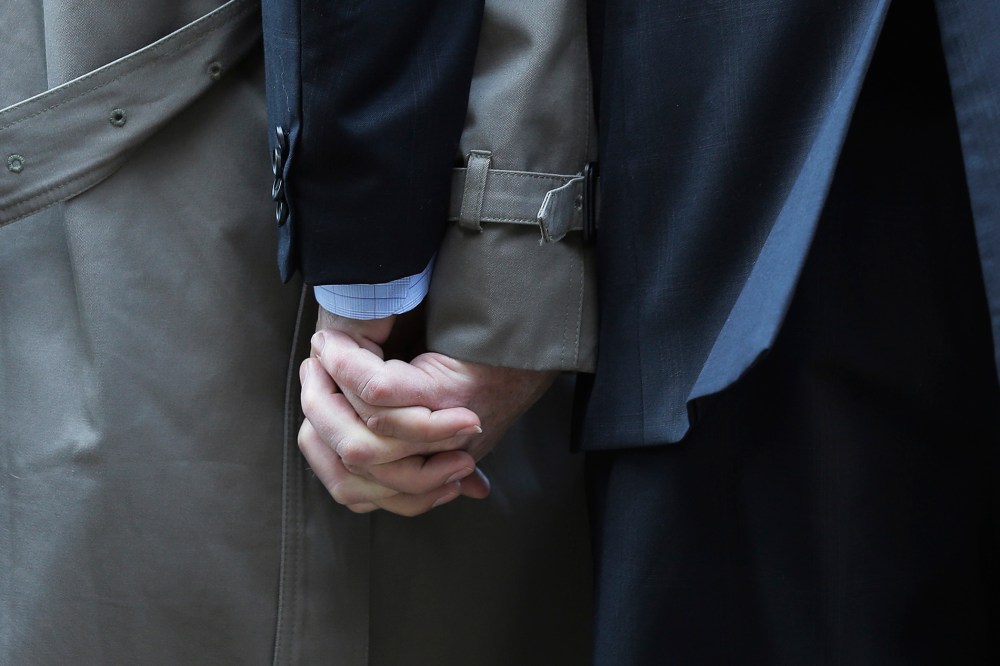
Marriage equality has officially infiltrated the deep South.
Texas moved to join 17 states and the District of Columbia on Wednesday in allowing gay couples to legally wed, after a federal judge struck down the state’s nine-year-old amendment banning same-sex nuptials. U.S. District Judge Orlando Garcia, an appointee of President Clinton, issued a preliminary injunction on the ban, then suspended his ruling, meaning gay couples won’t be able to marry in the Lone Star State until the case is heard by a higher court.
RELATED: Marriage equality advocates fly South, and not just for winter
In a 48-page opinion, Garcia found the state’s 2005 voter-approved ban on same-sex marriage violated the U.S. Constitution’s guarantee to equal protection under the 14th Amendment. He is the sixth federal judge to strike down all or part of a state ban on same-sex marriage since the U.S. Supreme Court gutted the federal Defense of Marriage Act last June, and the first to do so in the deep South.
“Without a rational relation to a legitimate governmental purpose, state-imposed inequality can find no refuge in our United States Constitution,” Garcia wrote. “These Texas laws deny plaintiffs access to the institution of marriage and its numerous rights, privileges, and responsibilities for the sole reason that Plaintiffs wish to be married to a person of the same sex.”
Republican Attorney General Greg Abbott, who’s also a gubernatorial candidate, said he would appeal the ruling. “This will be decided by the Supreme Court,” he told reporters at an appearance in San Antonio.
Earlier, Abbott’s office released a statement insisting that states have the authority to define their own marriage laws. “If the Fifth Circuit honors those precedents,” read the statement, “then today’s decision should be overturned and the Texas Constitution will be upheld.”
Republican Gov. Rick Perry also released a statement criticizing the ruling.
Though attorneys general in Nevada, Oregon, Pennsylvania and Virginia declined to defend their state bans, Abbott has been a staunch supporter of his state’s marriage amendment. Every Republican running to replace Abbott as attorney general also opposes same-sex marriage, meaning this case stands a good chance of continuing through the appeals process after the 2104 election.
“Some states have decided to expand that definition [of marriage,] while other states like Texas have decided to preserve the traditional definition,” Assistant Texas Solicitor General Michael Murphy said during the trial earlier this month. “This debate should not be taken out of the democratic process.”
Garcia rejected that argument, writing that his decision “is not made in defiance of the great people of Texas or the Texas Legislature, but in compliance with the United States Constitution and Supreme Court precedent.”
Texas voters approved the 2005 amendment with a 76% majority. Today, polls paint something of a muddied picture about where voters stand, but opposition to same-sex nuptials has decreased dramatically from a decade ago. According to a 2013 survey from the Equality Texas Foundation, more voters support marriage equality than oppose it, by a very slim margin–47.9% to 47.5%. A July survey from Public Policy Polling found 34% of Texas voters in favor of same-sex marriage, with 57% opposed. Sixty-four-year-old AD Smoot of San Antonio, Texas, said he was “very disappointed” by the ruling. “It’s easy to see that there is a breakdown in our society of spiritual values, ethical values, moral values,” he told msnbc. “I think that traditional marriage is one of those things that helps to uphold those values.” Abbott supporter Weston Martinez, 38, predicts the ruling will bring more voters to the ballot box in November. “We passed a constitutional amendment,” Martinez said. “So to have a liberal Bill Clinton appointee try to turn it over – it will impact the governors race, but it will make more Republicans turn out.” Ahead of his trial two weeks ago, 54-year-old Mark Phariss, one of the plaintiffs, told msnbc he believed “more Texans would have a problem” with his being an Oklahoma football fan, than with his sexuality. Wednesday’s decision came amid a wave of legal challenges to same-sex marriage bans, sparked by the Supreme Court’s rationale put forth in last year’s DOMA ruling. Forty-seven marriage cases are now making their way through the courts in 25 states, according to Freedom to Marry, and many of those lawsuits are happening in the South. Capitalizing on that momentum, Freedom to Marry launched a $1 million initiative earlier this week to pave the way for equal protections and benefits currently denied to the hundreds of thousands of gay couples living in 14 southern states. Democratic Rep. Joaquin Castro, one of the honorary co-chairs of the Southerners for the Freedom to Marry campaign, released a statement Wednesday praising Garcia’s ruling: “Today is a triumphant day for equality in Texas. The federal court in San Antonio reaffirmed what we’ve believed all along, that in the United States of America equality and freedom are not dependent on the color of your skin, the origin of your last name, or the person you love. I welcome today’s affirmation of our nation’s fundamental values and I look forward to seeing Texas, as well as more states across our country, continue to make progress.”
Zachary Roth
Emma Margolin
Emma Margolin is a reporter at MSNBC.com. Recommended


