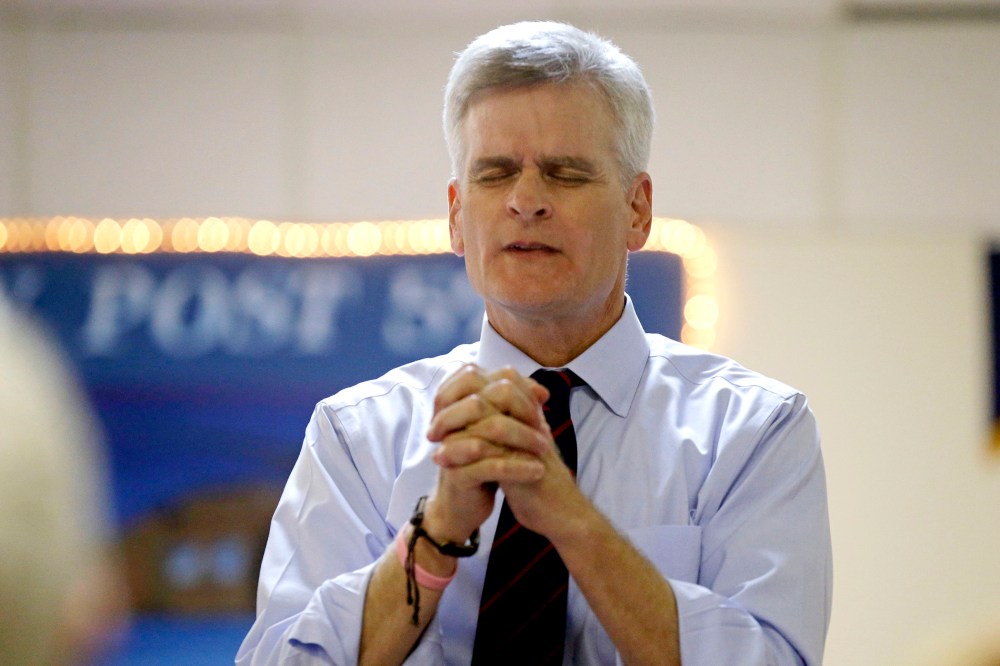
Two magic words earned Louisiana Republican Bill Cassidy a crucial endorsement in his challenge to Democratic Sen. Mary Landrieu: “Religious freedom.”
Cassidy, a three-term congressman, has a 100% anti-abortion voting record. He opposes same-sex marriage. But in the November general election, the Family Research Council Action PAC had thrown its support behind tea partier Colonel Rob Maness, who ran in the state’s “jungle primary” against Cassidy and Landrieu and got 13.8% of the vote.
Cassidy’s transgression? He once voted for a federal hate crimes bill that included protections for sexual orientation and gender identity. Or as FRC president Tony Perkins put it, “My lingering concern about your commitment to the defense of religious liberty over laws that would seek to provide special protection to individuals based upon their sexual behavior.”
Cassidy will face Landrieu in a runoff election next month. And two days into that campaign Cassidy gave the Family Research Council what it wanted. “Religious freedom and our First Amendment rights are being increasingly attacked,” Cassidy announced. “We all oppose physically violent acts. We should also oppose using the long arm of the state to intimidate people of faith.”
Welcome to the new culture war, this time rebranded as a battle over religious liberty or freedom. There are the same longstanding debates about sexuality and gender at the center of it. But this time, Christians — often business owners – are cast as the downtrodden victims of secularized government encroachment. And the rhetorical strategy, replete with references to liberty and the desire to have a debate, sounds downright progressive.
“Nobody is against religious liberty,” observed Jay Michaelson, who wrote a report for a progressive think tank on the phenomenon. “Liberals like it, conservatives like it.”
But the new definition of religious liberty is far broader than the right to practice a religion as commonly understood. Its proponents stretch it so broadly that all kinds of secular activities affecting the general public are religion, too.
The Supreme Court’s Hobby Lobby decision last June, allowing businesses with religious owners to opt out of providing contraceptive coverage to employees, brought new national attention to the debate, but that was just the opening salvo. The main event will be the 2016 presidential election.

Many likely 2016 GOP presidential hopefuls can hardly give a speech without mentioning the “silent war on religious liberty” (Louisiana Gov. Bobby Jindal) or warning “religious liberty has never been more under attack” (Texas Sen. Ted Cruz.) Former Pennsylvania Sen. Rick Santorum even made a documentary, One Generation Away: the Erosion of Religious Liberty, complete with Nazi imagery and featuring yet another potential Republican candidate, Mike Huckabee. The so-called assault on religious freedom was the focus of this year’s Values Voters Summit Washington, which drew conservative political leaders and activists from around the country.
The 2012 presidential election was a preview for the framing of social issues around religious liberty, as candidates like Santorum raced to object to the same contraceptive coverage Hobby Lobby did. Democrats in turn successfully turned the same policy into a rallying point for women voters, who heavily favored President Obama in the general election.
But despite Democrats trying to replay those arguments in the midterms, they faltered. Instead, Perkins recently claimed in a tweet, religious liberty arguments helped boost evangelical voter turnout. And the drumbeat in conservative media on Obama’s “war on religion” continues apace — priming such voters for the next presidential election.
“Any Republican running for president who shows the least bit of weakness on this has no chance. None,” syndicated conservative radio host Steve Deace told msnbc in an interview. Deace said it even superseded the long-galvanizing issue of abortion: “Your position on the life issue is irrelevant to me if we don’t have freedom to act on our religion.”

Austin Nimocks had one message for attendees at Cedarville University’s Religious Freedom Summit in October: Their very jobs were in danger, right here in the U.S., unless they were willing to renounce Christianity.
Just look at Don Mendell, said Nimocks, the senior counsel at the conservative Christian firm Alliance Defending Freedom. Mendell is a Maine educator and ADF client. After Mendell appeared in a television ad opposing marriage equality in Maine, two complaints were filed with a state licensing board. Another teacher had recorded a pro-marriage equality ad without such repercussions, Nimocks noted.
“They wanted to establish a litmus test,” Nimocks told the Ohio crowd, “that in order to get a license and participate in Maine society you had to be a vocal proponent of same sex marriage or you were no longer eligible for licensure, regardless of the fact that that has nothing to do with your ability.”
The same agency, Nimocks said, licensed professions from acupuncture to propane gas technicians. “This mindset brings everybody into this zone of danger with regard to religious freedom,” he insisted, adding, “We know how far it can go. Look at Nazi Germany, where the first inhabitants of concentration camps were Christian pastors who would not submit to the Third Reich.”
It wouldn’t be the first Nazi comparison by people claiming religious liberty is under attack.
There were other ominous comparisons. Warren Smith, an editor at the Christian magazine World, asked Nimocks about his organization’s work in the Middle East where “people are literally dying for their faith. We face some challenges here,” Smith said. “On the one hand it’s easy to say, well, let’s put this in perspective, people are dying over there. Then, though, when you start thinking about taking that to its logical conclusion, maybe that is the slippery slope that we’re on.”
The story of Don Mendell is, perhaps unsurprisingly, a little more complicated.
Mendell did indeed appear in a TV ad opposing gay marriage in 2009, urging voters to “prevent homosexual marriage from being pushed on Maine students.” But it wasn’t the state licensing board or any other government agency that challenged him. The complaints came from two of his colleagues, who argued he had violated the National Association of Social Workers Code of Ethics and that his comments would prevent LGBT students from feeling comfortable coming to him for counseling. According to ADF’s own web site, the state licensing board dismissed the complaints six months later. Mendell’s job was intact.
In the end, that was the only consequence to Mendell exercising his First Amendment rights.
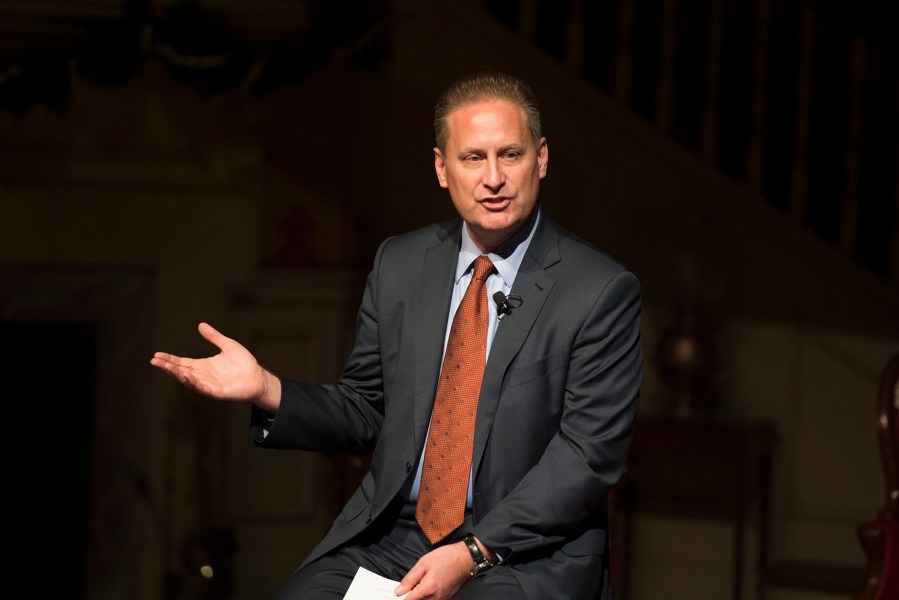
Later that day, Steve Green, president of Hobby Lobby, the craft store chain and Supreme Court plaintiff, took the stage. He and his billionaire family are heroes of the movement. Their health plan once covered many forms of contraception. Then they went to court to object to the Affordable Care Act’s requirement that all health care plans cover all FDA-approved contraception. What changed? Company founder David Green told the Wall Street Journal that an attorney from the Becket Fund for Religious Liberty had called to inform the company of the new Obama administration policy — and asked if they wanted to file suit.
Hobby Lobby, of course, won its case against the Obama administration. So did the Mennonite cabinet-makers represented by the Alliance Defending Freedom.
All of this is to say that so far, the so-called war on religious liberty has yielded very few casualties. But what is unquestionably real is the sense among conservative evangelicals that they are losing the war, and that the world as they know it is changing too fast. And they now lay some of that blame on Obama. In September, 57% of white evangelicals told Pew the Obama administration was “unfriendly towards religion.” In just five years, that number had risen nineteen points.
The woman approaching the microphone had a question that came up at the Cedarville summit again and again. “The pro-homosexual lobby equates their struggle with civil rights,” she said. “As far as the florist and the baker, people say, well, remember when black people couldn’t eat at lunch counters. Can you explain how we could counter some of that?”
Among the most heralded foot soldiers in conservatives’ fight for religious liberty are vendors like florists or photographers who refuse to provide services to same sex weddings. In states with laws protecting against discrimination on the basis of sexual orientation, some have had to pay fines.
Uncomfortably for evangelicals, the civil rights analogy would put them squarely in the role of the segregationist. They would prefer to see such vendors as martyrs.
Such refusals of service began in the anti-abortion movement, with “conscience clauses” for healthcare providers to refuse birth control or be anywhere near an abortion. But perhaps because there have been many successes in restricting abortion in red states, marriage equality seems to rankle the “religious liberty” crowd the most. “The people on the other side promised us that no one would lose the rights once there was marriage equality,” Deace, the Iowa radio host, told msnbc. “Where are all those people when people are losing their rights? They’re silent,” he said. “People are losing their businesses, they’re losing their homes, they’re losing their jobs. ” Their homes? Deace cited the case of Liberty Ridge Farm in upstate New York, a wedding venue owned by Robert and Cynthia Gifford, a couple who refused to host a lesbian wedding, though they often hold other weddings. A judge found that the farm “provides both goods and services to the public, therefore it is a place of public accommodation,” and subject to the state anti-discrimination law. The Giffords were fined $13,000 and are appealing. As law professors Reva Siegel and Douglas NeJaime observe in a forthcoming Yale Law Journal article, such cases involve “complicity-based conscience claims.” The canonical religious freedom cases of earlier years involved minority faiths asking for exemptions, the effects of which would be absorbed by the larger public — like a Jehovah’s Witness refusing to say the pledge of allegiance. The new religious refusal cases involve other people doing things opposed by the religious objector – using birth control or having an abortion, or getting married to a person of the same sex. As far as the Giffords are concerned, they are not merely engaging in a commercial transaction – they are being forcibly conscripted into the sexual revolution. Justice Samuel Alito implicitly endorsed that view in the Hobby Lobby decision and cited Catholic doctrine to explain it, saying the case raised “the circumstances under which it is immoral for a person to perform an act that is innocent in itself but that has the effect of enabling or facilitating the commission of an immoral act by another.” He added, in a decision that appeared to broadly extend the scope of religious accommodation, “It is not for the Court to say that the religious beliefs of the plaintiffs are mistaken or unreasonable. %22Any%20Republican%20running%20for%20president%20who%20shows%20the%20least%20bit%20of%20weakness%20on%20this%20has%20no%20chance.%20None.%22′ Among those who believe there is a war on religious liberty, anyone harmed in the process – the gay couple being discriminated against, the woman who can’t afford effective birth control – can go elsewhere. In this way, the religious freedom issue unites the business-friendly, libertarian wing of conservatism with the religious one. Here is the Heritage Foundation in a report on religious liberty and same-sex marriage: “Competitive markets can best harmonize a range of values that citizens hold, and there is no need for government to try to force every photographer and every florist to service every marriage-related event.” Daniel Mach, director of the ACLU Program on Freedom of Religion and Belief, begs to differ. “If a business voluntarily decides to open its door to the public, it can’t pick and choose which customers to serve,” he told msnbc. There are occasionally still alliances between the ACLU and groups like ADF – both groups filed amicus briefs in the pending Supreme Court case of Holt v. Hobbs, on behalf a Muslim prisoner who wants to grow a half-inch beard – but Mach draws the line when others are affected. “Religious liberty protects a vital right to make our own decisions on matters of faith,” he said. “But it’s not a blank check to discriminate or harm others.” By contrast, the “religious liberty” coalition insists that business transactions are protected religious exercise. At the Cedarville summit, Hobby Lobby’s Steve Green held court at a business-themed breakout session where he was asked, “How can actual business processes honor God?” It’s easy to tell people to go elsewhere. But for the woman with a low-wage job seeking an IUD or an abortion, or for a couple with doors slammed in their faces, each individual opt-out adds up. And it rarely ends with an individual refusal. In Rand Paul’s 2012 op-ed on the subject, entitled “The President’s War on Religious Freedom,” he accused the Obama administration of never having been “a protector of pro-life Americans’ conscience rights,” citing, among other things, “federal funding that Planned Parenthood receives.” That funding, for reproductive services that don’t include abortion, goes to health providers that apply for it and has nothing to do with religious objectors. In other words, Paul was talking about a broad policy objective that would affect millions of women, in the name of “conscience rights.” Even before the presidential race is officially on, the next Congress, fully under Republican control, may well tackle such issues. There is already a Marriage and Religious Freedom Act, sponsored by Rep. Raul Labrador and Utah Senator Mike Lee, that “prohibits the federal government from taking an adverse action against a person on the basis that such person acts in accordance with a religious belief that: (1) marriage is or should be recognized as the union of one man and one woman, or (2) sexual relations are properly reserved to such a marriage.” It’s all just the beginning of claiming a war on religious liberty. Republicans have lately been arguing that everything is the Obamacare of something else: That Dodd-Frank is “Obamacare for banks” (Congressman Paul Ryan and Sen. Mitch McConnell) or that net neutrality is “Obamacare for the Internet” (Cruz). It’s a way to tar any other issue with the unpopularity of the Affordable Care Act, with the implication that government is intruding too far or that even Obama is being dishonest. There is already such a line for the religious liberty claim, and it comes from Jindal. “The president is very concerned about religious liberty,” he said jokingly in February. “And also, if you like your religion, you can keep your religion.”
Irin Carmon Recommended