








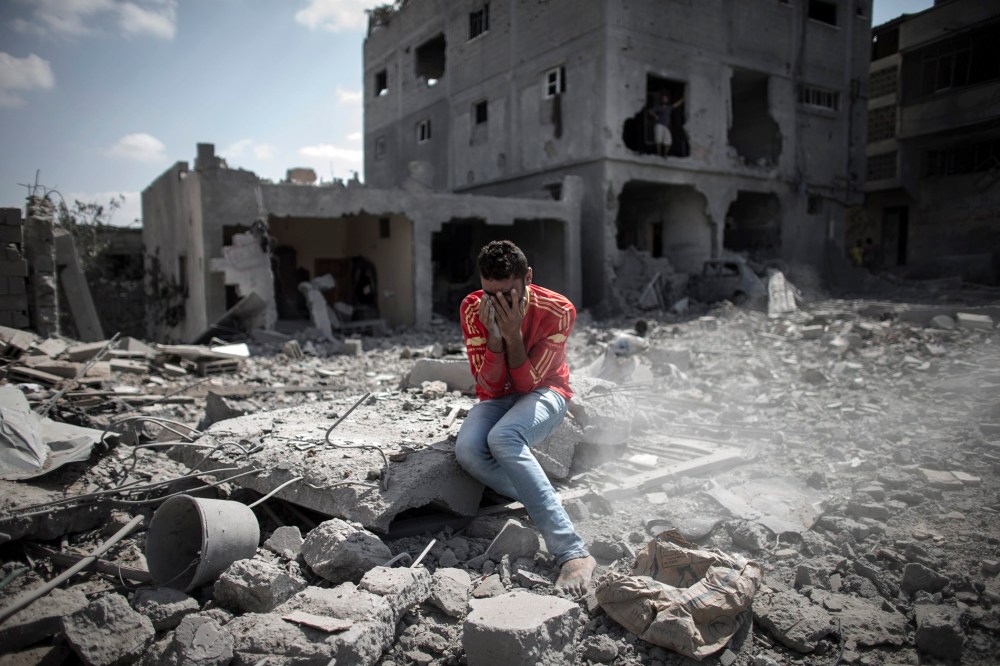
There are 1.8 million Palestinians in Gaza. In other words, there are 1.8 million stories of grief, loss and fear. Death comes at all hours of the day and night here. No one is safe and everyone is scared.
“The thing about this war,” 35-year-old Khaled Abu Khalil told me while waiting nearly three hours in a breadline, “is that it has made us all equal in one way: Rich or poor, man or woman, old or young, we are all dying the same way.”
Everywhere you go in Gaza there is a story — a human story, far away from the politics of war, but very much its consequence. Sometimes it’s the stories of those who survive that are the most disturbing.
%22The%20thing%20about%20this%20war%20is%20that%20it%20has%20made%20us%20all%20equal%20in%20one%20way%3A%20Rich%20or%20poor%2C%20man%20or%20woman%2C%20old%20or%20young%2C%20we%20are%20all%20dying%20the%20same%20way.%22′
Hassan al Hallaq is an IT manager at the Bank of Palestine. Soft-spoken, well-traveled and well-liked by his peers, he says he heeded Israel’s warnings to leave his Shejaiya neighborhood along the Israel-Gaza border and move into Gaza City. While he was eating dinner at his sister’s house, away from the war’s front lines, an Israeli missile slammed into the apartment, killing his pregnant wife and two children, his sister and her husband, his nephew and his mother.
There is Ashraf el Masry, who lived in Beit Hanoun and who spent his life’s savings to construct an apartment building with his five brothers — a place where they could all live and raise their families together. But that building was demolished. Now Ashraf and his brothers and their children — a family of 60 — are living together in one apartment.
There is Osama, a wealthy hotel manager who, after hearing that one of his employees’ family lost their home in an Israeli airstrike, offered to move them into his own home while he slept in his office. But then Osama’s own family farm and house were destroyed by an Israeli strike.
Nineteen-year-old Mona el Arrier and her 22-year-old fiancé Ahmed were just weeks away from their marriage. They had found and furnished an apartment, and were putting the final touches on their wedding, to be attended by family and friends on August 13. An Israeli strike on Shejaiya killed Mona’s father, her brother and two uncles. Another strike destroyed Ahmed’s family home. The home they had invested in to start a family close to their parents was also destroyed.
The stories of loss are compounded by stories of hardships. Life in Gaza has been on hold not just during the war, but for the last seven years, with every aspect of ordinary life crippled by Israel and Egypt’s stifling blockade by land, air and sea.
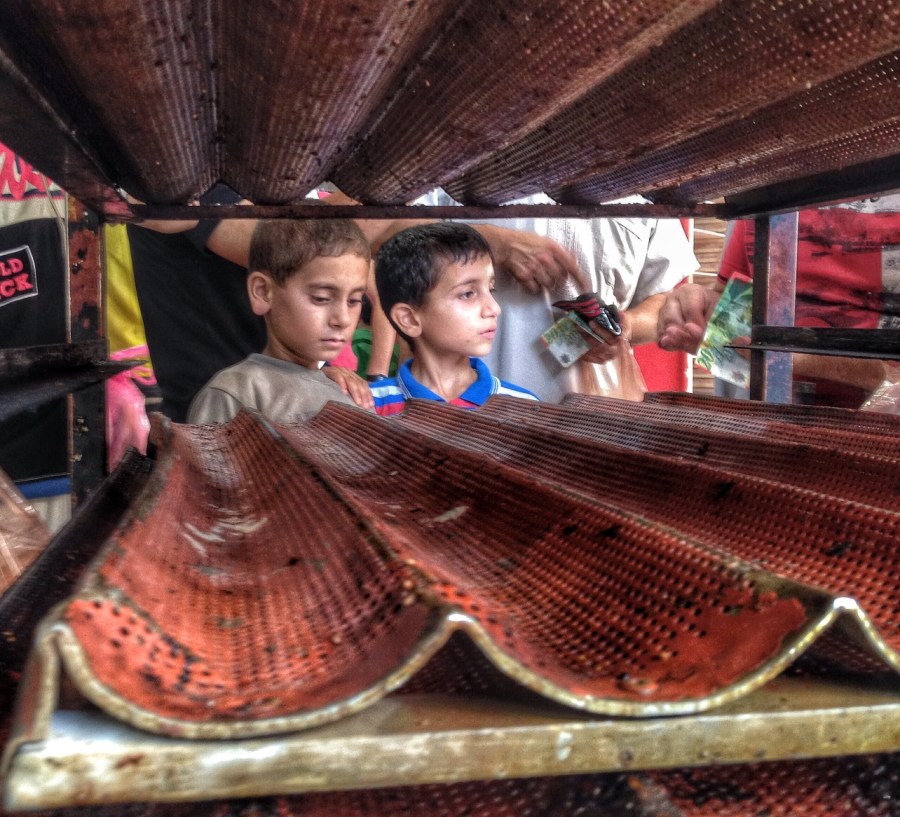
Daily progress is measured by increments of survival. Standing in line to get bread can take up to four or five hours. There is a shortage of everything in Gaza: fuel, food, electricity, water, medicine, blood. Drive past gas stations and it’s not cars you see in line, but people, holding jerry cans as they wait to fill up. They say they are not members of Hamas, or political leaders; just ordinary men, getting fuel to power up generators to light their homes and charge their phones in case they have to make that emergency call — a call that is likely to go unanswered by the ambulance services that are already so overwhelmed by the casualties of Israel’s shelling and strikes. %22Palestinians%20feel%20they%20are%20abandoned%20by%20the%20outside%20world.%20But%20there%20is%20a%20terrible%20irony%20to%20being%20on%20your%20own%20here.%22′ In Gaza, you are on your own to survive. Palestinians feel they are abandoned by the outside world. But there is a terrible irony to being on your own here: You are trapped with 1.8 million other people. While adults fill up their jerry cans at the gas stations, the children can be seen running the streets to nearby water tanks, filling up buckets just to have some fresh water to drink, shower or cook. Women go to the markets to get food. It’s the division of labor that is helping families survive, one day at a time. The people we meet and see in Gaza are ordinary men and women, with hopes and dreams of one day raising their families to be better and live better lives than they could. But this is not their reality. There is a generation of Palestinians who have grown up here knowing three wars in a span of six years. They are not fighting the wars. But they are paying the price. It’s why Palestinians, along with the United Nations and international legal experts, call what is happening in Gaza collective punishment. Samed Abu Zarifeh contributed to this report.
Ayman Mohyeldin is a host of "‘The Weekend: Primetime" and an MS NOW political analyst. Recommended


