








Join us in celebrating the first anniversary of the Supreme Court’s decision to strike down the Defense of Marriage Act. To gear up for the June 26 anniversary, msnbc will feature couples’ and individuals’ reflections on the impact the decision has had on their lives and the future of the LGBT rights fight in the United States.
In the last year, marriage equality has come to nine states. Federal judges have also struck down same-sex marriage bans in Idaho, Oklahoma, Virginia, Michigan, Texas, Utah, and Wisconsin, though their decisions are on hold pending appeals.
No ban on same-sex nuptials has survived in federal court since DOMA’s demise. And, as of this month, every remaining ban has been hit with a legal challenge. Both marriage equality advocates, and opponents alike, believe it won’t be long before the issue is once again before the U.S. Supreme Court, and ultimately legalized throughout the nation.
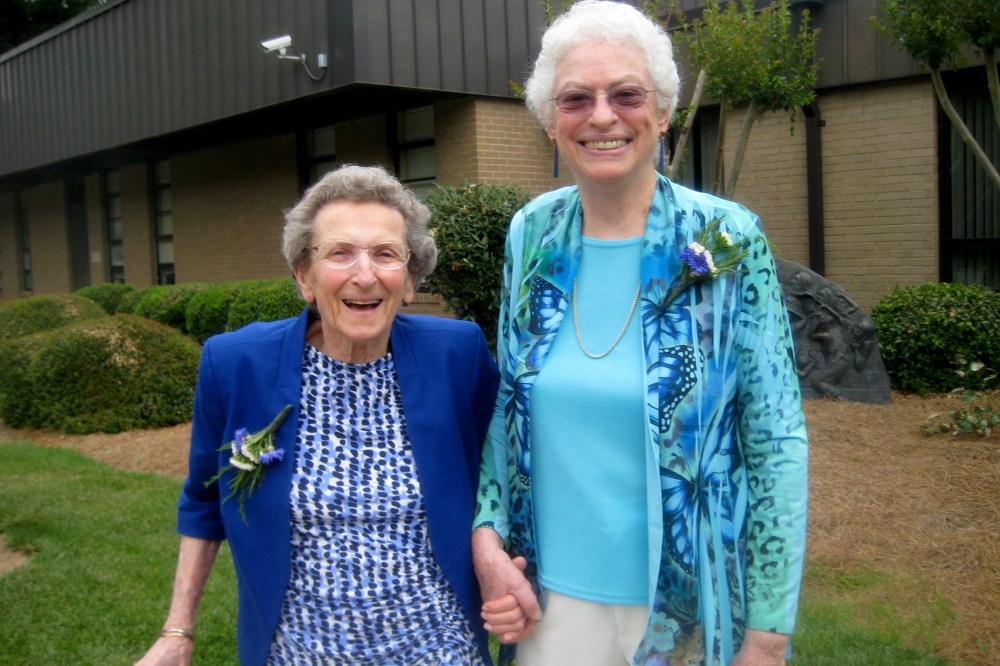
Names: Ellen W. Gerber (Lennie) and Pearl Berlin
Dates of wedding: June 2, 2013 (also our 47th anniversary) a traditional, legal Jewish wedding in Greensboro, North Carolina.
September 10, 2013, a legally recognized wedding, also by a rabbi, in the Jewish Museum of Maine in Portland Maine.
Professions:
Pearl: retired Professor
Lennie: retired attorney; Managing Attorney for a Legal Aid office, retired and then worked primarily on LGBT issues
Lennie and Pearl responded to the questions collectively.
Have you noticed a general shift in attitude toward the LGBT community since the Supreme Court ruling?
Beyond any doubt there is a marked increase in attention to LGBT issues in the media. The newspapers have kept their readers abreast of information relating to various considerations. The words gay community appear just about daily in the papers. And locally, we hear reference to gays and lesbians in both radio and TV talk. While most of what is said is factual or informative, there is rarely a negative or derogative point of view expressed. That an LGBT Community exists is now generally well-known by the public-at-large whereas not too many years ago, the existence of such a group of citizens might not have been realized. This recognition of us and our community has led to a significant change in attitude. For example, in just this last year, for the first time polls show that a majority of people in America now support same-sex marriage.
The day that the DOMA ruling came down only 11 states supported same-sex marriage. One year later it is 19 states plus D.C. In addition, District Courts in 13 states have ruled that bans on same-sex marriage are in violation of the US Constitution.
%22Gays%20and%20lesbians%20tell%20us%20how%20our%20public%20marriage%20has%20helped%20them%20to%20come%20out%20at%20work%20and%20in%20their%20churches.%22′
What are the ways in which the DOMA ruling has fallen short?
DOMA has fallen short in two ways. First, people like us, living in North Carolina or other anti-same-sex marriage states, do not have their legal marriages recognized by the state. In NC we still are considered single for all state purposes. We still have to worry that a hospital or a funeral home will not recognize us as spouses. That is why, along with two other couples who have dangerous health issues, we agreed to be plaintiffs in a lawsuit (Gerber & Berlin v. Cooper, filed 9 April 2014) to require NC to recognize our marriage.
WATCH: Lesbian couple sues NC over marriage ban
Second, the federal government has yet to make sure that every single agency treats same-sex married couples the same as it does opposite-sex couples. For example, Social Security does not yet do so. We still could not get survivor benefits because we live in a state that does not recognize same-sex marriages. What would you like President Obama and future leaders to prioritize in terms of LGBT rights? President Obama and all those who speak for the US government must make it known in all of their general statements that lesbians and gays are included. And, they must see to it that every single agency of government treats same-sex married couples exactly as it does straight couples. If you were married recently, how has it affected your lives? In the two years before our marriage, as we joined the fight against Amendment One which outlawed same-sex marriage in our state’s constitution, we began the process of being very public about us — about our lives and our love. In fact, a documentary was made about us called Living in the Overlap. A front page story emphasizing our love was written about us in the local newspaper, the News-Record and people began to feel more comfortable talking to us and expressing their support. WATCH: Iconic lesbian couple talk DOMA ruling and about finally getting married When we married, a front page story and pictures of our wedding appeared in three local papers. This marriage and the stories of our now 48 years of a very loving relationship has touched many people. Wherever we go people come up to us and congratulate us. They tell us how reading about us has changed one of their family members. Gays and lesbians tell us how our public marriage has helped them to come out at work and in their churches. They make us feel honored and humbled. Both of us always have been activists fighting for justice, fighting for the rights of women and blacks. And now we feel that in this last chapter of our lives (we are 78 and 89 years old) our wedding has helped us to fight for the rights of gays and lesbians. What are your hopes and dreams for the next generation or [for your children]? In the next generation, every child, teenager or adult who is gay or lesbian will be loved and accepted for who s/he is. Ideally, there will be no distinction between “straight” couples and LGBT couples in the future. That includes everything from recognition, activities, and evaluations. A couple whether male and female, male and male or female and female will be regarded as the same, that is, a couple. There should not be any need for different treatment of any kind. Get to know Janani, LGBT struggles go beyond marriage equality
Emma Margolin
Emma Margolin is a reporter at MSNBC.com.
Alicia Maule Recommended


