








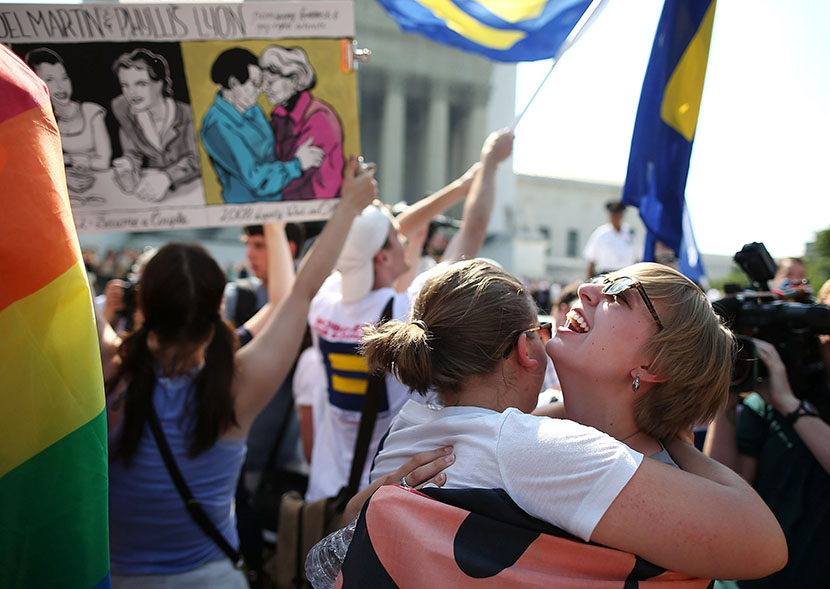
The Defense of Marriage Act is no more.
In a 5-4 opinion written by Justice Anthony Kennedy, the author of two prior landmark decisions on gay rights, found the 1996 law barring the federal government from recognizing same-sex marriages unconstitutional because it “singles out a class of persons deemed by a state entitled to recognition and protection to enhance their own liberty.”
Kennedy was joined by the Democratic appointees on the court, while the rest of the conservative bloc dissented. Congress, Kennedy wrote, can not “deny the liberty protected by the Due Process Clause of the Fifth Amendment.”
President Barack Obama praised the ruling, saying that “we are a people who declared that we are all created equal—and the love we commit to one another must be equal as well.”
DOMA, passed in 1996 and signed by President Bill Clinton, was meant to “defend” marriage from consenting adults of the same sex who wished to be married. Legislators said the purpose of DOMA was to “promote heterosexuality” and “defend traditional notions of morality,” by preventing the federal government from recognizing same-sex marriages. As a result, same-sex spouses were denied federal benefits available to heterosexual spouses, whether they are civilians, current or former service members, or Americans who marry foreigners of the same sex.
Related: Marriage equality celebrations sweep the country
This disparate treatment of same-sex couples compared to heterosexual ones is what Justice Ruth Bader Ginsburg referred to during oral arguments in March as “skim-milk marriage.” Now same-sex couples, at least in states where same-sex marriage is legal, will be entitled to the real thing.
The Obama administration had ceased defending the law in court in 2011, saying that it believed DOMA to be unconstitutional. That left House Republicans to take up the ultimately unsuccessful cause of defending DOMA. At a press conference held by conservative House Republicans denouncing the ruling, Rep. Michele Bachmann of Minnesota said “The Supreme Court, though they may think so, have not yet arisen to the level of God.”
Moments after the DOMA ruling, the Supreme Court also declined to overturn a lower court ruling that struck down California’s same-sex marriage ban, thus clearing the way for gay marriage in the Golden State.
While the full impact of the decision will be borne out over time, the likely consequences for same-sex couples who until now have been denied legal recognition by the federal government are difficult to overstate. Families headed by married same-sex couples will now be recognized by the federal government as families. Service members fighting for their country will not have to worry about their spouses being denied benefits. The same-sex spouses of Americans who are not U.S. citizens will not be denied green cards on the basis that their marriages don’t count.
Kennedy’s opinion striking down DOMA applies to states where same-sex marriage is already legal. But Kennedy’s reasoning, that same-sex marriage bans violate Americans’ constitutional right to equal protection under the law, could easily be applied to state bans on same-sex marriage as well.
That fact was not lost on the rest of the conservative bloc, which treated the decision as a tragedy of epic proportions. For Justice Antonin Scalia—who once euphemistically referred to gay sex as “flagpole sitting,” wanted to uphold laws criminalizing sex between gay and lesbian partners, and compared same-sex couples to “roommates”—the decision symbolized nothing less than an end to democracy. Scalia wrote that in striking down DOMA, the majority had “pawned” the gift of “a system of government that permits us to rule ourselves.” Scalia once compared laws banning sex between same-sex couples to laws banning murder or child molestation—in his dissent he complains that the majority opinion declared “anyone opposed to same-sex marriage an enemy of human decency.” Related: Supreme Court clears way for gay marriage in California Justice Samuel Alito, in a separate dissent, likewise lamented the high court’s decision not to subject the fundamental rights of same-sex couples to popularity contests, while observing that there is no explicit right to same-sex marriage in the Constitution. “The silence of the Constitution on [the question of same-sex marriage] should be enough to end the matter as far as the judiciary is concerned,” Alito wrote. In point of fact, the Constitution does not mention interracial marriages either, which were illegal in many states until the Supreme Court declared such bans unconstitutional in 1967. The Constitution does not mention marriage at all. The DOMA decision comes after decades of advocacy on behalf of the gay and lesbian community, whose movement for equal rights began 44 years ago with the Stonewall demonstrations in New York City. The reversal of public approval for laws like the Defense of Marriage Act since 1996 has been swift and unprecedented, as have the reversals of prominent lawmakers who once backed them. In 1996, only a quarter of Americans supported marriage rights for same-sex couples. By 2011, those who supported same-sex marriage rights had become a majority. For those couples and families who have waited for this moment, it could not have come soon enough. That includes DOMA plaintiff Edie Windsor, whose 2007 marriage to Thea Spyer in Canada was never recognized by the U.S. government while Spyer was alive. “I lived with and loved Thea Spyer for more than four decades in love and joy, in sickness and in health, till death did us part,” Windsor told reporters after the decision Wednesday. “In the eyes of my government, the woman I had loved and cared for and shared my life with was not my legal spouse, but was considered to be a stranger with no relationship to me.” Thanks largely to Windsor, same-sex spouses in America can now look forward to a different future. Related stories:
Adam Serwer Recommended


