








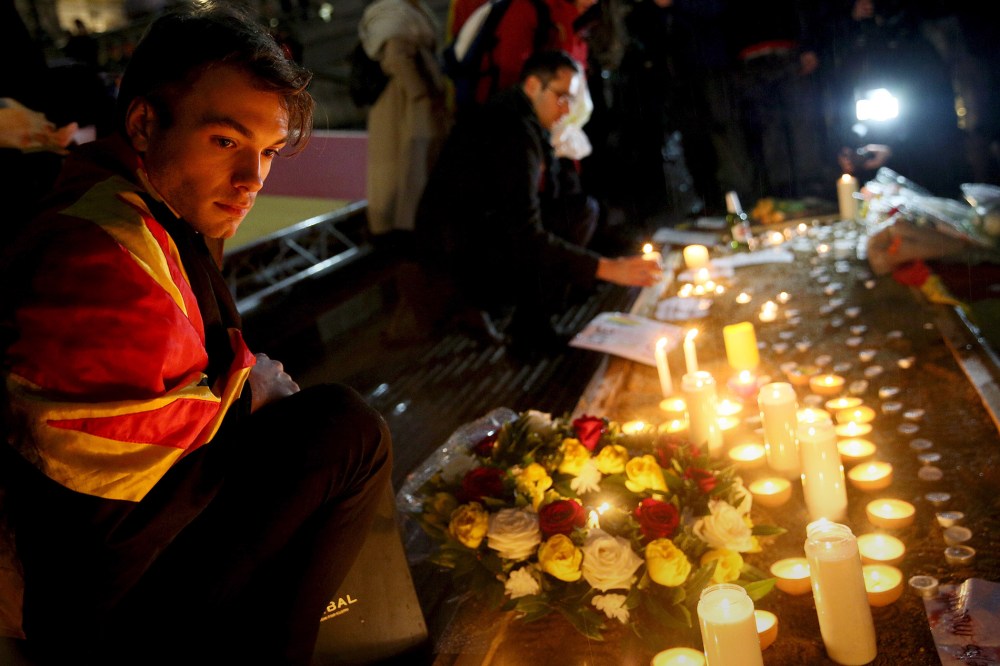
The Brussels attacks on Tuesday were not only scenes of incredible carnage — as suicidal terrorists unleashed bombs at the airport and a metro station, killing at least 31 and injuring hundreds — but also of heroism and love: Strangers helped strangers, not because it was it was their job but because they saw fellow humans in need. Here are some of their stories.
The baggage worker
Alphonse Youla was smiling for a picture at work on Tuesday morning, minutes before two bombs ripped through the airport.

The baggage security worker dove behind a machine to hide. When he got up a few minutes later he saw people on the ground, body parts and blood.
“The blood was everywhere,” said Youla, an immigrant from the Ivory Coast.
Youla said he sprung into action to help as many people as he could. Fear didn’t figure into the equation.
“I wasn’t afraid,” he explained. “If I was was going to die, I would’ve died.”
There were two police officers who’d lost their legs. A woman with shards of glass sticking out of her.
Youla put the basic first-aid skills he’d learned as a Boy Scout to work, tying tourniquets and applying bandages because “the blood was running, running.”
One woman was crying out “help me, help me,” he recalled. Youla said he picked her up and carried her out, trying to reassure her by saying “calm down calm down calm down, rescuers are coming.”
When asked how many people he helped, Youla can only guess.
“Many, many people,” he offered up. “I was there to help everyone.”
It didn’t cross his mind to flee — “where we work, at Zavantem, if you see someone in distress you help them,” Youla said.
“I saw a lot of people on the ground who were crying ‘help us, help us’. I couldn’t shut my eyes,” Youla said.
He hasn’t shut them in the three days since either, unable to sleep amidst the images swirling in his head.
%27I%20wasn%27t%20afraid.%20If%20I%20was%20going%20to%20die%2C%20I%20would%27ve%20died.%27′
“When I lay down I can’t think of anything else… It hurts my heart,” Youla said.
He hopes he’ll be able to reconnect one day with some of those of the wounded he met that day.
“I think all the time of the people I helped,” he said. “I’d love to see them again and comfort them.”
In the meantime, images of his courageous acts have ricocheted across the Internet and made him a hero in his adopted country.
Now, people stop him on the street and ask to take a picture. Strangers shake his hand.
When asked if he’s ok with the title of hero, Youla says that’s not for him to judge.
“I can’t say I’m a hero,” he explained. “I did what I needed to do.”
The Belgian Red Cross had prepared for a massive terror attack in wake of the deadly siege on Paris in November.
“We knew something like that might happen in Brussels, so we had a lot of meetings, we had a lot of preparation,” Belgian Red Cross Director Raphael Schmidt explained. “But when the call comes in, it’s different.”
No amount of exercises could have fully prepared him and his teams for the call that came in on Tuesday — two calls, actually.
The Red Cross immediately sent teams to the airport to assist in bombings’ aftermath — then they learned about the attack on the Metro and had to call in extra volunteers. In total 160 were deployed to the airport and 180 to the Maalbeek metro station.
%27Some%20people%20don%27t%20talk%20and%20some%20people%20don%27t%20want%20to%20say%20what%20they%27ve%20seen.%27′
“They were at home, they were at work… they all left their duties,” Schmidt said.
The volunteers arrived and fanned out — there were victims everywhere — and got to work, all while unsure if another attack would hit or if another call would come in.
Seeing images of a terror attack on TV are far different from experiencing it up close — there are noises, smells that don’t transcend a screen.
“It’s impossible to be really prepared,” he said.
The volunteers focused on the task at hand, trying not to think about anything other than treating the wounded.
“You try to do your job and it’s after that that you realize what really happened,” Schmidt said.
He said “there is no doubt” that first responders can be as traumatized as those physically caught up in the attacks.
“We are victims too,” Schmidt said.
Meanwhile, the operation didn’t stop on Tuesday — Schmidt said calls still are coming in from injured or traumatized people. He thinks that could last for week or even months.
Keeping an eye on how the volunteers are doing psychologically is critical, Schmidt said. “Some people don’t talk and some people don’t want to say what they’ve seen,” he said. “Some were afraid, and that’s normal. Some were anxious, that’s normal.. We try to make them aware of that. and we now have to wait a couple of days, probably a couple of weeks, to see how everybody’s going.” Youssef Benayad works in security for the Brussels transport network. When news of the explosion at Maalbeek station came in, he and two others jumped in cars and headed straight to the scene. “When we get there we saw a lot of wreckage,” he said. “All over the place people were crying, anxious, in critical condition.” He had to fight the urge to send his team into the station immediately — the perimeter needed to be secured first. His teams did so while also ushering emerging wounded to safety. Then they could finally go in. “We started to bring the bodies out,” Benayad told NBC News. “The magnitude of the event was huge.” He encountered “wounds that usually you never see” — burned bodies, broken bodies — like “war wounds.” The fellow passenger Yasin Aanouz became part of the rescue operation by chance — he’d landed at Zaventem Airport shortly before the bombs exploded. One boom followed by another made clear to him that an attack was taking place, so he ducked. Once he raised his head the horror came into focus. “I couldn’t hear anything. I could just see movements, people were running,” Aanouz said, holding his bandaged arm carefully at his side. “I saw people with blood, people on the ground … I could see young children crying, moms looking for their children — it’s the first time I was seeing something like this, the first time,” he said softly. The next hour or so passed like a blur — but Aanouz didn’t initially feel any pain from the injuries to his face and arm. “With the adrenaline and the shock, everything went very fast,” he said. “It was like in a movie … a nightmare.” He said his “first reflex” was to help others. So Aanouz stayed in the battered terminal to help the evacuate the more severely wounded. “The ambulances were dealing with serious injuries — there were dead people, people whose heads were open. It was horrific,” he explained without flinching. All the while ambulances and police were “all you could see — it was like a war” — and sirens were screaming everywhere. He was later checked out by the Red Cross, who bandaged his arm and cleaned his facial wound. The adrenaline did eventually wear off and Aanouz found himself at home in the Brussels suburb of Anderlecht with his family. Bandaged and bruised, he too hasn’t been able to sleep. “I tried but it was impossible — no way,” he said. While he knows his physical wounds will heal, Aanouz is worried about another less visible scar from his brush with terrorism. “I’ve been to my doctor — now I need a psychologist,” he said plainly. “For these images … I keep on having these images in my head. When I eat, I have this image in my head, when I walk, I also have these images in my mind. And when I’m with my friends I also have these images in my head. I don’t know.” Mac William Bishop also contributed to this report. This article originally appeared on NBCNews.com.
Cassandra Vinograd
Kelly Cobiella Recommended


