








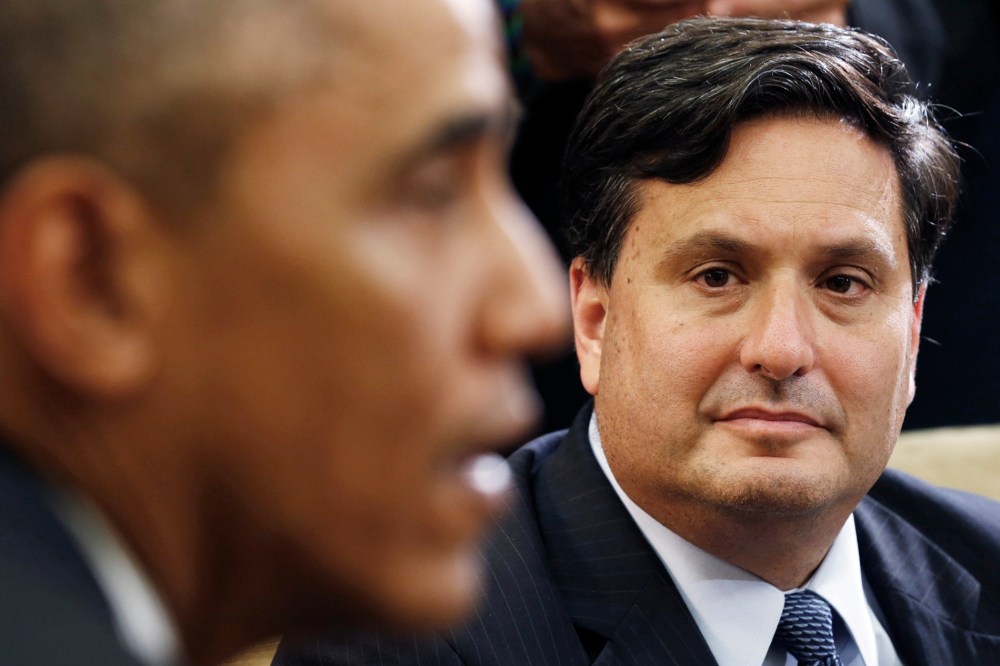
President Obama used his bully pulpit this week to hail the efforts of American health care workers fighting Ebola in West Africa. After the president left the podium Wednesday, the nitty-gritty policy discussions began in the White House, and Ron Klain was among the top administration officials at the table.
Klain, Obama’s newly appointed Ebola response coordinator, told the non-governmental organizations at the meeting that he hoped they would publicly emphasize the importance of their own work in West Africa as well, according to Dan Neal of Heart to Heart International, a humanitarian group building an Ebola treatment unit in Liberia.
RELATED: Obama taps Ron Klain for Ebola Czar
“The president came out really supporting health care workers, and [Klain] was wanting all of us NGOs to continue that messaging — to advocate for ourselves as well,” said Neal, who attended the meeting.
It’s an early sign of Klain’s imprint as questions have swirled about his new job, which Obama created after a growing public outcry about the U.S. government’s response to Ebola. A former chief of staff to Vice President Joe Biden, Klain has been in his new job as Ebola Response Coordinator — aka “Ebola Czar”— for just over a week.
Normally loathe to make such gestures, Obama bowed to public pressure to create the position just as America’s panic about Ebola and criticism over the government’s response was reaching new heights. On Oct. 15, a second American nurse was diagnosed with Ebola after caring for Thomas Eric Duncan, the Liberian man who was the first to die of the disease in the U.S. The Dallas hospital that treated Duncan and the Centers for Disease Control and Prevention made various missteps along the way. Such events prompted GOP lawmakers like Sen. John McCain to demand that Obama designate a leader to oversee the response. “I’d like to know who’s in charge,” the Arizona Republican said at the time.
RELATED: Feds mull quarantine for docs who treat Ebola in West Africa
But Klain’s appointment on Oct. 17 was immediately met with a flurry of criticism, including attacks from some of the very lawmakers, like McCain, who were calling for Obama to create the position. Critics cited Klain’s lack of military or medical experience; skepticism only intensified amid reports that he’s now in line to become a senior Obama aide.
Since Klain officially started his job on Oct. 22, questions at the White House press briefings have been unending: “What’s Ron Klain doing?” one reporter asked Friday. “Is he accomplishing what he was appointed to do?” another asked Monday. “What has he done?” a third reporter asked Tuesday.
White House press secretary Josh Earnest has explained repeatedly that Klain’s work would principally be “behind the scenes,” offering broad, bland descriptions of his work.
“He is somebody who has been convening meetings and regularly working closely with officials at the CDC and [Department of Health and Human Services] as they put in place some of the protocols that have been announced over the course of this week,” Earnest said last week. Klain also has the ear of the president: In his first seven days on the job, he briefed the president on six of them, Earnest said.
RELATED: Ebola continues its deadly march
%22He%27ll%20do%20the%20job%20behind%20the%20scenes%2C%20not%20talk%20about%20it.%22′
But the message that Klain delivered to aid groups on Wednesday sheds some more light on his role—and how his political experience may be informing his work. As fear and alarmism has increasingly fueled the public and media response to Ebola, the White House has stepped up its own communications strategy, with Obama publicly championing health care workers — and pushing back against critics — two days in a row this week. And Klain believes that outside groups can aid that strategy through their communications, as well as their policy work on the ground in West Africa, where the disease has claimed at least 5,000 lives.
Neal is now taking Klain’s advice back home to the Heart to Heart International team in Kansas City, Kansas. “Normally, we don’t do advocacy, it’s not been in our DNA in the past. But that was an important thing — we need to speak up about this,” Neal said, noting the climate of fear and negativity that has recently surrounded health care workers who have treated Ebola patients overseas.
Obama officials said they don’t want to drive media speculation about Klain’s role, stressing that he is more focused on the job at hand than his public image. Certainly, any sweeping judgments would be premature given that he’s been in the position for barely a week. But it has also been challenging to gauge Klain’s efforts given the nature of his job managing a sprawling bureaucracy with many moving parts and agencies involved in a global operation. The broad — some would say overly vague — descriptions of his responsibilities haven’t satisfied the media either.
The administration will say this: One of Klain’s first major projects has been to help usher in the CDC’s new guidelines for returning health care after New York and New Jersey issued controversial quarantine orders last weekend.
RELATED: Obama: No ‘hiding under the covers’ on Ebola
What does that mean, practically speaking? Those familiar with his activities compare his current job to his work on the 2009 economic stimulus package. He has been shuttling between different agencies and the White House to make sure everyone’s on the same page, working to speed up bureaucratic processes, and making sure the individual pieces fit into the administration’s broader Ebola strategy.
Officials were vague, however, when asked whether Klain was involved in pushing back against New York Gov. Andrew Cuomo and New Jersey Gov. Chris Christie on their quarantine orders, which they scaled back after an outcry and reports of White House resistance. When posed the question at a recent briefing, Earnest replied: “The administration has been in close touch with [Klain] for a number of weeks, including over the weekend.” The CDC’s official take is that Klain “has supported efforts to improve lines of communication between CDC and other federal components of the response, including issues related to the updated interim guidance on movement and monitoring issued this week,” according to CDC spokesperson Barbara Reynolds. She added that Klain is offering “a broad perspective on elements of the response to help inform CDC’s public health decisions” both domestically and in West Africa. On Thursday, Klain traveled to CDC headquarters in Atlanta for the first time in his new role. Given how frequently the CDC has served as the public face of the administration’s Ebola response, the attention seems warranted. The CDC faced earlier setbacks in the domestic Ebola response when the first U.S. cases emerged. CDC Director Tom Friedan faced a barrage of criticism after saying that Dallas nurse Amber Vinson should not have flown on a commercial airline before becoming symptomatic with Ebola, when she had in fact cleared her travel with a CDC official. Some of the CDC’s earlier efforts to tighten its Ebola protocols for health care workers fueled public skepticism about the agency’s knowledge of the disease. Other officials said they’re still getting a feel for Klain’s approach to managing the response across different agencies. On Sunday, and again on Wednesday, before Obama’s remarks on the virus, Klain attended early meetings convening all major staff heading up the Ebola response in the U.S. and overseas. Outside critics have flayed the White House for Klain’s absence in the public spotlight — “Where the Hell Czar You?” read the cover of Tuesday’s New York Daily News. But agency officials and policy experts said there has been a real need for a point person to help manage the response from the inside. “The hope for the Ebola czar is to be able to coordinate across the Department of Defense, CDC, NIH (National Institutes of Health)—that could help,” Jen Kates, director of global health for the Kaiser Family Foundation, said last week. RELATED: Obama: US doesn’t ‘react based on our fear’ There’s also an expectation that Klain’s role will take some of the burden off of Lisa Monaco, Obama’s homeland security adviser, and National Security Adviser Susan Rice, who have both been spearheading the Ebola response in addition to the rest of their portfolio. (Klain reports directly to Rice and Monaco.) Heart to Heart’s Neal added that face-to-face meetings like the one he attended with Klain and other administration officials are important to the broader Ebola response. At Wednesday’s meeting, Health and Human Services Secretary Sylvia Burwell told the aid groups that she would be personally willing to get on the phone with health care workers to convince them to go to West Africa—as would the president, according to Neal. Per Klain’s advice, Neal said he plans to deliver the message of support for health care workers at his church and children’s school in his own community. “We can continue that messaging at a local grassroots level and at a local level and a state level, and that way folks will hear it from both directions,” he said. It’s unlikely, however, that Klain will be among those to personally deliver it. He won’t be among the officials to testify at a Senate hearing on Ebola scheduled for next week. That’s not likely to please Republicans, who claimed he was “not prepared” when the White House declined a House invitation for him to testify last week. Those who’ve worked with Klain say he prefers to stay out of the spotlight, generally speaking. “Ron is pretty old-school about this,” said Jared Bernstein, a former Biden staffer who worked with Klain. “He’ll do the job behind the scenes, not talk about it.”
Suzy Khimm Recommended


