








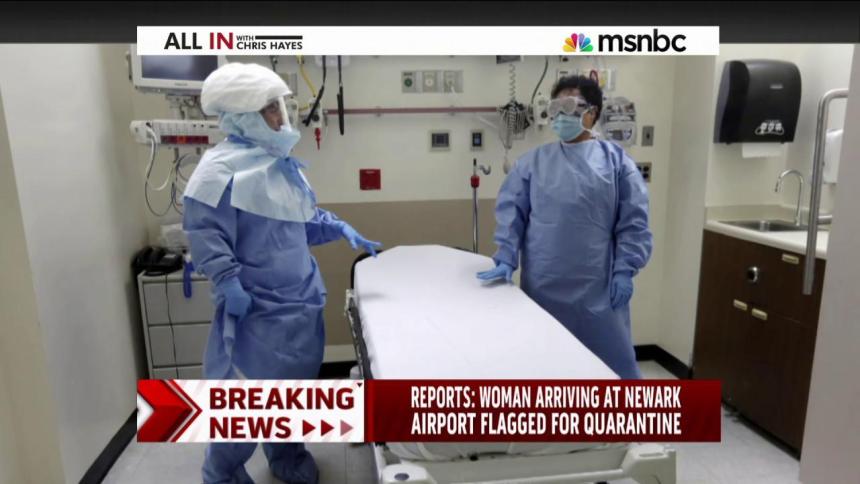
Federal officials are considering a mandatory quarantine for health care workers who come back to the U.S. from West Africa after the Ebola diagnosis Thursday of New York City doctor Craig Spencer, who was helping to fight the virus overseas.
PHOTO ESSAY: Ebola continues its deadly march
“There are lots of options being discussed. We want to strike the right balance of doing what is best to protect the public’s health while not impeding whatsoever our ability to combat the epidemic in West Africa,” Jason McDonald, a spokesman for the Centers for Disease Control and Prevention, said Friday when asked about the quarantine proposal.
“That is something on the active discussion and we will be hearing shortly about the guidelines,” Dr. Anthony Fauci of the National Institutes of Health said when asked about a mandatory quarantine for returning health care workers at a Friday press conference. He added, however, that “it isn’t just the CDC and federal government, but the states have an awful lot to say about what happens.”
New York and New Jersey are already taking stronger measures. Both states will require an automatic quarantine “for medical personnel returning from Ebola-stricken countries.” Other travelers could be quarantined or medically monitored as well, depending on an interview and screening process, state officials added. Cuomo’s decision was made without consultation with New York City officials, The New York Times reported.

On Thursday, a woman became the first person in New Jersey placed in state-mandated quarantine. “The health care worker Governor Chris Christie indicated earlier today would be quarantined because of a recent history of treating Ebola patients in West Africa had no symptoms upon arrival at Newark Liberty International Airport earlier today,” said Director of Communications for the New Jersey Department of Health Donna Leusner in a statement released late Thursday. “This evening, the health care worker developed a fever and is now in isolation and being evaluated at University Hospital in Newark.”
Doctors Without Borders confirmed that the woman in quarantine worked in Africa as part of the organization’s staff.
Spencer was diagnosed with Ebola on Thursday, hours after being admitted to Bellevue Hospital in New York City. He returned to the U.S. on Oct. 17 after traveling to Guinea with Doctors Without Borders. He began feeling “sluggish” on Tuesday, but exhibited no active symptoms of Ebola until registering a fever of 100.3 degrees on Thursday morning. The night before, he went out bowling with friends—an excursion that has now fueled public alarm and suspicion about the existing CDC protocols.
Infectious disease and public health experts said a mandatory 21-day quarantine for such workers isn’t likely to help reduce the incidence of Ebola at home. “I don’t think there’s going to be an added benefit in terms of health,” said Dr. Art Reingold, head of epidemiology at the University of California’s School of Public Health. “I don’t think it’s going to make a difference in terms of cases of Ebola in the U.S.”
Tara Smith, an epidemiology professor at Kent State University, agreed. “It doesn’t seem like it would do very much. We’ve not seen [Ebola patients] to be infectious before they get symptoms.” The move to consider a mandatory quarantine “seems more like political maneuvering, rather than based on science,” Smith added.
%22We%20want%20to%20strike%20the%20right%20balance%20of%20doing%20what%20is%20best%20to%20protect%20the%20public%E2%80%99s%20health%20while%20not%20impeding%20whatsoever%20our%20ability%20to%20combat%20the%20epidemic%20in%20West%20Africa.%22′
While a mandatory quarantine might help quell an anxious public, it’s “not likely to change the risk equation since Ebola can only be transmitted when symptomatic, and the current protocol accounts for that,” said Jen Kates, vice president and director of global health for the Kaiser Family Foundation.
Ebola can only be transmitted through direct contact with the bodily fluids of an infected individual who is actively displaying symptoms, or through infected objects like bedsheets or needles; the virus’s incubation period ranges from two to 21 days.
Doctors Without Borders (Medecins Sans Frontieres) said that Spencer, who worked with the group, had followed all of the organization’s protocols upon returning home from Guinea. The NYC-based doctor monitored his temperature twice a day and immediately contacted the office upon developing a fever, one known symptom of the virus. “He posed no public health threat prior to developing symptoms,” the group said in a statement.
Doctors Without Borders argued that a mandatory quarantine for returning workers would be an “excessive” step. “Based on the information and science known today on the Ebola virus, isolating all of [the group’s] or other organizations’ staff returning from West Africa would be an excessive measure to take at this stage,” spokesperson Tim Shenk said in an email. “Other organizations such as [World Health Organization] and CDC are on the same line and don’t recommend that measure. As long as a patient hasn’t developed symptoms, the risk of contamination is close to zero.” In addition to twice-daily temperature checks, Doctors Without Borders requires returning health workers to finish malaria treatment, “be aware of relevant symptoms, such as a fever; stay within four hours of a hospital with isolation facilities” and contact its U.S. office immediately “if any relevant symptoms develop.” “This protocol is based on science—Ebola can only be spread when someone is symptomatic and through direct contact with body fluids,” said Kates of the Kaiser Family Foundation. %22This%20protocol%20is%20based%20on%20science%E2%80%94Ebola%20can%20only%20be%20spread%20when%20someone%20is%20symptomatic%20and%20through%20direct%20contact%20with%20body%20fluids.%22′ Earlier missteps by the CDC and other health officials have undermined public confidence in the agency’s Ebola protocols, however. Neither the CDC nor Texas officials discouraged the health care workers who treated Thomas Eric Duncan in Dallas — the only patient to die of Ebola in the U.S. — from traveling. Those protocols changed after one of his nurses, Amber Vinson, was diagnosed with Ebola shortly after flying from Ohio to Dallas on Oct. 13; she has since been declared virus-free. “Until we have a vaccine, we have to err even more on the side of caution that we initially thought,” said Reingold. Like others studying the disease in the U.S. and fighting it on the ground, however, Reingold and other health experts stressed that the single best way to protect the U.S. is to focus on the epicenter of the disease overseas. “We need to concentrate on that than really excessively worrying here,” said Smith, the Kent State epidemiologist. World Bank President Jim Yong Kim warned on Friday that a shortage of health care workers could cripple the battle in West Africa, calling for those at U.S. hospitals and institutions to step up. And some worry that a mandatory quarantine upon return might make that recruitment effort even more difficult. “That would be my concern—that it would decrease people’s willingness to volunteer,” Smith said. “Three weeks—that’s no short amount of time.” Doctors Without Borders said it remains committed to finding more staff to fight Ebola at its source. “It’s impossible to predict what impact this case will have on future recruitment, but [the group] is committed to continuing its struggle against Ebola in West Africa,” said Shenk. “We will do our utmost to continue to find the human resources needed to battle this epidemic.”
Suzy Khimm Recommended


